
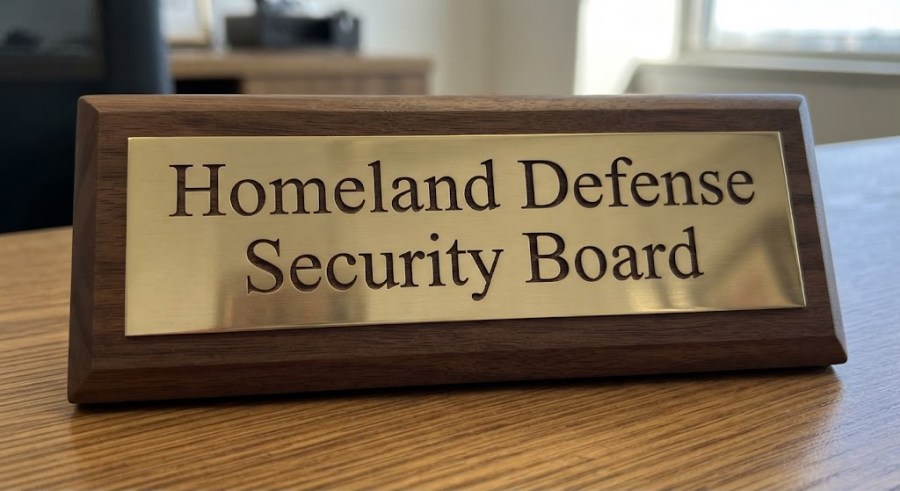
The Homeland Defense Board is chaired by Defense Secretary Pete Hegseth.
The board is structured to include up to 20 members, drawing from senior defense officials, national security advisors, and military leadership to oversee domestic defense missions, infrastructure protection, and coordination between the Department of Defense and the Department of Homeland Security.
Because the board functions as an internal advisory committee appointed directly by the Secretary of Defense, a comprehensive, public full-roster breakdown naming every individual seat is managed internally through the Office of the Secretary of Defense rather than as a public legislative committee.
“We will never announce the members. The Public does not need to know…”
Understanding the Homeland Defense Board: Roles, Responsibilities, and Civil Liberty Concerns
1. Executive Summary
In late 2026, the Department of Defense formally introduced the Homeland Defense Board, an advisory and policy-coordination body overseen by the Secretary of Defense, Pete Hegseth.
UA.NEWS
The board was established to advise military leadership on safeguarding the territorial United States, protecting critical domestic infrastructure, and improving military-civilian defense cooperation. However, the prospect of the Pentagon expanding its focus to the domestic sphere has raised significant questions among civil liberty advocates, constitutional scholars, and the public.
UA.NEWS
This paper outlines what the board is designed to do, why domestic military bodies draw scrutiny, and the potential risks of overreach or abuse involving American citizens.
2. Background: What is the Homeland Defense Board?
Under the U.S. Constitution and federal law, the Department of Defense focuses primarily on external defense (protecting the country against foreign nations and outside threats), while domestic law enforcement is handled by local, state, and federal civilian agencies (such as local police, the FBI, and the Department of Homeland Security).
The Homeland Defense Board functions as a high-level committee to:
- Advise the defense secretary on domestic defense readiness. UA.NEWS
- Coordinate responses to unconventional threats on U.S. soil (such as cyberattacks on power grids, hostile drone activity, and border security support).
- Align military logistics and technical intelligence with civilian homeland security efforts.
While advisory boards do not unilaterally make laws, the recommendations they generate influence how military personnel, funding, and surveillance assets are deployed domestically.
3. Potential Risks and Areas of Concern for American Citizens
When military agencies take on broader roles inside national borders, the traditional boundary between civilian policing and military action can blur. Critics and legal scholars typically identify four main risks:
A. Erosion of the Posse Comitatus Act
The Posse Comitatus Act of 1878 is a foundational law limiting the federal government’s ability to use the U.S. military for domestic law enforcement (like arresting citizens, patrolling streets, or conducting traffic stops).
- The Concern: If a homeland defense board recommends deploying active military units to assist with domestic order, civil demonstrations, or border enforcement, it risks bypassing the spirit of this law.
- The Impact: Regular citizens could find themselves interacting with armed military personnel trained for war rather than civilian police trained in de-escalation and constitutional policing.
B. Domestic Surveillance and Privacy Infringements
The military possesses advanced intelligence tools, including satellite imagery, signals interception, facial recognition, and communications monitoring.
- The Concern: If military surveillance assets are turned inward to track domestic threats, the privacy of everyday Americans could be compromised.
- The Impact: Routine communications, internet traffic, and location data could inadvertently be swept up without the typical Fourth Amendment warrant requirements demanded of civilian police.
C. Chilling Effect on Free Speech and Peaceful Protest
When broad definitions of “domestic security” or “extremism” are applied by centralized military or defense boards, political dissent can easily be mischaracterized.
- The Concern: If protests, political rallies, or activist groups are categorized as potential national security threats, military-advised security operations could target lawful political assembly.
- The Impact: Citizens might avoid exercising their First Amendment rights out of fear of being flagged, monitored, or investigated by defense bodies.
D. Politicization of Defense Institutions
A recurring criticism of centralized boards led by politically appointed figures is the potential for institutional bias.
- The Concern: Decisions about which domestic groups or actions constitute a “threat” could be influenced by political ideology rather than objective national security benchmarks.
- The Impact: Law enforcement or military resources could be unevenly applied against political opponents while overlooking similar actions by political allies.
4. Key Differences: Civilian Law Enforcement vs. Military Defense
| Feature | Civilian Law Enforcement (e.g., Police, FBI) | Military Defense (DoD / Armed Forces) |
|---|---|---|
| Primary Mission | Preserve public peace, solve crimes, protect constitutional rights | Defeat foreign adversaries, protect territory from attack |
| Training Philosophy | De-escalation, adherence to criminal procedure, minimum force | Decisive force, neutralization of hostile entities |
| Legal Protections | Strict Fourth Amendment search warrants, Miranda warnings | Rules of engagement designed for armed conflict |
| Oversight | Local courts, elected officials, civilian review boards | Uniform Code of Military Justice (UCMJ), Defense leadership |
5. Safeguards and Constitutional Protections
To prevent any domestic defense body from overstepping its authority, several established checks and balances exist:
- Congressional Oversight: Committees such as the House and Senate Armed Services Committees have subpoena power and budgetary control to investigate board directives and policies.
- The Federal Judiciary: Federal courts have the power to strike down executive orders, policies, or deployments that violate constitutional protections or statutory limits like Posse Comitatus.
- Inspectors General: Independent watchdogs within the Department of Defense monitor waste, fraud, and unlawful executive action.
- The Insurrection Act Constraints: While a president can invoke the Insurrection Act under emergency conditions to deploy troops domestically, doing so requires clear statutory justification and carries strict political and legal consequences.
6. Conclusion
The Homeland Defense Board represents an effort to centralize defense strategies against modern, borderless threats such as cyberwarfare, infrastructure attacks, and unconventional incursions. However, whenever military authority interacts with domestic life, the risk of mission creep is real. Preserving civil liberties requires robust congressional transparency, clear legal boundaries separating military action from civilian policing, and ongoing vigilance over how “threats” inside the homeland are defined and handled.


You must be logged in to post a comment.