
Billionaires come in, pay no or little taxes and steal your Electricity and Water that Texans paid for by paying their Electricity Bills and Water Bills. While these Billionaires continue getting filthy RICH on your hard labors.
Get ready for exuberant ELECTRICITY COSTS!!! Rolling BLACKOUTS! Or total GRID SHUTDOWN.
Data Centers in Texas. They said 500 9f them are coming here. But can our electric grid handle their demand for electricity.
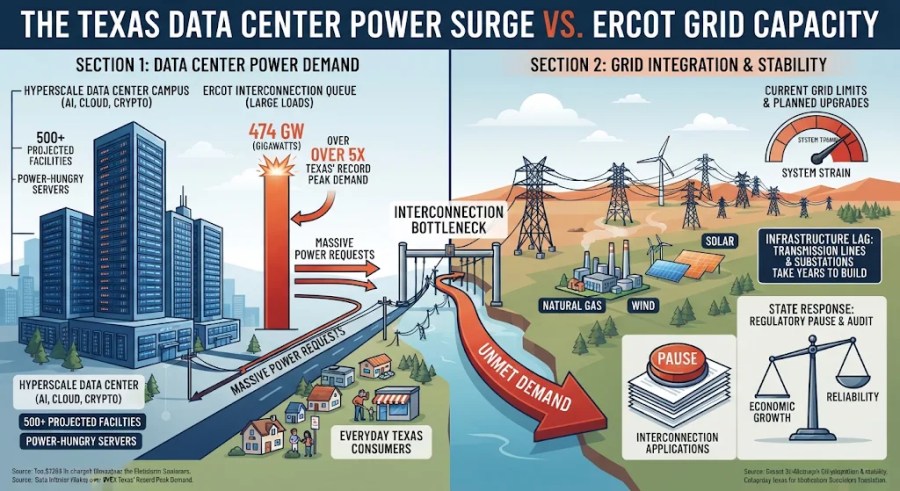
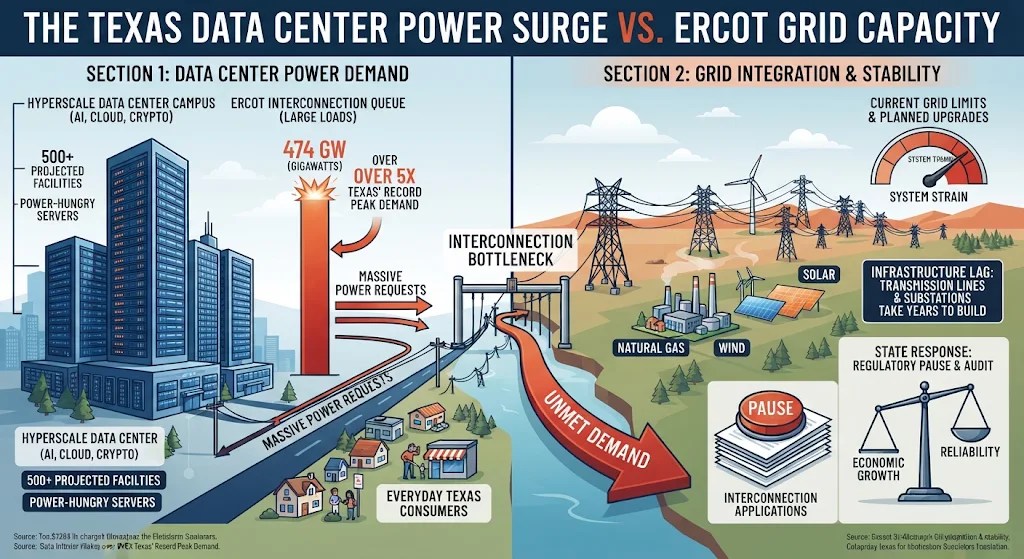
The short answer is: Right now, the electric grid in Texas (managed by ERCOT) would struggle significantly to handle the sheer volume of new data centers being requested, which is why state leaders and regulators have hit the brakes.
Utility Dive
The scale of the data center boom heading toward Texas has far outpaced traditional grid planning.
Texas Electricity Ratings
The Scale of the Demand
- Massive Queue: ERCOT’s interconnection queue has faced unprecedented requests for large-load power—fueled heavily by artificial intelligence, cloud computing, and crypto-mining facilities. Roughly 90% of those massive power requests are coming from data centers. Utility Dive
- Multiplying Demand: Regulators have warned that overall energy demand on the grid could double over the next several years, driven by both population growth and these mega-scale tech facilities.
Why Regulators and Officials Got Concerned
Because the requests piled up so fast (amounting to hundreds of gigawatts of new potential demand—several times larger than the entire state’s historical peak load), state officials stepped in:
Utility Dive
- The Audit and Pauses: State leaders called for comprehensive audits of all data centers in the ERCOT queue to separate speculative projects from serious, shovel-ready developments. ERCOT also paused parts of its standard review process (like “Batch Zero”) to figure out how to safely manage the grid integration without causing widespread blackouts or destabilizing local power lines. Utility Dive+ 1
- Infrastructure Lag: While Texas has an abundance of fast-growing solar and battery storage, high-voltage transmission lines, local substations, and dispatchable power plants (like natural gas) take years to build. Power plants cannot be spun up overnight to match the instantaneous multi-gigawatt demand of modern AI server farms.
Can the Grid Adapt?
Texas won’t hook up all hundreds of proposed data centers at once. Industry analysts expect that a massive percentage of the speculative projects in the queue will ultimately be canceled, scaled back, or relocated due to stricter rules, higher infrastructure costs, and required grid-reliability safeguards.
For the data centers that do move forward, utility companies and developers are increasingly looking at “colocating” power—meaning the data centers build dedicated behind-the-meter natural gas turbines or dedicated solar-plus-storage fields so they don’t completely drain power from everyday residential and commercial customers.
Ultimately, while Texas has plenty of room to grow as a tech hub, maintaining grid stability and keeping consumer electricity rates manageable will depend heavily on slowing down the rush, forcing large tech companies to pay their fair share of infrastructure costs, and aggressively building out new generation capacity. You are correct that modern semiconductor fabrication plants, such as the proposed Terafab facility, require enormous, industrial-scale amounts of both water and electricity to operate.
Because chip manufacturing is an extremely precise and energy-intensive process, these facilities essentially operate as massive, 24/7 high-tech factories and power consumers combined.
1. Electricity Demand
- The Need: Advanced chip fabrication (or “fabs”) requires a perfectly stable, uninterrupted supply of high-quality electricity. Any minor voltage fluctuation or power blip can ruin an entire batch of silicon wafers, which are worth millions of dollars. http://www.facilitiesdive.com+ 1
- The Scale: A facility the size of Terafab (projected to be 100 million square feet) would likely consume as much electricity as a mid-sized city. This power is used to run thousands of complex machines, including photolithography tools, ultra-pure water pumps, and massive HVAC systems that control temperature and humidity to microscopic tolerances.
- The Terafab Plan: Because the demand is so specific and massive, SpaceX and Tesla are not expected to rely on the local public power grid (ERCOT) for baseload power. Instead, reports indicate they plan to build their own on-site natural gas power plant and supplement it with large-scale Tesla Megapack battery storage. This is designed to guarantee both the volume of power and the “clean” (stable voltage) quality of power required. http://www.datacenterdynamics.com
2. Water Consumption
The Terafab Plan: The massive scale of water needed has been the primary concern for residents in Grimes County, Texas. To mitigate this, SpaceX has indicated it intends to source its water from the Gibbons Creek Reservoir, located on the same property, rather than relying solely on local groundwater aquifers that many residents and farms depend on for drinking and irrigation. Furthermore, such a modern plant would be expected to have highly advanced water recycling systems to treat and reuse a significant percentage of its process water, minimizing overall withdrawal. finance.biggo.com
The Need: Similarly, semiconductor manufacturing uses vast quantities of Ultra-Pure Water (UPW). Water is used in virtually every step of the process to clean silicon wafers between etching and deposition layers. This water must be purified to an incredibly high standard—far cleaner than drinking water—to prevent impurities from contaminating the microscopic chips.
the Scale: A single, large-scale fab can consume millions of gallons of water every single day. For context, major chipmakers in Texas, like Samsung Austin Semiconductor, draw billions of gallons of municipal water per year. evwire.com


You must be logged in to post a comment.