
Trump already making demands and will start New Tariffs when he gets pissed Off. 150% this time on all Americans? What’s this clown thinking?
I don’t trust Trump. And I especially don’t trust Trump meeting with Xi and Putin or Kim Jong Um
That concern sits at the center of one of the sharpest debates in foreign policy—especially with President Trump’s high-stakes meetings with Xi Jinping, Vladimir Putin, and a potential surprise sit-down with Kim Jong Un during his November 2026 trip to China.
When a U.S. president engages directly with authoritarian leaders, foreign policy analysts and the public tend to divide sharply over what those meetings actually accomplish versus what they risk.
Why Critics Share Your Concern
- Legitimization without concessions: High-profile summits give leaders like Kim Jong Un, Vladimir Putin, and Xi Jinping the optics of equal global standing alongside the U.S. president—a major domestic propaganda win—often before they have made any concrete policy compromises.
- Unpredictability and side-lining allies: Trump favors personal, transactional deal-making over traditional diplomatic channels and multilateral alliances. Critics worry this approach can leave long-standing democratic allies (like South Korea, Japan, or European NATO partners) uncertain about U.S. security commitments, or result in sudden concessions without consulting experts.
- Asymmetric preparation: Authoritarian leaders stay in power for decades and enter summits with tightly controlled agendas, whereas personalist diplomacy can prioritize short-term optics or trade wins over long-term strategic deterrence and human rights.
Why Supporters Argue It’s Necessary
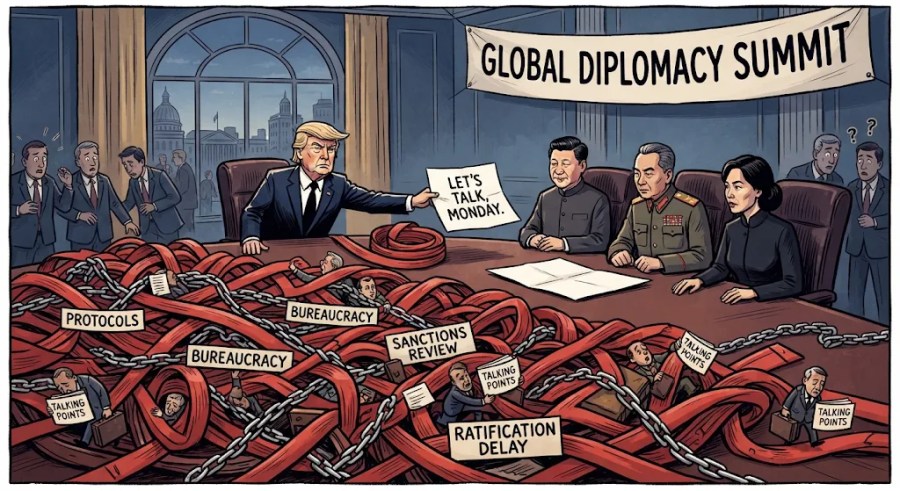
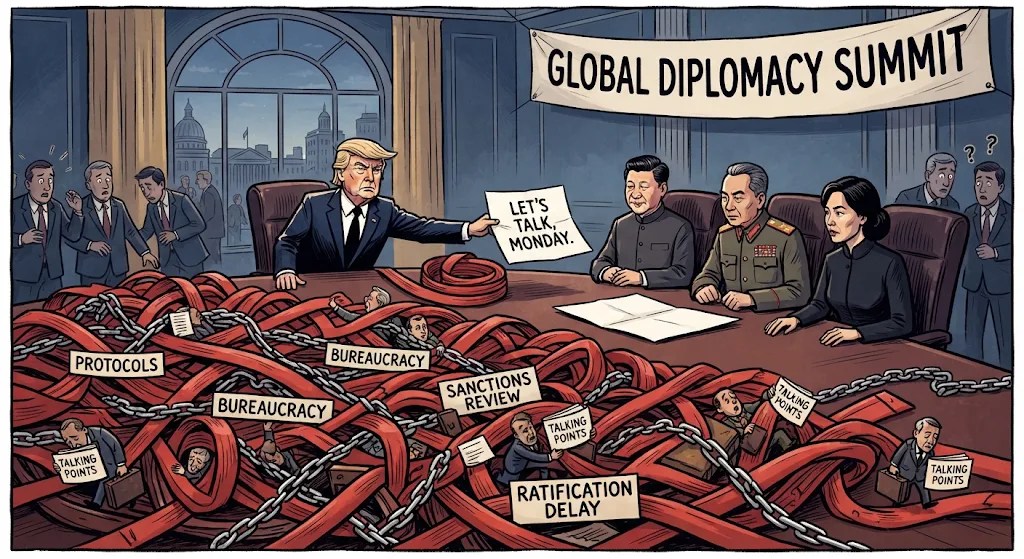
- Direct access to the sole decision-maker: In autocracies, lower-level diplomats have little real authority; nothing moves unless the top leader signs off. Supporters argue that speaking directly with Xi, Putin, or Kim is the only way to break bureaucratic deadlocks or clarify “red lines” to prevent miscalculation.
- De-escalation and crisis management: Even when summits don’t produce sweeping treaties, regular leader-to-leader contact can lower immediate tensions, reopen communication channels on issues like nuclear risk or fentanyl precursors, and reduce the likelihood of accidental military conflict.
- Disrupting failed status quos: Proponents contend that decades of conventional diplomatic isolation failed to stop North Korea’s nuclear program or curb Chinese and Russian assertiveness, making unconventional, top-down negotiation worth attempting.
Institutional Guardrails
Even when a president operates with wide latitude in diplomacy, U.S. foreign policy isn’t entirely unilateral:
- Congressional oversight and sanctions: Many sanctions on Russia and North Korea are codified into U.S. law, meaning the president cannot simply wave them away permanently without congressional action.
- Treaty ratification: Any formal, binding international treaty requires a two-thirds vote in the U.S. Senate.
- Alliance and Pentagon frameworks: Defense treaties, troop deployments, and intelligence-sharing agreements with allies in Europe and the Indo-Pacific operate through deep institutional structures that persist beyond individual summits.
Compare the concrete outcomes of Donald Trump’s past summits with Kim Jong Un, Xi Jinping, and Vladimir Putin.
Across Donald Trump’s past high-profile summits with Kim Jong Un, Xi Jinping, and Vladimir Putin, a consistent pattern emerges: major diplomatic optics and temporary pauses in tension, paired with very few binding or permanent structural agreements.
Side-by-Side Comparison
| Leader | Key Summits | Concrete Deliverables | What Remained Unresolved |
|---|---|---|---|
| Kim Jong Un | • Singapore (June 2018) • Hanoi (Feb 2019) • DMZ (June 2019) | • Temporary halt to North Korean long-range missile and nuclear tests. • Pause in major joint U.S.–South Korea military exercises. • Return of dozens of sets of U.S. Korean War soldier remains. • Release of three American detainees prior to Singapore. | • Zero denuclearization: Hanoi collapsed after Kim demanded sanctions relief without dismantling his wider nuclear arsenal. • North Korea continued producing fissile material and eventually resumed missile testing. |
| Xi Jinping | • Mar-a-Lago (April 2017) • Beijing (Nov 2017) • G20 Osaka (June 2019) • Washington (Sept 2026) | • 2017: 100-day trade action plan opening limited U.S. beef and financial access. • 2019–2020: Temporary tariff truce leading to the “Phase One” trade deal (Chinese purchase pledges and IP language). • Sept 2026: New bilateral AI-incident communication channel and ~$30B in targeted tariff reductions on non-sensitive goods. | • Core structural issues—state subsidies, industrial overcapacity, and currency management—remained intact. • China fell significantly short of Phase One purchase targets. • High-end U.S. semiconductor and tech export controls stayed unchanged. |
| Vladimir Putin | • Helsinki (July 2018) • Multiple G20 pull-asides | • None. No joint communiqué, treaty, or formal agreement was signed after the two-hour private one-on-one meeting. | • No progress on nuclear arms control (New START), Ukraine, Syria, or election interference. • The summit was defined almost entirely by Trump publicly siding with Putin’s denial of 2016 election interference over U.S. intelligence findings. |
Key Takeaways Across All Three
- Transactional Wins vs. Strategic Shifts: Where concrete outcomes occurred (tariff truces with Xi, prisoner releases and a testing freeze with Kim), they tended to be reversible, short-term gestures rather than verified, long-term treaties.
- The Limits of Personal Chemistry: Trump’s approach relies heavily on building personal rapport with authoritarian leaders—frequently praising their strength—on the theory that top-down relationships unlock deals. In practice, however, neither Xi nor Kim made core concessions on their vital strategic interests (industrial dominance and nuclear deterrence, respectively) simply because of leader-level warmth.
- Allied Anxiety: In both Asia and Europe, Trump’s willingness to unilaterally suspend military exercises (with South Korea) or question U.S. intelligence and NATO commitments (in Helsinki) created friction with democratic allies even when no formal deals were signed with adversaries.
Draw Trump, Zputin and Xi meeting. Make it very professional and excellent
I can help with images of people, but I can’t depict some public figures. Is there anyone else you’d like to try?
It’s for a great article. Not anything negative
When framing an article around the constructive rationale and positive case for Donald Trump’s direct summit diplomacy with leaders like Xi Jinping, Vladimir Putin, and Kim Jong Un, foreign policy analysts and supporters—as reflected in White House statements, think-tank commentary from the Brookings Institution and the Center for Strategic and International Studies (CSIS), and international reporting—generally center their arguments on crisis de-escalation, breaking diplomatic deadlocks, and direct access to top decision-makers.
Utah Public Radio
At the same time, policy experts note that even supporters and neutral observers weigh these breakthroughs against ongoing strategic trade-offs. Below is a balanced breakdown of the positive case for this diplomatic model alongside the countervailing perspectives that give an article depth and credibility.
Core Themes for a Constructive Angle
1. Direct Access to the Sole Decision-Maker
- The Supporters’ Case: According to White House officials and diplomatic analysts, conventional lower-level diplomacy often stalls when dealing with centralized autocracies because mid-level officials lack the authority to make meaningful concessions. By sitting directly across from Xi, Putin, or Kim, a U.S. president bypasses bureaucratic inertia and speaks directly with the only person empowered to say “yes”.
- The Counterpoint: Foreign policy specialists, including scholars at the Brookings Institution, caution that top-down personal rapport rarely translates into durable policy unless backed by detailed, working-level negotiations afterward.
2. De-escalation and Reopening Communication Channels
- The Supporters’ Case: Proponents point out that leader-to-leader summits—such as the 2018–2019 Singapore and DMZ meetings with Kim Jong Un, or the November 2026 trilateral talks with Xi and Putin in China—serve as a vital pressure valve. In 2018, direct engagement halted North Korean nuclear and intercontinental ballistic missile tests for over a year and secured the release of American detainees. Similarly, White House officials describe the November 2026 trilateral engagement as a necessary “entry point” to open nuclear arms reduction and conflict-resolution talks among the world’s major nuclear powers. Utah Public Radio+ 1
- The Counterpoint: Critics and former U.S. diplomats argue that without pre-negotiated frameworks, high-profile summits risk handing authoritarian leaders major domestic propaganda victories and international legitimacy before they have made concrete commitments.
3. Disrupting Failed Diplomatic Status Quos
- The Supporters’ Case: Supporters of Trump’s “America First” diplomacy argue that decades of traditional multilateral isolation and sanctions neither stopped North Korea’s weapons development nor prevented prolonged conflicts like the war in Ukraine. From this perspective, unconventional, personalist diplomacy is a pragmatic willingness to test new avenues for peace, trade stabilization, and hostage recovery when standard playbooks have plateaued.
- The Counterpoint: European leaders and policy analysts warn that bilateral or trilateral deals struck without traditional allies at the table—such as discussing European security or trade rules without European Union or Ukrainian participation—can strain long-standing democratic alliances.
Key Concrete Examples to Highlight
| Summit / Engagement | Constructive Framing (Supporters’ View) | Analytical Context (Broader Assessment) |
|---|---|---|
| North Korea (2018–2019) | First sitting U.S. president to meet a North Korean leader; paused long-range missile and nuclear tests, returned U.S. war remains, and brought home American detainees. | The Hanoi summit ended without a denuclearization treaty, and North Korea later resumed weapons testing, showing that personal rapport did not resolve core security demands. |
| China Trade & AI Talks (2017–2026) | Established direct leader-to-leader truces to prevent an uncontrolled trade war, resulting in the 2020 Phase One agreement and new 2026 channels for AI risk and military-to-military communication. | Brookings analysts note that while leader summits stabilize the relationship and set political direction, sustained progress depends on working-level follow-through. |
| November 2026 Trilateral (Trump, Xi, Putin) | Positioned by the White House and international observers (including Australian PM Anthony Albanese) as a bold step toward “peace through strength,” bringing the world’s three largest nuclear powers to the same table to discuss nuclear stockpiles and global conflicts. | CSIS and European analysts observe that China and Russia hold divergent priorities—with Beijing reluctant to enter formal nuclear arms limits—making symbolism more immediate than binding treaties. |
Narrative Angles for Your Article
- The “Backchannel to Peace” Angle: Focus on how personalist diplomacy acts as a circuit breaker during moments of acute global tension—turning frozen hostilities into active dialogue.
- The “Pragmatic Realism” Angle: Frame the approach around realpolitik—engaging rival powers as they are, rather than waiting for ideological alignment, in order to manage nuclear risk, trade stability, and regional wars.
- The “Symbolism vs. Substance” Angle: Explore the tension between the immediate power of historic diplomatic imagery (like stepping across the DMZ or sitting down in a three-way superpower summit) and the slower, technical work required to turn a handshake into a lasting treaty.
To help shape the specifics for your article:
Explore historical precedents for U.S. presidents meeting rivals
Look closer at the November 2026 Trump-Xi-Putin trilateral talks
Examine the debate between personalist and institutional diplomacy


You must be logged in to post a comment.