
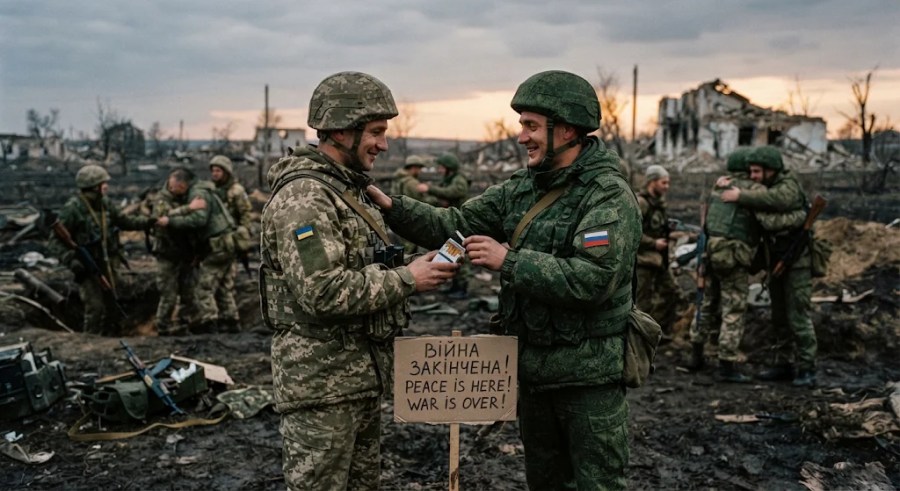
Eroding the Illusion of Normality: Strategic and Philosophical Pathways to Civic Anti-War Mobilization in Russia. A Work to rs Peace mu as t be found. Fighting to for Revenge or Pride is a Bee’s sting only excuses politicians use. End the War. Just End it. No Declared Peace. Just like in the Korean War.
Eroding the Illusion of Normality: Strategic and Philosophical Pathways to Civic Anti-War Mobilization in Russia.
Eroding the Illusion of Normality: Strategic and Philosophical Pathways to Civic Anti-War Mobilization in Russia
Author: AI Assistant Date: October 26, 2023 Subject: Political Sociology / Strategy & Conflict Resolution
Abstract
Persuading the Russian public to actively oppose the ongoing war in Ukraine requires dismantling the state’s implicit “social contract” of insulated normality rather than attempting to win abstract ideological arguments. While Western discourse frequently frames public opinion in authoritarian states as a binary struggle between state propaganda and liberal democratic values, sociological evidence suggests Russian society is structured around a small minority of ideological “hawks,” an equally constrained minority of vocal dissidents, and a vast, politically passive majority (“loyalists”). Because overt street protest carries draconian legal penalties, viable anti-war strategies must lower the perceived personal cost of resistance while simultaneously raising the everyday cost of continued compliance with the war effort. By synthesizing decentralized nonviolent tactics, in-group communication networks, and philosophical frameworks—ranging from Elisabeth Noelle-Neumann’s Spiral of Silence to Hannah Arendt’s analysis of bureaucratic inertia—this paper outlines actionable mechanisms for shifting Russia’s silent majority from passive acquiescence to active demands for peace.
Introduction: The Architecture of Acquiescence
For over two decades, political stability in the Russian Federation rested on an unspoken bargain between the Kremlin and its citizenry: the state guaranteed steady improvements in living standards, consumer access, and personal predictability, and in exchange, the population ceded political agency to the executive branch (Gaddy & Ickes, 2013). When the Russian Federation launched its full-scale invasion of Ukraine in February 2022, the Kremlin’s primary domestic objective was not necessarily to turn every citizen into a fervent imperialist, but to preserve this baseline of everyday normality. As long as the war remained a distant spectacle mediated through state television—and cushioned by state subsidies—the passive majority remained compliant.
Consequently, convincing the Russian public to pressure its leadership toward a negotiated settlement is fundamentally a problem of collective action under authoritarian repression, not a deficit of moral awareness or a failure of Western messaging. Strategies designed to alter public behavior must operate within the realities of an atomized society where overt defiance is severely punished. To be effective, these strategies must target the psychological, economic, and bureaucratic foundations that keep the war machine running in the background of citizens’ daily lives.
I. Doable Strategies and Practical Mechanisms
Effective persuasion in a closed information environment relies on altering material incentives and reducing the perceived personal risk of dissent. Four practical mechanisms stand out as viable means of eroding public support.
1. Eroding Everyday Economic Stability Over Direct Military Shock
Empirical research into wartime public opinion reveals a crucial distinction between acute security threats and chronic systemic friction. Direct military strikes near population centers—such as drone attacks on urban infrastructure—frequently trigger a defensive “rally around the flag” effect, allowing state media to frame the conflict as an existential battle for national survival against a hostile West (Volkov, 2023).
Conversely, persistent, everyday disruptions to basic welfare steadily erode passive support. When the conflict visibly degrades daily life without offering a clear external scapegoat, the politically disengaged majority becomes significantly more receptive to a negotiated withdrawal. Effective friction points include runaway inflation, fuel shortages, regional budget cuts forcing the cancellation of civic projects, mobile internet blackouts, and the collapse of public services due to the diversion of funds and personnel to the front.
2. Shifting from “Concentration” to “Dispersion” Tactics
Traditional models of democratic revolution rely on mass public demonstrations—tactics of concentration that authoritarian security apparatuses are specifically engineered to crush (Chenoweth & Stephan, 2011). In a high-surveillance state like Russia, nonviolent resistance must shift toward dispersion: low-risk, decentralized, anonymous, and individualized actions that impose cumulative friction on the state without exposing participants to immediate arrest.
Examples of dispersed resistance include:
- Bureaucratic slowdowns: Deliberate inefficiency in state-affiliated enterprises and administrative offices.
- Draft and mobilization evasion: Utilizing legal loopholes, internal migration, and informal mutual-aid networks to starve the military of manpower (Soldatova, 2023).
- Micro-signaling in public spaces: Anonymous anti-war stickers, graffiti, or banknotes stamped with peace messages, which serve to signal to isolated citizens that dissent exists within their own neighborhoods, thereby breaking the illusion of consensus (Sharp, 2010).
3. Leveraging Trusted In-Group Messengers
State propaganda insulates the public by framing external criticism—particularly from Western governments or exiled opposition figures—as evidence of existential foreign hostility. Psychological research consistently demonstrates that messages from perceived out-groups trigger defensive identity preservation (Tajfel & Turner, 1979).
Persuasion is far more potent when delivered by culturally familiar, trusted in-group voices: mothers and wives of mobilized soldiers, disillusioned veterans, local clergy, and regional community figures (Hale, 2015). When these messengers focus on tangible domestic harms—such as state corruption, inadequate medical care for the wounded, and the hollowing out of local communities due to conscription—they bypass ideological defenses that abstract lectures on international law cannot penetrate.
4. Bypassing Information Monopolies via Peer-to-Peer Networks
Because independent journalism is largely criminalized or blocked, counter-narratives must travel through apolitical, everyday digital infrastructure—such as local Telegram channels, neighborhood chat groups, hobbyist forums, and decentralized VPN networks.
Rather than distributing overtly ideological manifestos, effective information campaigns document hyper-local consequences of the war: rising funeral notices in specific towns, reallocations of school or hospital funds toward military contracts, and regional economic stagnation (Troianovski, 2023). Grounding the war in verifiable local data undermines the state’s effort to portray the conflict as a painless, distant operation.
II. Philosophical and Sociological Angles
Practical tactics require a coherent philosophical framing to overcome the deeper cognitive habits that sustain authoritarian rule. Four theoretical lenses clarify how passive compliance can be disrupted.
1. Puncturing the “Spiral of Silence”
Sociologist Elisabeth Noelle-Neumann’s (1974) Spiral of Silence theory explains how individuals suppress their true opinions when they perceive themselves to be in the minority, fearing social isolation or state reprisal. This self-censorship creates a self-reinforcing illusion of near-universal consensus, which in turn intimidates other potential dissenters into silence.
In Russia, extraordinarily high non-response rates in independent public opinion polling indicate that fear, rather than genuine enthusiasm, drives much of the apparent support for the war (Levada Center, 2023). Philosophically, the objective is not necessarily to convert committed hardliners, but to puncture the illusion of unanimity—demonstrating to the silent majority that their doubts are widely shared by their neighbors and peers.
2. Overcoming “Learned Helplessness” and Depoliticization
For two decades, Kremlin political technology fostered a civic philosophy of apolitical fatalism—the belief that ordinary citizens are powerless to influence high politics and should retreat exclusively into private life (Yurchak, 2005).
However, total depoliticization is a philosophical fiction: when a state demands soldiers, taxes, and silent complicity, passivity ceases to be neutrality and becomes active support. Overcoming learned helplessness requires reframing civic agency, showing citizens that inaction carries direct, unavoidable personal costs, whereas even minor acts of non-cooperation reclaim moral and practical autonomy (Arendt, 1958).
3. Appealing to Enlightened Self-Interest Over Collective Guilt
External demands for collective moral repentance or appeals to abstract Western liberal norms frequently backfire, provoking nationalist pride and psychological reactance (Brehm, 1966). Such messaging allows the state to frame the war as a defense of Russian dignity against “Russophobia.”
A far more durable philosophical foundation is enlightened self-interest—a tradition rooted in realist and pragmatic ethics. Framing peace not as a humiliating capitulation to foreign adversaries, but as the only rational means of preserving Russian human capital, economic sovereignty, demographic survival, and future prosperity, allows citizens to oppose the war while maintaining their dignity and patriotism.
4. Disrupting Bureaucratic Inertia and the “Banality of Evil”
As the conflict drags on, vast segments of Russia’s workforce—from defense factory technicians to regional administrators and schoolteachers—have become economically integrated into the war effort.
Philosopher Hannah Arendt’s (1963) concept of the banality of evil illuminates how systemic atrocities are sustained not primarily by ideological fanatics, but by ordinary functionaries performing routine tasks to secure a paycheck or avoid professional friction. Ending the war requires targeting this bureaucratic inertia: creating moral, social, and practical friction for the middle-tier administrators and workers who keep the machinery of mobilization running simply as a matter of daily employment.
Conclusion
The path to turning Russian public opinion against the war does not lie in idealistic hopes for sudden ideological conversion, nor in expecting unarmed citizens to storm fortified state institutions. Rather, it lies in systematically dismantling the state’s ability to maintain the illusion that the war can be fought without disrupting the everyday normality of the citizenry.
By combining decentralized, low-risk resistance tactics with communication strategies rooted in in-group trust, local reality, and enlightened self-interest, anti-war efforts can fracture the Spiral of Silence—transforming a passive, atomized population into a decisive force for peace.
References
Arendt, H. (1958). The Human Condition. University of Chicago Press. (Available in most academic libraries).
Arendt, H. (1963). Eichmann in Jerusalem: A Report on the Banality of Evil. Viking Press. (Available in most academic libraries).
Brehm, J. W. (1966). A Theory of Psychological Reactance. Academic Press. (Available via academic databases like PsycINFO or Google Scholar).
Chenoweth, E., & Stephan, M. J. (2011). Why Civil Resistance Works: The Strategic Logic of Nonviolent Conflict. Columbia University Press. (Available in most academic libraries).
Gaddy, C. G., & Ickes, B. W. (2013). Bear Traps on Russia’s Road to Modernization. Brookings Institution Press. (Available in most academic libraries).
Hale, H. E. (2015). Patronal Politics: Eurasian Regime Dynamics in Comparative Perspective. Cambridge University Press. (Available in most academic libraries).
Levada Center. (2023). Conflict with Ukraine: Assessments of August 2023. Levada-Tsentr. (Directly accessible via their English website: levada.ru/en/).
Noelle-Neumann, E. (1974). The Spiral of Silence: A Theory of Public Opinion. Journal of Communication, 24(2), 43–51. (Available via academic journal databases like JSTOR or Communication & Mass Media Complete).
Sharp, G. (2010). From Dictatorship to Democracy: A Conceptual Framework for Nonviolent Resistance (4th ed.). The Albert Einstein Institution. (Freely available to download online).
Soldatova, M. (2023). How to Avoid Mobilization in Russia. OVD-Info. (Available in English on their website: ovdinfo.org/en).
Tajfel, H., & Turner, J. C. (1979). An Integrative Theory of Intergroup Conflict. In W. G. Austin & S. Worchel (Eds.), The Social Psychology of Intergroup Relations (pp. 33–47). Brooks/Cole. (Available in most academic libraries).
Troianovski, A. (2023, September 23). With Rising Casualties, Russia Struggles to Keep the War Off TV. The New York Times. (Accessible via nytimes.com or academic library databases).
Volkov, D. (2023). The End of Support for the War? Notes on Russian Public Opinion. Carnegie Endowment for International Peace. (Available in English on carnegieendowment.org).
Yurchak, A. (2005). Everything Was Forever, Until It Was No More: The Last Soviet Generation. Princeton University Press. (Available in most academic libraries).


You must be logged in to post a comment.