
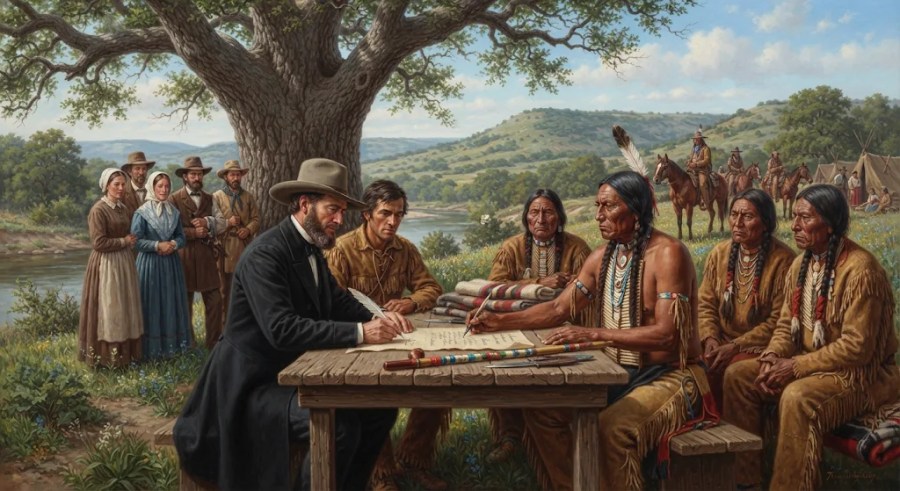
Peace, a word sought but hard to achieve…
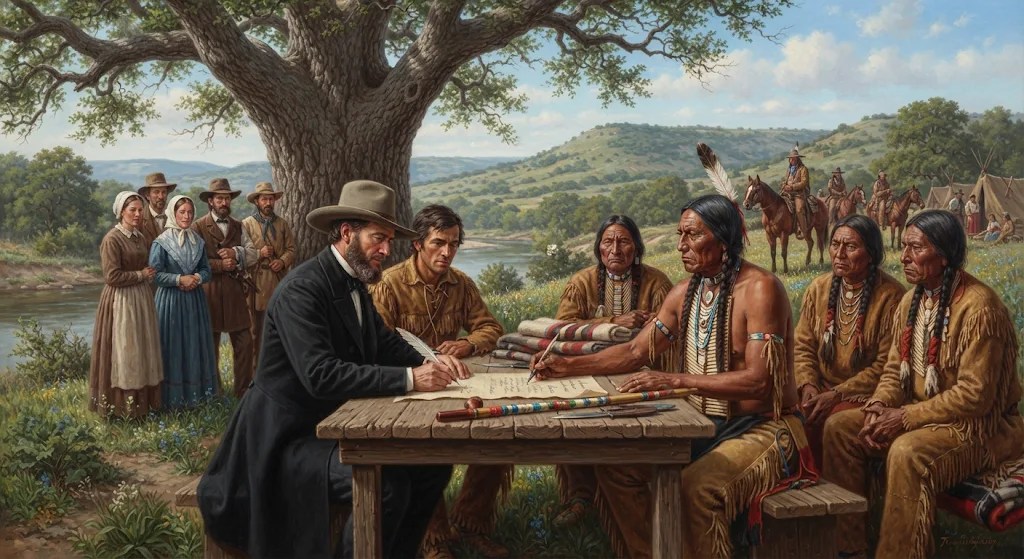
Tell me about German Immigrants with land grants on Llano River. I watched a movie that said Buffalo Hump signed a treaty with them and it was never BROKEN. Fill me in with dates and history behind this. Make it very readable and grab the reader
In 1847, a group of German aristocrats and settlers pulled off one of the rarest feats in American frontier history: they negotiated a peace treaty with the fierce Penateka Comanche that neither side ever broke.
The movie you watched got the core legend right. While the Texas frontier burned with constant warfare, the German settlements along the Llano River survived—and thrived—because of a risky handshake between an idealistic German baron and Buffalo Hump, one of the most formidable Comanche war chiefs in Texas history.
The Setup: A Broken Promise in Europe
In 1842, a group of 21 German noblemen formed the Adelsverein (Society for the Protection of German Immigrants in Texas). Facing overpopulation and economic hardship in Germany, thousands of families sold everything and sailed to Texas, promised lush, empty farmland.
Instead, they arrived in 1844–1845 to chaos. The Adelsverein went nearly bankrupt, and the land they had secured—the Fisher-Miller Land Grant—was a massive, 3-million-acre tract deep in the Texas Hill Country, right in the heart of Comancheria.
The Man Who Walked Into the Fire
By 1846, thousands of Germans were stranded on the Texas coast, dying of cholera and starvation, while the man meant to lead them, Prince Carl of Solms-Braunfels, gave up and went home.
Enter Baron Ottfried Hans von Meusebach—who dropped his noble title, changed his name to John O. Meusebach, and took over the collapsing colony. Meusebach realized the settlers couldn’t survive unless they moved north onto the Fisher-Miller grant along the Llano River. There was just one problem: the Texas Rangers warned him that entering Comanche hunting grounds meant certain death.
The Peace Pipe on the San Saba (1847)
Meusebach refused to bring an army. Instead, he decided to treat the Comanche as sovereign equals.
- January 1847: Meusebach rode into the Hill Country with a small party of about 20 men—mostly surveyors, scientists, and an interpreter—carrying no heavy weapons.
- February 1847: Meusebach’s scouts made contact with the Penateka Comanche along the San Saba River, just north of the Llano. Rather than attacking, the Comanche respected the bravery of the unarmed, bearded German leader, whom they nicknamed El Sol Colorado (“The Red Sun”) because of his flowing red beard.
- March 1–2, 1847: Council fires were lit. Across from Meusebach sat the legendary Penateka war chiefs: Buffalo Hump, Santa Anna, and Old Owl.
For two days, they negotiated. Meusebach made a radical offer: he didn’t ask the Comanche to leave their land. Instead, he asked to share it.
The Terms of the Meusebach-Comanche Treaty
Signed in May 1847 in Fredericksburg, the treaty was remarkably simple and built on mutual benefit:
- Shared Territory: German settlers could survey and farm the Fisher-Miller grant along the Llano River without being attacked.
- Mutual Protection: Both sides agreed to report any troublemakers or horse thieves from their own people to the other side for punishment.
- Free Movement & Trade: Comanches could visit German towns (like Fredericksburg and Castell) freely to trade buffalo hides, bear grease, and game for tools, blankets, and corn.
- Gifts, Not Bribes: Meusebach gave the chiefs $3,000 worth of provisions and gifts as a token of friendship, not as a purchase price for the land.
Why It Was Never Broken
While dozens of treaties between the U.S. government and Native tribes were torn up within months, the Meusebach-Comanche Treaty held for decades—until the U.S. Army eventually forced the Comanche onto reservations in Oklahoma in the 1870s.
It survived because both sides kept their word:
- No Land Greed: Unlike Anglo-American settlers who fenced off massive cattle ranches and drove away wildlife, the Germans settled in small, tight-knit farming communities (like Castell, Leiningen, and Bettina on the Llano River), leaving the surrounding hunting grounds intact.
- Shared Enemies: Neither the Germans nor the Comanche had much love for the encroaching Texan military authorities.
- Genuine Respect: Comanche families routinely camped outside Fredericksburg and Llano settlements, trading peacefully and even letting their children play with German settler kids. When Buffalo Hump himself visited the German towns, he was welcomed as an honored guest rather than feared as a raider.
What Happened to the Llano Settlements?
In 1847, immediately after the treaty was signed, Meusebach founded several colonies directly on the banks of the Llano River—including Castell (which still exists today as a tiny, historic Hill Country town) and Bettina, an experimental commune founded by radical German intellectuals that collapsed after a year due to internal arguments over who had to do the chores, not because of any Indian raids.
The peace lasted through the Civil War and beyond, making the Meusebach-Comanche Treaty one of the only agreements with Native Americans in U.S. history that was never broken by either party.
Explore more of this Hill Country history:
Tell me about the Utopian commune of Bettina on the Llano
How did Buffalo Hump’s life end after the treaty?
What German traditions still survive in the Texas Hill Country?
MHow Buffalo Hump’s Life Ended After the Treaty
While the peace between Buffalo Hump’s Penateka Comanches and the German settlers held firm, the wider Texas frontier was closing in around them. Following the 1847 treaty, Buffalo Hump spent his final decades navigating the painful end of the Comanche’s free-roaming way of life:
- The Final Years of Freedom (1847–1856): Throughout the late 1840s and early 1850s, Buffalo Hump continued to visit German settlements like Fredericksburg in peace. However, massive waves of Anglo-American settlers, U.S. Army forts, and the rapid disappearance of the buffalo herds pushed the Penateka band to the brink of starvation.
- Relocation to Reservations (1856–1859): Realizing that armed resistance against the U.S. military had become impossible, Buffalo Hump led his remaining followers onto the Brazos River Reservation in Texas in 1856. Constant friction with hostile Texas neighbors forced the federal government to move the tribe north across the Red River in 1859, settling them on the Kiowa-Comanche Reservation near Fort Cobb in Indian Territory (present-day Oklahoma).
- A Quiet End (c. 1867–1870): In a dramatic shift for one of the fiercest war chiefs in Plains history, Buffalo Hump spent his final years living quietly near Fort Cobb. He gave up raiding entirely, settled into a wooden house, and took up farming—trying to set an example so his people could survive in a changed world. He died peacefully on the reservation around 1867 to 1870 (historical records vary slightly on the exact year), and the exact location of his grave remains unknown.
German Traditions That Still Survive in the Texas Hill Country
Because the German settlements were isolated in the Hill Country for generations—and insulated from frontier warfare by the Meusebach treaty—their culture didn’t just survive; it became the defining identity of towns like Fredericksburg, New Braunfels, Boerne, and Castell.
Easter Fires (Osterfeuer): Unique to Fredericksburg, every Easter Eve, bonfires are lit on the hills surrounding the town. The tradition began in 1847 when Comanche scouts lit signal fires on the hills during Meusebach’s treaty negotiations; to keep her frightened children calm, a German mother told them the smoke was from the Easter Bunny boiling wildflowers to dye Easter eggs—a story still celebrated every spring.
Texas German (Texasdeutsch): Isolated from Germany for over a century, the original settlers preserved a unique 19th-century dialect mixed with English loanwords (for instance, calling a skunk a Stinkkatze or “stink cat”). While fluent speakers are now mostly elderly, linguists actively record it, and local heritage groups still hold regular Stammtisch (roundtable) gatherings to keep the language alive.
Distinctive Stone Architecture: Walk down Main Street in Fredericksburg or through the countryside near the Llano River, and you’ll see classic Fachwerk (half-timbered buildings filled with local limestone) and “Sunday Houses.” Sunday Houses were tiny, one-and-a-half-story cottages built in town by rural farmers so their families had a place to stay when they came in on Saturday for supplies and stayed through Sunday church services.
Food and Beer Culture: Traditional German Gasthäuser (biergartens and restaurants) still serve authentic schnitzel, bratwurst, sauerkraut, and red cabbage alongside German-style craft lagers and pilsners. Local bakeries continue to make pfeffernüsse (spiced cookies), strudel, and stollen, while local butcher shops cure traditional smoked sausages.
Community Festivals and Schützenvereine: Every autumn, towns across the region erupt into massive Oktoberfest celebrations, complete with polka music, traditional Trachten (lederhosen and dirndls), and waltz contests. Many communities also maintain historic Schützenvereine (shooting clubs) founded in the 1850s—originally created for frontier defense and target practice, they still host annual Schützenfest marksmanship tournaments to crown a “Shooting King.”


You must be logged in to post a comment.