
The history of Donald Trump’s grandfather, Friedrich Trump, is a well-documented saga of frontier opportunism and a failed attempt to return to his homeland.
The Midnight Departure (1885)
Born in Kallstadt, Kingdom of Bavaria, Friedrich Trump left home at age 16 in 1885. His departure was sudden and technically illegal; he left a note for his mother but did not notify the authorities. By leaving at this age, he avoided the mandatory two-year military conscription required of Bavarian men. He arrived in New York with very little money and spent his early years working as a barber.
“Mining the Miners”: Sex and Alcohol
Friedrich made his fortune by moving west, eventually following the Klondike Gold Rush to the Yukon in the late 1890s. Rather than digging for gold himself, he “mined the miners” by providing the three things they craved most:
- Alcohol: His establishments, such as the Arctic Restaurant and Hotel, were known for being open 24 hours and serving plenty of liquor.
- Food: He served luxury items like “fresh-slaughtered, quick-frozen horse” to prospectors.
- Sex: Historical accounts and newspaper advertisements from the era suggest his hotels included “private boxes” for female companionship and prostitution, which was a common feature of frontier hotels at the time.
By 1901, Friedrich had amassed a fortune of roughly 80,000 marks (roughly $500,000 today), which he deposited in a Bavarian bank to prove his status as a “productive citizen”.
The Failed Homecoming and “Deportation”
In 1902, Friedrich returned to Kallstadt to find a wife, eventually marrying Elisabeth Christ. However, when he attempted to have his Bavarian citizenship reinstated so the couple could live there permanently, the government refused.
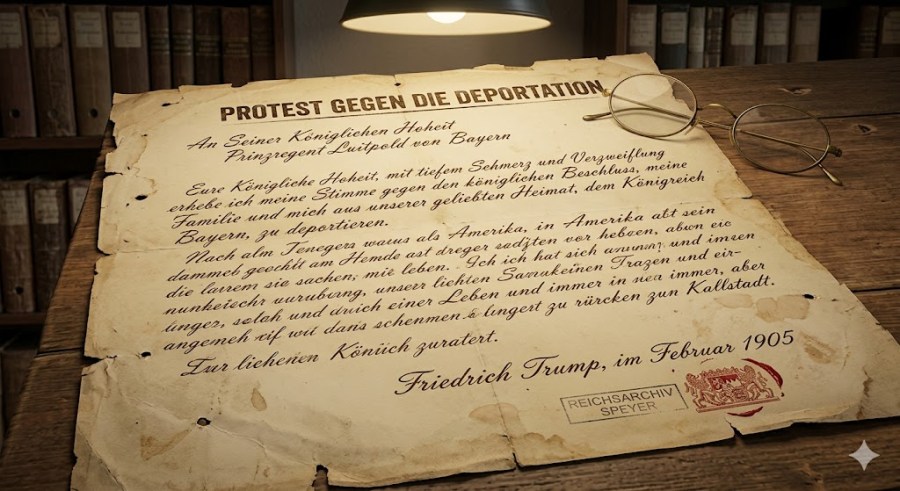
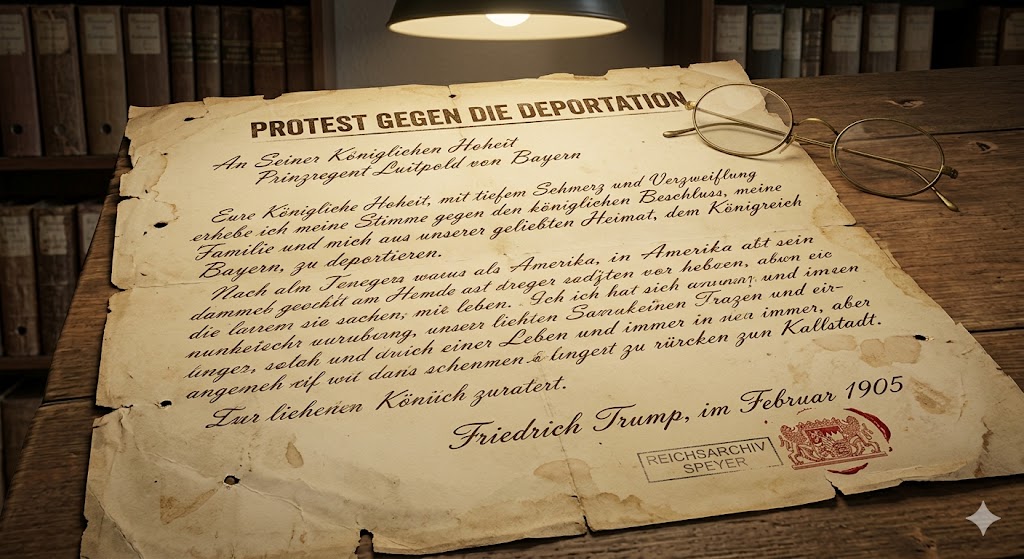
Bavarian authorities ruled that he had emigrated specifically to evade military service and failed to register his departure. In February 1905, the Kingdom of Bavaria issued a royal decree: Friedrich was an “illegal emigrant” and was given eight weeks to leave the country or face deportation.
The Handwritten Protest Letter
Following the decree, Friedrich wrote a desperate, emotional letter to Prince Regent Luitpold of Bavaria in 1905. This letter, which resurfaced in German archives roughly 100 years later, contained several notable pleas:
- A “Lightning Strike”: He described the order to leave as a “lightning strike from fair skies” that “paralyzed” his family with fright.
- Flattery: He addressed the Prince as “Most Serene, Most Powerful Prince Regent” and “just sovereign lord”.
- Family Hardship: He noted that his wife was overcome by anxiety and his child had become sick due to the stress of the situation.
Despite his flowery language and claims of being a “pious” and “obedient” subject, the Prince rejected the appeal. Friedrich, his wife, and their daughter were forced to board a ship back to America on July 1, 1905. At the time of their “deportation,” Elisabeth was pregnant with Fred Trump, Donald Trump’s father.


You must be logged in to post a comment.