
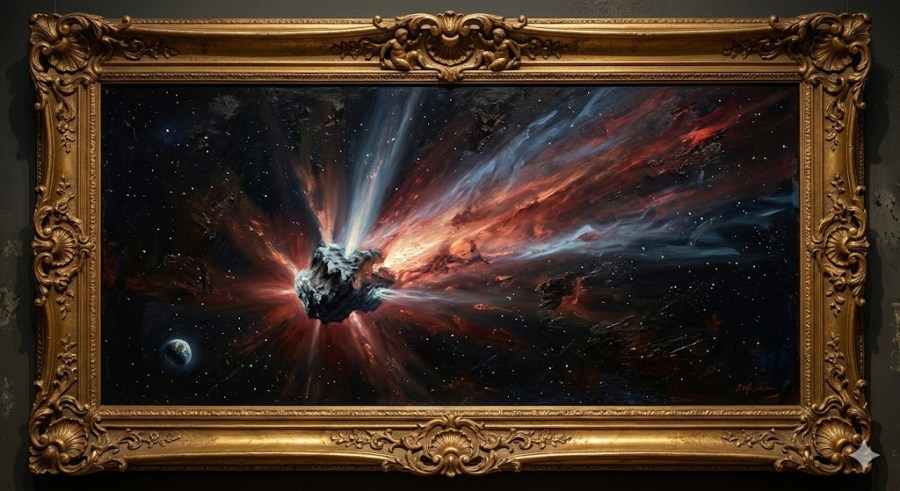
Will you be alive to see it? I saw it in 1986. It was AWESOME!
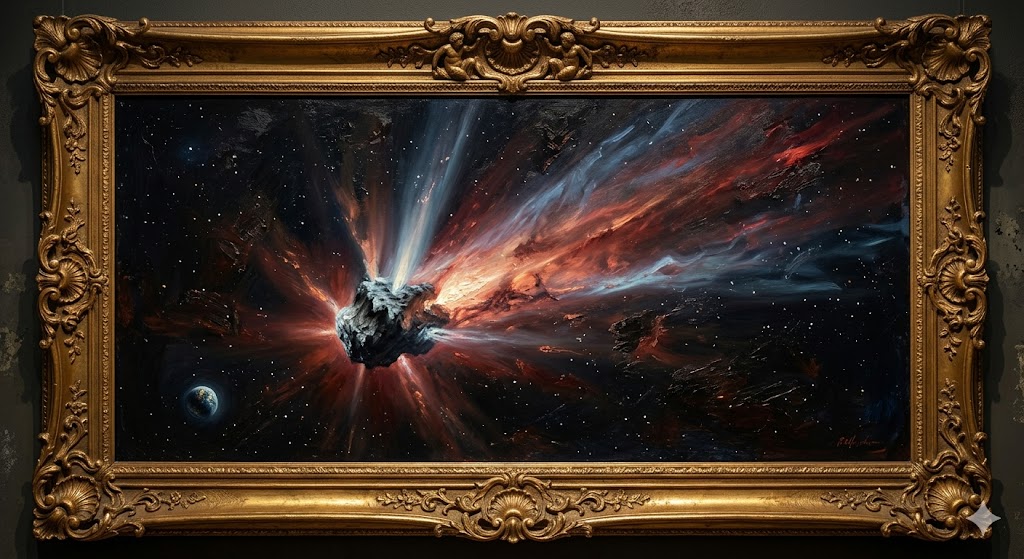
The year was 1910, and the world stood at a jagged crossroads. The Victorian era was a fading ghost, and the age of the machine was screaming into existence. When the news broke that Halley’s Comet—that great, icy wanderer of the deep—was plunging back toward our sun, the collective psyche of humanity didn’t just ripple; it fractured.
The Great Panic of 1910
The initial reaction was not wonder, but a primal, shivering terror. The newspapers of the day, hungry for sensation, latched onto a scientific discovery: French astronomer Camille Flammarion had announced that the comet’s tail contained cyanogen gas. While scientists knew the gas was too thin to harm a soul, the public heard only one word: Poison.
A hysteria swept across the globe that feels almost alien to us now. In the back-alleys of Chicago and the farmsteads of Texas, people prepared for the end of the world. Shady entrepreneurs made fortunes selling “Comet Pills” and “Anti-Comet Umbrellas.” In rural villages, families spent their life savings on “bottled oxygen.” As the date approached when Earth was scheduled to pass through the tail, the atmosphere turned funereal. Men and women in the Great Plains stuffed wet rags into the window frames of their cabins, huddling together in the candlelight, praying they wouldn’t wake up to find their lungs filled with the “noxious vapors” of the heavens. Some even chose to end their lives early rather than face the celestial executioner.
The Transformation
But as the comet cleared the sun and swung into the night sky, the fear evaporated, replaced by a silence so heavy it felt like prayer.
The sight was nothing short of a miracle. The comet did not just sit in the sky; it dominated it. It was a jagged, brilliant spear of white fire, dragging a tail that spanned nearly 100 degrees across the firmament. If you held your hand out at arm’s length, the tail would stretch from the horizon to the very top of the sky. It was an ethereal, shimmering veil of dust and ionized gas, glowing with a ghostly, pale blue light that seemed to pulse in time with a heartbeat only the universe could hear.
For those who lived through it, the comet was a bridge between the ancient and the modern. One moment, you were a farmer who plowed his fields with a mule; the next, you were staring at a messenger from the beginning of time. It turned the night into a cathedral.
The Return: 1986 and Beyond
When it returned again in the mid-1980s, the world had changed. We had split the atom and walked on the lunar surface. We met the comet not with wet rags and prayers, but with a fleet of spacecraft—the “Halley Armada”—that flew into its heart to see the black, boiling nucleus for the first time.
Yet, for those who stepped out into the crisp night air to see it with their own eyes, the technical data didn’t matter. To see Halley’s Comet is to witness the clockwork of God. It is a heavy, awe-inspiring realization that this same ball of ice was watched by Genghis Khan, by the soldiers at the Battle of Hastings, and by the ancient astronomers of China.
When you see that tail stretching out—a million-mile-long ribbon of stardust caught in the solar wind—it does something to the soul. It makes the petty squabbles of Earth feel invisible. It is a sight of such immense, silent power that it stays with you forever. It is the feeling of being a tiny part of a very big, very beautiful story. It is a celestial promise, written in ice and fire, that the universe is far more magnificent than we ever dare to imagine.
It is the great traveler, the silent witness to our history, and when it returns in 2061, it will find a world even more transformed—but the awe it inspires will be exactly the same.


You must be logged in to post a comment.