
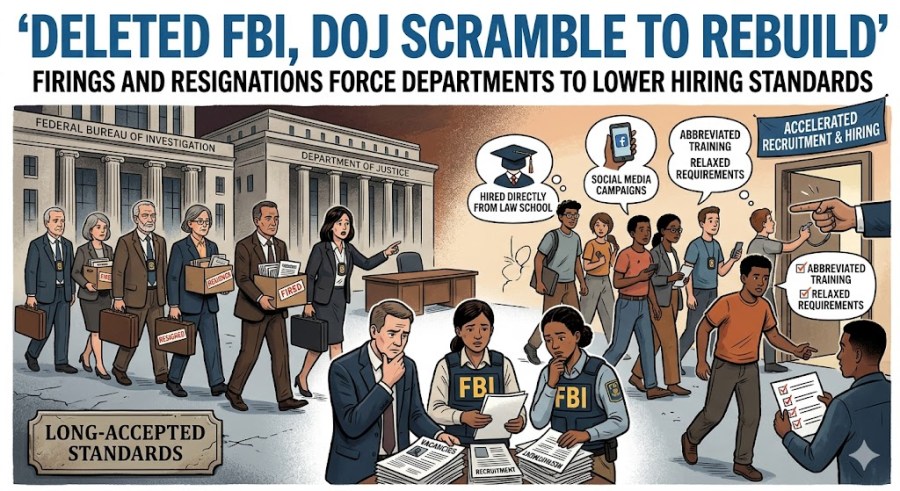
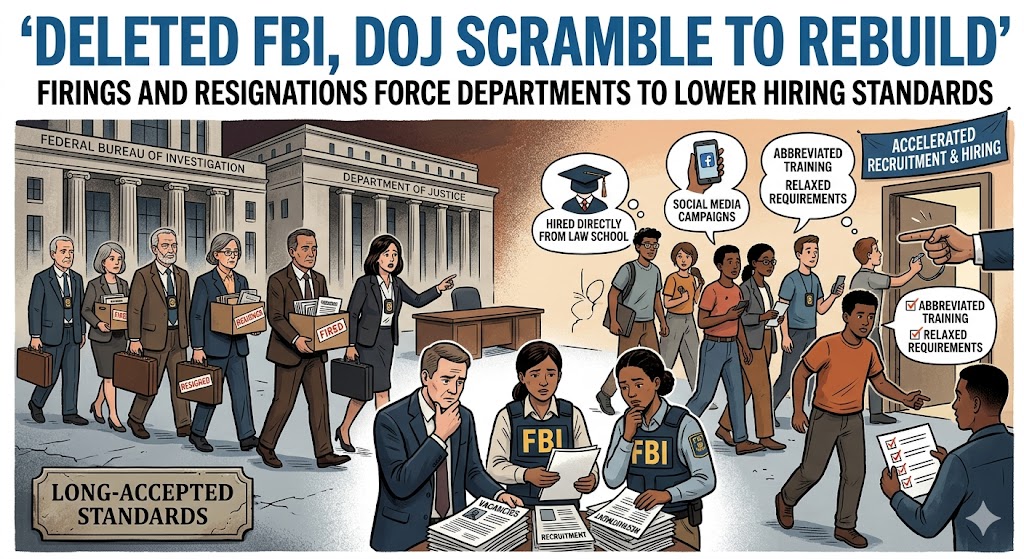
This latest report highlights a significant shift in the operational “DNA” of the country’s most prominent law enforcement and legal institutions. The exodus at the FBI and DOJ isn’t just about a change in personnel; it’s a fundamental restructuring of how these agencies function and who leads them.
TRUMP and PROJECT 2025 has 🇺🇸 Fooled!
To get a clearer picture of the impact, we can break down the current state of affairs into three main categories:
1. The “Experience Gap” and Lowering Standards
The most immediate concern raised by officials is the dilution of expertise. Traditionally, the FBI and DOJ have been “slow-growth” organizations where seniority and a track record of non-partisan service were the primary filters for advancement.
- Accelerated Recruitment: By offering abbreviated training and easing requirements for support staff to become agents, the FBI is essentially fast-tracking people into high-stakes roles.
- Direct Entry for Prosecutors: Hiring lawyers straight out of law school for U.S. Attorney offices is a major departure. Historically, these roles were reserved for seasoned litigators with years of experience in state courts or private practice.
- Leadership Vacuum: Promoting less-experienced employees into management risks losing the “institutional memory” required to navigate complex counterintelligence and domestic terrorism cases.
2. Parallels Across the Federal Government
You mentioned the firing of Generals and Admirals. When viewed alongside these DOJ and FBI departures, a broader pattern emerges:
- Systemic Reshaping: This suggests an effort to move away from the “meritocracy-based” civil service model toward one that prioritizes ideological alignment with the executive branch.
- The “Loyalty” Factor: The article explicitly notes that many departures were prompted by the firing of employees deemed “insufficiently loyal.” This creates a feedback loop where those who remain or are newly hired may feel their job security is tied to political compliance rather than objective law enforcement.
3. Emerging Risks
Critics and former officials are pointing toward several potential “red flags” resulting from these depleted ranks:
| Risk Area | Potential Impact |
|---|---|
| National Security | Fewer veteran agents to track sophisticated foreign intelligence or terror threats. |
| Legal Integrity | Inexperienced prosecutors may be more prone to procedural errors or overreach in high-profile cases. |
| Morale | A “brain drain” often leads to a cycle where remaining top talent leaves due to increased workloads and a shift in agency culture. |
Note: The class-action lawsuits mentioned in the related stories—where fired agents are alleging a “retribution campaign”—will be the next major development to watch. These legal battles will likely determine if these personnel changes are seen as legitimate administrative restructuring or illegal political purging.
It’s a massive “rebooting” of the federal government’s enforcement arm. Do you think the reduction in hiring standards is a temporary “emergency measure” to fill seats, or a permanent shift in how these agencies will be staffed from now on?
Trump is behind all of this or is it PROJECT 2025
The answer is: both. It is difficult to separate the two because Project 2025 was designed as the “instruction manual,” and the Trump administration is the “hand” putting it into practice.
Think of it like this: Project 2025 provided the blueprints, the list of names for new hires, and the legal arguments for how to fire people. Donald Trump is the one who signed the Executive Orders (EOs) to actually pull the trigger.
Here is how the two are working together right now in 2026:
1. The “Schedule F” Strategy
- The Blueprint: Project 2025’s central goal was to strip civil service protections from thousands of federal workers so they could be fired more easily.
- The Action: On January 28, 2025, President Trump issued an EO creating “Schedule F,” which reclassified thousands of career experts as “political” employees, allowing the administration to fire them for being “disloyal”.
2. Targeting the DOJ and FBI
- The Blueprint: Project 2025 explicitly called for the “Mandate for Leadership” to take partisan control of the DOJ and FBI, transforming them from independent law enforcement into tools for the President’s agenda.
- The Action: Since late 2025, there have been mass firings of FBI agents and DOJ lawyers—specifically those who worked on past investigations into Trump. Acting Attorney General Todd Blanche has publicly cheered these firings as a necessary purge of “rogue” elements.
3. The “Personnel is Policy” Rule
- The Blueprint: The Heritage Foundation (which leads Project 2025) spent $22 million building a database of over 20,000 “vetted” loyalists to replace the career staff who were fired.
- The Action: As of February 2026, trackers show that the administration has already implemented roughly 53% of the Project 2025 agenda. The “abbreviated training” and “hiring from law schools” mentioned in your article are the direct results of having to fill these vacancies quickly with people from that database.
Summary of Differences
| Aspect | Project 2025 | Trump Administration |
|---|---|---|
| Role | The Think Tank / The Plan | The Executive / The Power |
| Focus | Long-term “institutionalizing Trumpism”. | Immediate action through Executive Orders and firings. |
| Connection | Led by former Trump officials like Paul Dans and Kevin Roberts. | Roughly two-thirds of early executive actions “mirrored” Project 2025 proposals. |
Key takeaway: While the Trump campaign at times tried to distance itself from Project 2025 during the election, the actual governance in 2025 and 2026 has shown a nearly seamless alignment between the two.
Do you think the government can actually function effectively with this much turnover, or are the court errors we’re seeing just the tip of the iceberg?
Trump is behind all of this or is it PROJECT 2025
The answer is: both. It is difficult to separate the two because Project 2025 was designed as the “instruction manual,” and the Trump administration is the “hand” putting it into practice.
Think of it like this: Project 2025 provided the blueprints, the list of names for new hires, and the legal arguments for how to fire people. Donald Trump is the one who signed the Executive Orders (EOs) to actually pull the trigger.
Here is how the two are working together right now in 2026:
1. The “Schedule F” Strategy
- The Blueprint: Project 2025’s central goal was to strip civil service protections from thousands of federal workers so they could be fired more easily.
- The Action: On January 28, 2025, President Trump issued an EO creating “Schedule F,” which reclassified thousands of career experts as “political” employees, allowing the administration to fire them for being “disloyal”.
2. Targeting the DOJ and FBI
- The Blueprint: Project 2025 explicitly called for the “Mandate for Leadership” to take partisan control of the DOJ and FBI, transforming them from independent law enforcement into tools for the President’s agenda.
- The Action: Since late 2025, there have been mass firings of FBI agents and DOJ lawyers—specifically those who worked on past investigations into Trump. Acting Attorney General Todd Blanche has publicly cheered these firings as a necessary purge of “rogue” elements.
3. The “Personnel is Policy” Rule
- The Blueprint: The Heritage Foundation (which leads Project 2025) spent $22 million building a database of over 20,000 “vetted” loyalists to replace the career staff who were fired.
- The Action: As of February 2026, trackers show that the administration has already implemented roughly 53% of the Project 2025 agenda. The “abbreviated training” and “hiring from law schools” mentioned in your article are the direct results of having to fill these vacancies quickly with people from that database.
Summary of Differences
| Aspect | Project 2025 | Trump Administration |
|---|---|---|
| Role | The Think Tank / The Plan | The Executive / The Power |
| Focus | Long-term “institutionalizing Trumpism”. | Immediate action through Executive Orders and firings. |
| Connection | Led by former Trump officials like Paul Dans and Kevin Roberts. | Roughly two-thirds of early executive actions “mirrored” Project 2025 proposals. |
Key takeaway: While the Trump campaign at times tried to distance itself from Project 2025 during the election, the actual governance in 2025 and 2026 has shown a nearly seamless alignment between the two.
Do you think the government can actually function effectively with this much turnover, or are the court errors we’re seeing just the tip of the iceberg?
We ain’t seen nothing yet…
uh
 thelivingbreathingjamesbrown.com
You must be logged in to post a comment.