
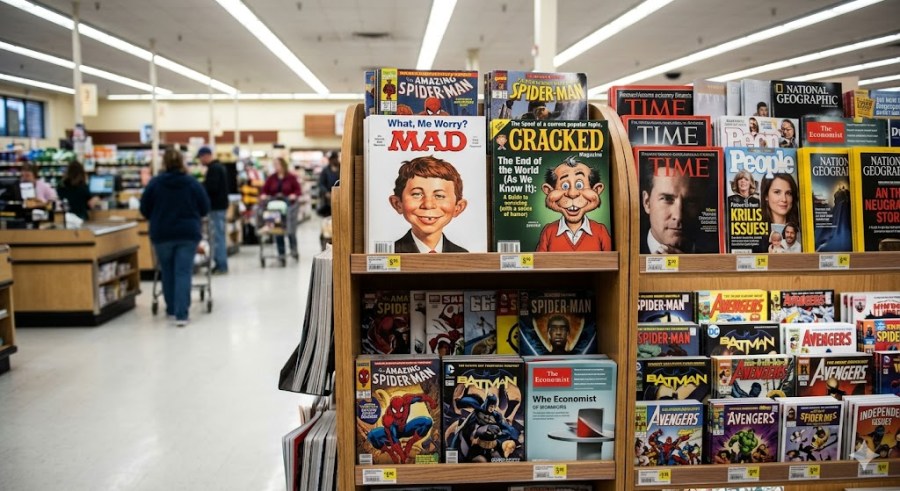
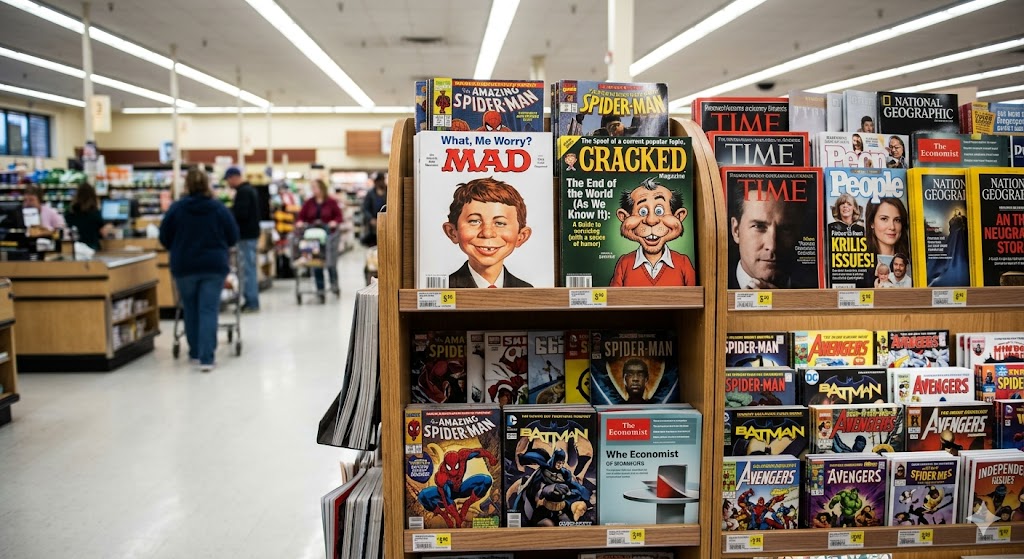
The mid-twentieth century witnessed a profound shift in American media as a countercultural undercurrent began to challenge the pristine, conformist facade of the post-WWII era. At the vanguard of this cultural shift were satirical comics and magazines, most notably MAD and Cracked. While often dismissed by contemporary critics as mere juvenile distractions, these publications functioned as critical lenses through which young Americans decoded the burgeoning landscapes of mass advertising, political duplicity, and societal anxiety. This paper explores the parallel trajectories, distinct creative philosophies, and enduring cultural legacies of MAD and Cracked, analyzing how their corporate rivalry shaped the evolution of American satire.
1. The Genesis of the Satirical Magazine
The Birth and Transformation of MAD
MAD was launched in October 1952 by EC Comics under the editorial vision of Harvey Kurtzman and publisher William Gaines. Originally formatted as a standard comic book titled Tales Calculated to Drive You MAD, the publication specialized in parodying popular comic genres, radio shows, and American consumer culture.
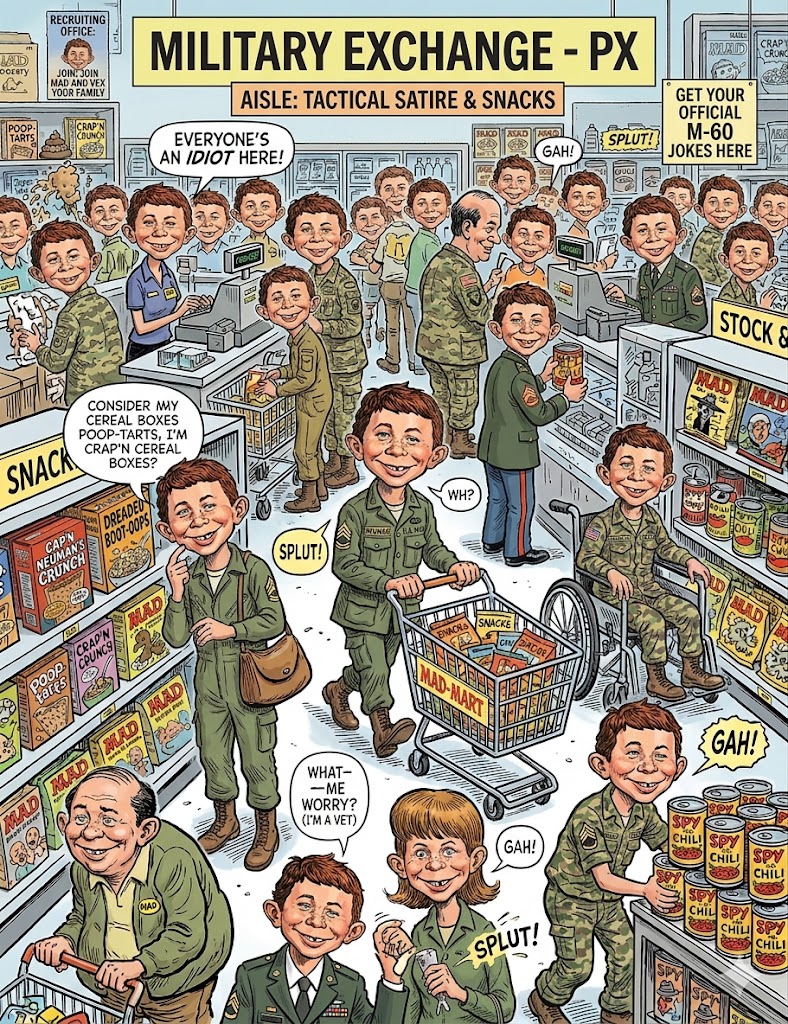
The pivotal moment in MAD’s history occurred in 1955 with Issue #24. To bypass the draconian censorship of the newly formed Comics Code Authority (CCA)—which sought to sanitize the comic industry—Gaines reclassified MAD as a “magazine.” This structural shift liberated the publication from industry self-censorship and allowed it to target a more sophisticated, collegiate, and adult audience. It also introduced Alfred E. Neuman, the grinning, gap-toothed mascot whose carefree mantra, “What, me worry?”, became an ironic symbol of Cold War-era skepticism.
The Emergence of Cracked
Recognizing the massive financial and cultural success of MAD, rival publishers rushed to replicate the formula. Among the legion of imitators—such as Panic, Get Lost, and Sick—only Cracked achieved sustained longevity. Launched in March 1958 by Major Magazines and spearheaded by editor Sol Brodsky, Cracked was unashamedly patterned after MAD.
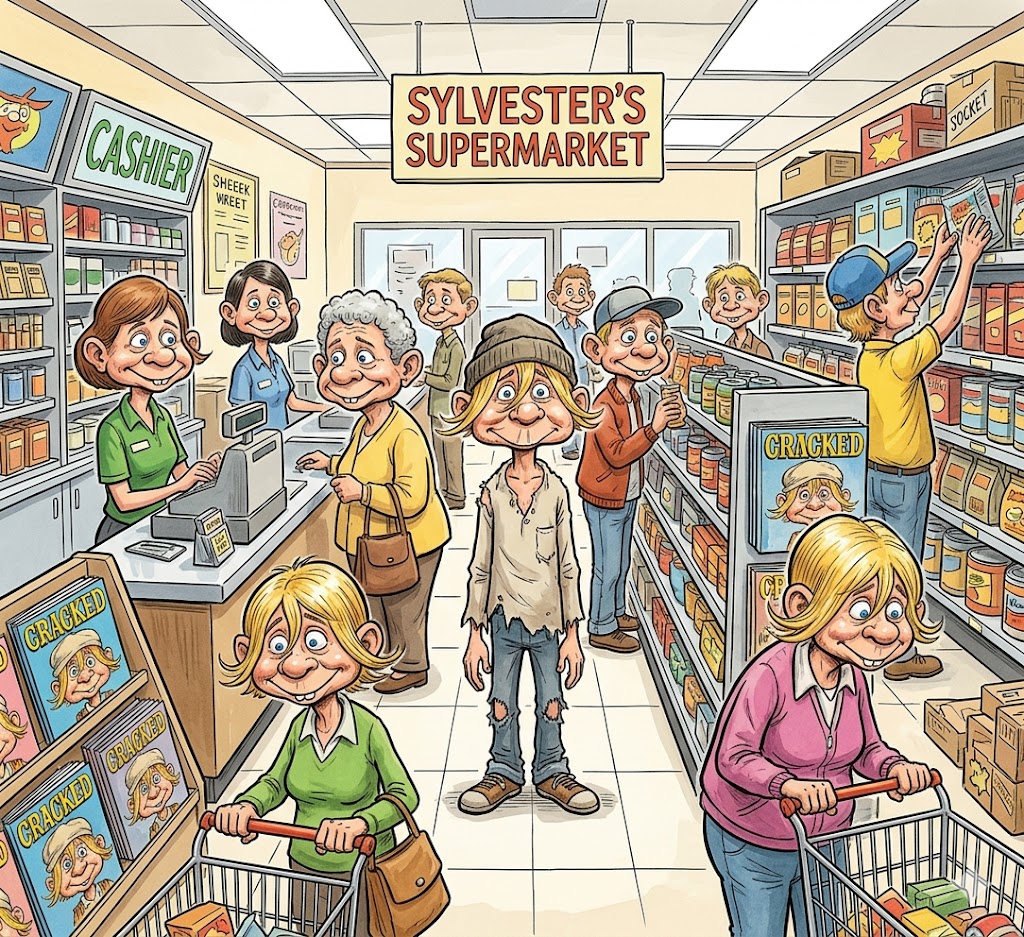
To compete with Alfred E. Neuman, Cracked introduced Sylvester P. Smythe, a dim-witted janitor character who served as the magazine’s mascot. Despite its origins as an imitation, Cracked carved out its own market share by focusing heavily on television and film parodies, visual slapstick, and a slightly more blue-collar, accessible comedic sensibility.
2. Editorial Philosophies and Creative Rivalry
The competition between MAD and Cracked defined the satirical landscape for nearly half a century. While MAD was widely regarded as the premium, intellectual standard-bearer, Cracked maintained a gritty, highly productive alternative presence.
MAD’s “Usual Gang of Idiots”
Under the long-term editorship of Al Feldstein (who succeeded Kurtzman in 1956), MAD assembled a legendary stable of artists and writers known affectionately as “The Usual Gang of Idiots.” This collective included:
- Don Martin: Celebrated for his bizarre, exaggerated anatomy and unique onomatopoeic sound effects (e.g., GLUG-GLUG, SPLAT).
- Mort Drucker: The definitive caricature artist whose movie and television parodies set the industry standard for likeness and cinematic storytelling.
- Sergio Aragonés: The master of the “marginal” comic—silent, pantomime gags drawn in the literal margins of the pages.
- Al Jaffee: Creator of the iconic “Fold-In,” a satirical, interactive back-cover feature that subverted traditional magazine formats.
MAD’s editorial policy was famously anti-commercial; the magazine refused to accept outside corporate advertising for decades (until 2001), ensuring that its critiques of Madison Avenue and consumerism remained entirely untainted by corporate influence.
Cracked’s Resilience and Unique Voice
Though frequently derided as the “poor man’s MAD,” Cracked boasted immense creative talent of its own. Central to the visual identity of Cracked was John Severin, a veteran EC Comics artist whose meticulous cross-hatching and highly detailed draftsmanship gave the magazine a distinct aesthetic edge over standard comic art.
Cracked also benefited from the contributions of cartoonists like Jack Davis and Will Elder (both of whom had worked on the early comic version of MAD), as well as Don Orehek and Dan Clowes early in their careers. Because Cracked accepted commercial advertising and operated on lower production budgets, it was often more agile in its publication schedule and distribution, capturing readers when MAD was sold out on newsstands.
3. Cultural Impact and Political Subversion
Both magazines functioned as essential counter-educational texts for baby boomers and subsequent generations, teaching children to question authority and see through the manipulation of politicians and media conglomerates.
       [ Cold War Conformity / Corporate Advertising ]
                            │
              ┌─────────────┴─────────────┐
              ▼                           ▼
       [ MAD Magazine ]           [ CRACKED Magazine ]
    • Anti-commercial stance   • Heavy pop-culture focus
    • High-intellect parody    • Accessible slapstick
              │                           │
              └─────────────┬─────────────┘
                            ▼
     [ Legacy: The Deconstruction of American Media ]
Deconstructing the Cold War and Consumerism
MAD tackled the absurdities of the Cold War directly. The wordless comic Spy vs. Spy, created by Cuban expatriate Antonio Prohías, served as a brilliant, ongoing allegory for the futility of the nuclear arms race, wherein two identical spies engaged in endless, mutually assured destruction. Similarly, MAD dissected political campaigns, exposing the calculated marketing strategies used by political figures long before mainstream media routinely analyzed political optics.
Cracked mirrored this skepticism, targeting the omnipresent nature of television culture. By relentlessly parodying the domestic sitcoms and procedural dramas of the 1960s and 70s, Cracked pulled back the curtain on the artificiality of suburban American life.
4. The Digital Age and Corporate Dissolution
The twilight of the print magazine industry at the turn of the twenty-first century forced both publications into radical transformations, leading to wildly divergent outcomes.
The Death and Rebirth of Cracked
By the late 1990s, print sales for Cracked plummeted. Following a series of ownership changes, the print magazine folded in 2006. However, the brand underwent a revolutionary digital rebirth. Acquired by Demand Media, Cracked.com was relaunched under the editorial direction of Jack O’Brien.
Shifting from illustrated parodies to long-form, comedic, information-rich listicles and video series, the digital iteration of Cracked became a juggernaut of internet culture in the late 2000s and early 2010s, proving that its brand of analytical, pop-culture-infused humor could thrive in a hyperlinked environment.
The Slow Fade of MAD
MAD resisted the digital pivot longer, relying on its legacy print model. In 1995, DC Comics (a subsidiary of Time Warner) acquired full control of the magazine. Facing declining circulation, MAD began accepting color printing and corporate advertising in 2001, breaking a 44-year tradition.
In 2018, DC relocated MAD’s editorial offices from New York City to Burbank, California, relaunching the magazine with a brief creative refresh. However, in 2019, DC announced that MAD would cease publication of new material for newsstands, limiting its distribution primarily to the subscription and comic shop markets via reprinted archival content packaged with new covers.
5. Conclusion
MAD and Cracked were far more than humor magazines; they were cultural institutions that democratized cynicism and structured the comedic sensibilities of modern media. Without the template established by Gaines, Kurtzman, and Feldstein, and kept agile by competitors like Major Magazines, the landscape of contemporary American satire—from The Onion and Saturday Night Live to The Daily Show and modern internet meme culture—would be unrecognizable. They taught generations of citizens that the structures of power and media were not sacrosanct, but rather ripe for parody, proving that laughter is often the most potent weapon against institutional absurdity.
References
- Gaines, W. M. (1972). The MAD Morality: Or, The Ten Commandments Revisited. New York: Warner Books.
- Kurtzman, H. (1991). From Aargh! to Zap!: A Visual History of the Comics. New York: Prentice Hall Press.
- Reidelbach, M. (1991). Completely MAD: A History of the Comic Book and Magazine. New York: Little, Brown and Company.
- Severin, J., & Brodsky, S. (2001). The Cracked Historian: Decades of Imitation and Innovation. Comic Book Marketplace, 2(84), 45-52.
- Lopes, P. (2009). Demanding Respect: The Evolution of the American Comic Book. Philadelphia: Temple University Press.
- Hajdu, D. (2008). The Ten-Cent Plague: The Great Comic Book Scare and How It Changed America. New York: Farrar, Straus and Giroux.
- Feldstein, A. (2013). The MAD Companion: Letters and Editorials from the Golden Age. Seattle: Fantagraphics Books.
- O’Brien, J. (2012). You Might Be a Zombie and Other Bad News: A Cracked.com Anthology. New York: Plume.
- Spiegelman, A. (2006). Abstract Thought Is a Warm Puppy: The Legacy of Harvey Kurtzman. The New Yorker, 82(41), 112-118.
- Gabilliet, J. P. (2010). Of Comics and Men: A Cultural History of American Comic Books. Jackson: University Press of Mississippi.
 thelivingbreathingjamesbrown.com
You must be logged in to post a comment.