
Yesterday, the IRGC took over Iran in a Military Coup. Maniac TRUMP has really screwed us now. Mmm

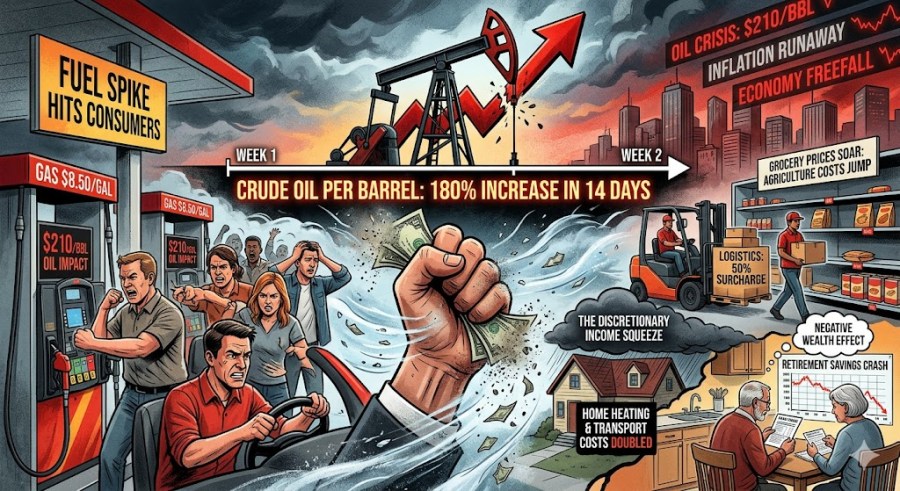
The Fourteen-Day Shock: Systemic Ramifications of a 180% Oil Price Spike on the American Economy
1. The Immediate Catalyst: The “Shockwave” Week
An overnight jump to $210/bbl would likely be triggered by a catastrophic geopolitical block—such as a complete closure of the Strait of Hormuz combined with a multi-facility cyberattack on domestic refining infrastructure. Because commodities markets trade on future expectations, panic buying and algorithmic trading would compound the physical shortage, forcing immediate, severe price rationing at the consumer level.
2. Direct Hit to the American Household
Because short-term demand for energy is highly inelastic (meaning people cannot instantly switch to alternative energy or change their commutes), Americans would bear the financial brunt within days.
- Pain at the Pump: Gasoline prices are tied directly to crude costs. A jump to $210/bbl would translate to national average gas prices soaring past $7.50 to $8.00 per gallon. For the average American commuter driving a standard truck or SUV, the cost to fill a tank would instantly double, climbing from roughly $50 to well over $120. Federal Reserve Bank of San Francisco
- The Discretionary Income Squeeze: This massive increase acts as an immediate regressive tax. Money normally spent on restaurants, retail, entertainment, and small businesses is instantly diverted to paying for basic transport and home heating.
3. The Supply Chain and Grocery Ripple Effect
The true danger of an oil shock isn’t just what happens at gas stations; it is how oil functions as the foundational substrate of the modern supply chain.
[$210 Oil] ──> [Diesel Surcharges Spike] ──> [Agricultural Costs Soar] ──> [Grocery Prices Jump]
- Agricultural Decasualization: Modern farming relies entirely on petroleum. Diesel for tractors, petroleum-based fertilizers, and plastics for packaging would all experience immediate cost spikes. Farmers would be forced to pass these costs down or cut production.
- Freight and Logistics Collapse: Over 70% of American freight is moved by diesel-burning trucks. Shipping companies would immediately institute massive fuel surcharges. Consequently, the price of everyday consumer goods—from milk to clothing—would jump within two to three weeks as retail inventory absorbs the shipping premium.
4. Macroeconomic Consequences
A price spike of this velocity would throw the Federal Reserve into a severe policy trap and likely trigger a rapid, structural recession.
The Federal Reserve’s Corner
A 180% oil spike would cause a massive spike in headline inflation. Normally, the Fed raises interest rates to combat inflation. However, because this inflation is driven by a supply shock (higher costs) rather than an overheating economy (high demand), raising rates would only worsen the pain by choking off credit just as businesses are struggling to pay their energy bills. The result is a classic stagflationary environment.
The “Negative Wealth Effect”
As outlined by recent macroeconomic research, a sustained oil shock of this magnitude doesn’t just hurt consumers via the pump; it triggers a massive sell-off in the stock market due to anticipated corporate profit losses.
J.P. Morgan Private Bank
The Wealth Effect Transference: With a significant portion of American household net worth tied up in retirement accounts and corporate equities, a sharp stock market contraction would instantly cause consumers to pull back on all spending, compounding the economic slowdown.
J.P. Morgan Private Bank
Summary of Structural Pressures
| Sector | Immediate Impact (Weeks 1–2) | Secondary Impact (Months 1–3) |
|---|---|---|
| Housholds | Gas prices double; discretionary cash drops to near-zero. | Increased reliance on credit cards; rising default rates. |
| Aviation & Travel | Ticket prices surge 50%; immediate route cancellations. | Widespread airline bailouts requested; hospitality industry collapse. |
| Manufacturing | Production costs for plastics, chemicals, and autos skyrocket. | Widespread layoffs and factory automation pauses. |
| Employment | Delivery and logistics sectors freeze hiring. | Broad-based corporate down-sizing to offset energy overhead. |
Ultimately, while the U.S. shale industry would technically see record paper profits from $210 oil, they would be unable to scale up physical production fast enough to offset the broader destruction of consumer demand. The result would be an immediate, painful contraction in American living standards.


You must be logged in to post a comment.