
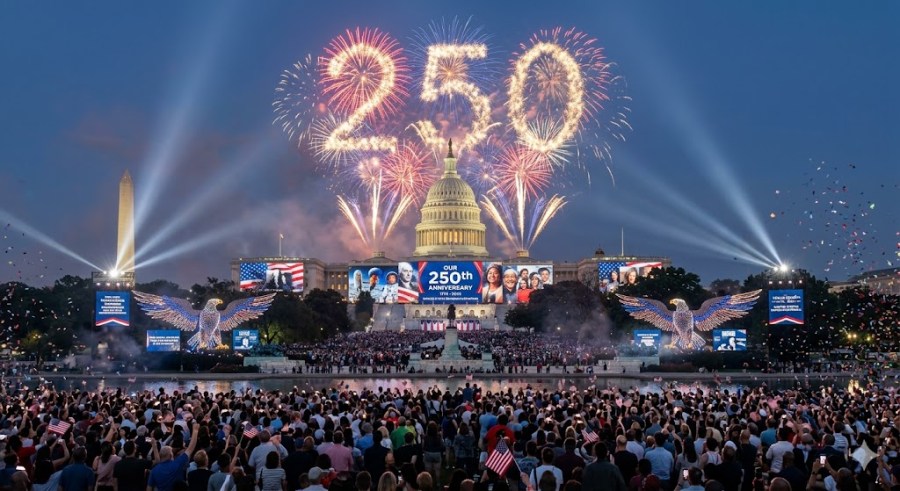
The Crucible of Two Hundred and Fifty Years: An American Reflection
As July 2026 approaches, the United States stands on the precipice of its Semiquincentennial—250 years since a group of audacious, flawed visionaries signed a document declaring that all men are created equal. To look upon this milestone is to look into a mirror cracked by trauma, yet framed in gold.
America is not a simple story. It is a grand, sweeping, sometimes terrifying epic.
The Blood and the Breath: What It Cost
We cannot celebrate the beauty of the American project without first counting the ghosts who wander its foundations. The sheer scale of American loss—both from the defense of our ideals and the visitations of nature—is staggering.
The Cost of Freedom and Conflict
In the fields of Yorktown, the orchards of Gettysburg, the trenches of Europe, and the sands of the Middle East, liberty demanded a physical toll. More than 1.1 million American service members have laid down their lives in the nation’s wars. Over 646,000 perished directly in the crucible of battle, while hundreds of thousands more were taken by wounds and disease in theater.
Military.com
Yet, before the Republic was even born, the cost of the land itself was paid in an indigenous apocalypse. Historical estimates suggest that through a combination of brutal warfare, forced displacement, and imported pathogens to which they had no immunity, up to 90% to 95% of the Native American population—millions of souls—were wiped out following the European arrival. Their loss is the silent backdrop against which our cities stand.
Wikipedia
The Invisible Enemies
America’s strength has been tested not just by iron, but by pestilence. Generations have been brought to their knees by pandemics that reshaped our communities:
PMC – NIH
- The 1918 Influenza Pandemic: Tearing through a nation already weary from World War I, the “Spanish Flu” claimed an estimated 675,000 American lives in a matter of months. Pan American Health Organization
- The Polio Epidemics: For decades in the early-to-mid 20th century, polio terrorized American families, paralyzing tens of thousands of children annually until Jonas Salk’s vaccine broke its grip in 1955.
- The COVID-19 Pandemic: A century after the Great Flu, a new virus breached our shores, claiming over 1.2 million American lives and leaving an indelible scar on our modern psyche. Wikipedia
The Scars of Injustice
A reflection paper must confront the moments when America turned its power inward, against its own. The path to 250 years is stained by racial violence where Black and Hispanic Americans were hunted, targeted, and killed simply for existing within the borders of the Republic.
From the horrors of chattel slavery to the post-Reconstruction era, thousands of Black Americans were victims of extrajudicial lynchings—terror tactics designed to enforce subjugation. Entire prosperous communities, like the Greenwood district during the 1921 Tulsa Race Massacre, were burned to ash, leaving hundreds dead.
Similarly, Hispanic Americans faced systemic violence and displacement. Events like the “Hora de Sangre” (Hour of Blood) in Texas during the 1910s saw the extrajudicial slaughter of hundreds, if not thousands, of Mexican-Americans and Mexicans by law enforcement and vigilantes.
The Paradox of Majesty: A New Roman Empire
Where does this leave us at 250? It leaves us in possession of the most magnificent, powerful paradox in human history.
There is an undeniable, breathtaking beauty to being an American. In many ways, the modern United States echoes the grandeur of Rome—what can be seen as a New Roman Empire. Like Rome, America built roads that span a continent, created an economic engine that dictates the global tide, and projected a military shield that shapes the geopolitics of the entire earth. We possess that same classical majesty: a sprawling, diverse republic transformed into a global superpower, absorbing cultures, exporting ideals, and commanding the horizon.
But the true beauty of the American “Empire” isn’t its legions or its capital; it is the fact that our founding document gives us the tools to fix our own tyranny. Rome collapsed under the weight of its internal rot and rigid hierarchies. America, however, was designed with a self-correcting mechanism. We are an empire of citizens, not subjects.
The Generational Ledger: Rights, Wrongs, and the Debt
To sustain this New Roman Empire for another 250 years, we must audit what the generations before us achieved, where they failed, and how we fix the crushing weight threatening our future.
What the Generations Got Right
Previous generations mastered the art of the pivot. They built the arsenal of democracy to defeat global fascism. They engineered the civil rights movement to force the nation to read its own founding ledger. They pioneered the digital age, mapping the human genome and sending voyagers into the cosmos. They proved that a free people, left to innovate, can elevate the human condition worldwide.
What the Generations Got Wrong
They deferred the bill. They kicked the can down the road, treating the future as an infinite line of credit. They allowed political polarization to weaponize our differences, turning institutional checks and balances into gridlock. Most critically, they prioritized short-term consensus over long-term fiscal sanity, leaving us with a mountain of national debt.
Escaping the Shadow of the $34+ Trillion Debt
Our massive national debt is the modern barbarian at the gate. It threatens to devalue the dollar, stifle innovation, and collapse the empire from within. To get out of this crisis, we must apply a dual strategy of fiscal discipline and aggressive expansion:
- Entitlement and Budgetary Reform: We must structurally reform entitlement programs to ensure their longevity while eliminating systemic government waste. This requires bipartisan political courage to cap spending and tie budget increases strictly to economic growth.
- A Blueprint for Pro-Growth Economics: We cannot simply spend less; we must earn more. By deregulating critical industries, reclaiming manufacturing independence, and incentivizing domestic energy and technological production, we can supercharge GDP growth.
- Widening the Tax Base Through Prosperity: When the domestic economy booms, tax revenues increase naturally without raising rates to stifling levels. A thriving workforce operating in a high-growth environment is the ultimate engine for debt reduction.
Conclusion
At 250 years old, America is weary, scarred, and heavily burdened. Yet, her light is undimmed. We are the inheritors of a tragic, beautiful, and monumental legacy. If we can summon the courage of our ancestors to face our fiscal realities, and the wisdom of our founders to protect our liberties, this New Roman Empire will not fall. It will endure, a beacon of human achievement, for centuries to come.

