
This article details a major escalation in the Middle East, specifically highlighting how geopolitics, shipping security, and global energy markets collide in a single, narrow chokepoint.
Here is a breakdown of the core issues, the strategic geography at play, and the immediate global impacts from today’s developments.
1. The Core Geopolitical Dispute
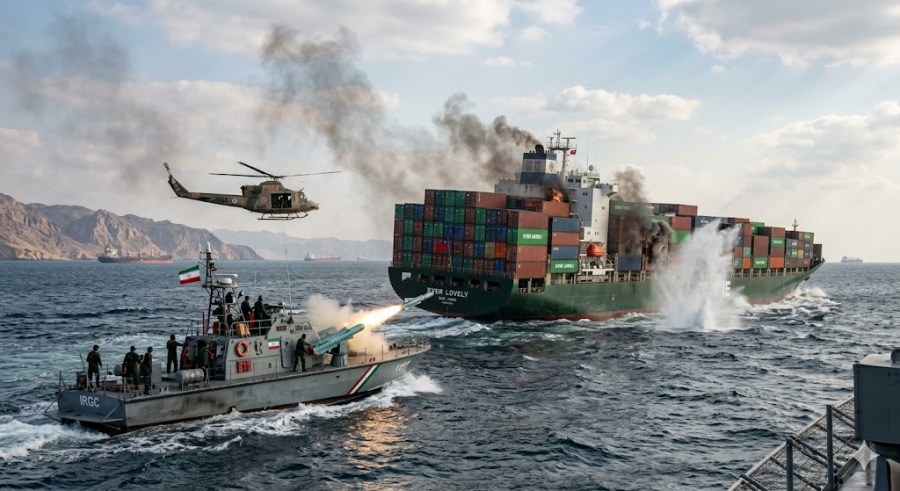
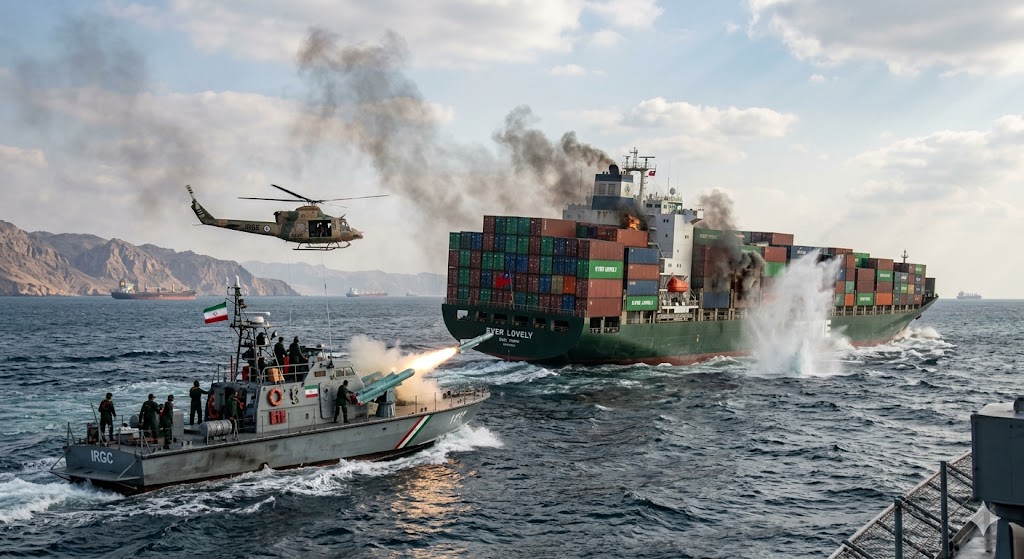
The strike on the Taiwanese-owned container ship Ever Lovely highlights a fundamental disagreement over who controls the Strait of Hormuz:
- The Iranian Position: Tehran wants complete jurisdictional control over the maritime traffic passing through the strait. The Islamic Revolutionary Guards Corps (IRGC) insists that all vessels must coordinate directly with its navy. Iran is using these threats to force the international community to accept a “navigational order” on its own terms. This is a World Domination Declaration by Iran. In other words, An Iranian Declaration of WAR on the World!
- The U.S. & International Position: Represented by Secretary of State Marco Rubio’s statements in Bahrain, the U.S. maintains that the strait is an international waterway belonging to no single nation state. The U.S. military has been actively assisting ships by routing them away from Iran and closer to the coast of Oman.
2. The Tactical Flashpoint: The “Omani Route”
To understand why this specific strike happened, it helps to look at the geography of the chokepoint.
The Strait of Hormuz: A highly contested maritime bottleneck.. Source: Mapcreator
As shown in the map, the Strait of Hormuz narrows to less than 21 miles wide. Because the international shipping channels pass directly through the territorial waters of Iran and Oman, routing choices are highly politicized:
- The Alternative Path: To avoid Iranian harassment during the recent U.S.-Israeli war on Iran, hundreds of stranded commercial vessels began utilizing a southern route that hugs the coast of Oman.
- The Catalyst for the Strike: This alternative route angered Tehran because it bypassed their oversight and undermined their leverage. The Ever Lovely was targeted just 7.5 nautical miles off the coast of Oman, sending a direct signal that Iran will not tolerate ships using Omani waters to evade their authority.
3. The Immediate Global Fallout
The drone strike has abruptly halted what was supposed to be a major resurgence in global trade following last week’s framework peace agreement.
| Affected Sector | Immediate Impact |
|---|---|
| Energy Markets | Oil prices spiked over 2% immediately following the attack. Brent crude jumped to around $75 a barrel, while West Texas Intermediate (WTI) rose to roughly $72 a barrel. |
| Humanitarian & Shipping Operations | The International Maritime Organization (IMO) completely suspended its plans to safely evacuate crew members from the hundreds of commercial ships left stranded in the Persian Gulf during the war. |
| Diplomatic Fallout | The attack directly undermines President Trump’s previous public assurances that the waterway was open. It also forces Secretary of State Rubio to address intense security anxieties from Gulf Cooperation Council (GCC) allies like Bahrain, Kuwait, and the UAE, whose concerns over Iran’s drone and missile programs were left unaddressed by the initial peace framework. |
The Underlying Tension: While a fragile, two-month window was opened last week to allow stranded oil tankers to exit the Gulf, the lack of clarity regarding how the strait will actually be managed means shipping companies are operating under extreme risk.
The timing is incredibly fraught. Just two days ago, on June 23, the Senate joined the House in passing a concurrent War Powers Resolution directing the administration to halt unauthorized military hostilities against Iran.
Because it is a concurrent resolution, it bypasses the President’s desk entirely. While its legal enforceability will be tied up in constitutional debates for months, the immediate political and strategic optics could not be worse given today’s drone strike on the Ever Lovely.
The clash between Congress’s move and today’s reality creates a dangerous dynamic on three fronts:
1. Perceived American Division
In any military or diplomatic standoff, clarity is leverage. President Trump blasted the congressional vote on Truth Social, complaining that lawmakers just made his job harder, while Iranian officials are reportedly asking U.S. negotiators what the domestic political fracturing actually means for American resolve. By passing this resolution right as a fragile framework peace deal is being hammered out, Congress has inadvertently signaled to Tehran that the U.S. Executive branch does not have unified domestic backing for continued military action.
2. Emboldening the IRGC
The Iranian Islamic Revolutionary Guard Corps (IRGC) Navy clearly calculated that they could push the envelope without triggering a massive, sustained U.S. kinetic response. Hours after warning commercial shipping to stay out of the southern “Omani route,” they struck a Taiwanese container ship. The timing of the War Powers vote likely reinforced their belief that Washington’s appetite for an extended conflict is entirely exhausted, giving them the confidence to aggressively reassert their dominance over the Strait of Hormuz.
3. Secretary Rubio’s Impossible Position
Secretary of State Marco Rubio is currently in Bahrain trying to reassure Gulf Cooperation Council (GCC) allies that the United States has their back and will protect regional stability. It is a tough sell. He is trying to convince nervous partners—who are highly vulnerable to Iranian missile and drone strikes—that America remains a reliable security guarantor, even as the U.S. legislature explicitly votes to pull the plug on unauthorized military operations in the region.
With oil prices spiking past $75 a barrel and the International Maritime Organization suspending its evacuation of stranded crews, this legislative rebuke has completely tangled the lines of communication right when the White House is trying to project absolute deterrence.
The Guardian


You must be logged in to post a comment.