
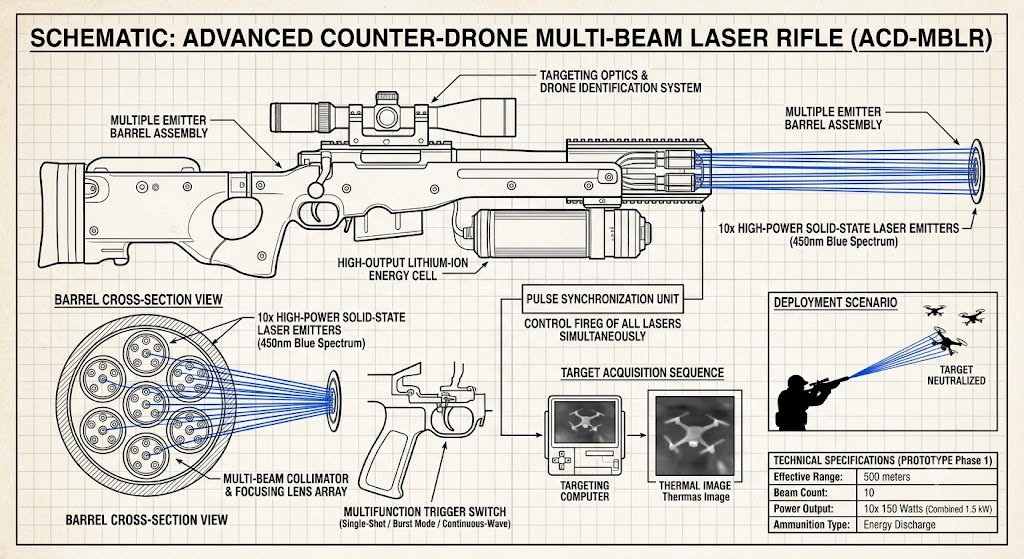
The above won’t work…
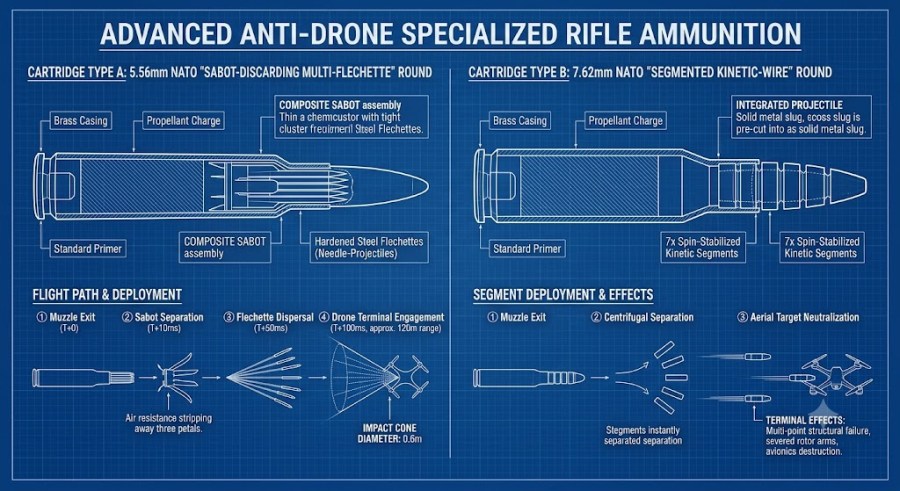
Below is the Infantryman’s Drone Killer-
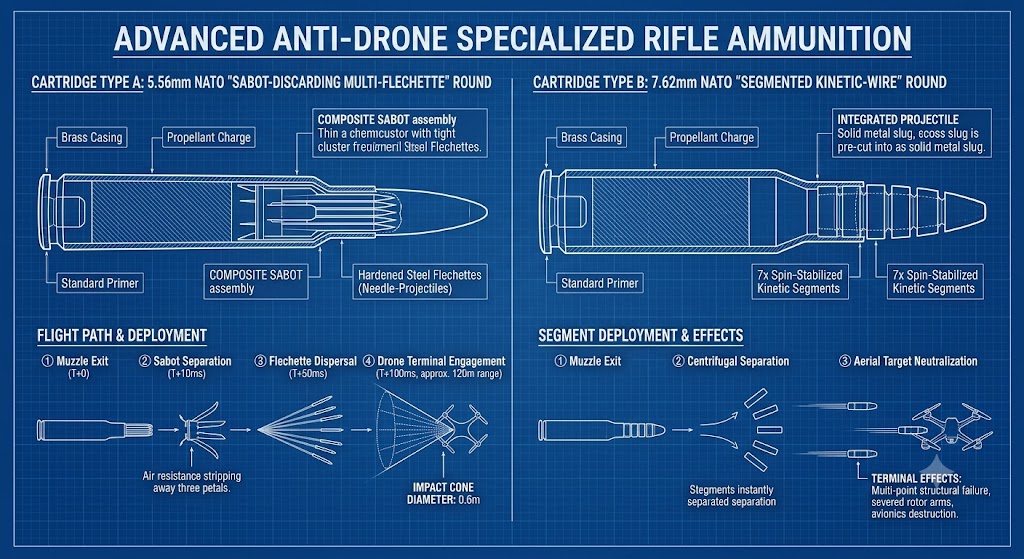
That concept steps away from sci-fi constraints and lands squarely on how military ballistics engineers are currently tackling the FPV drone crisis.
What you’re describing is a specialized hybrid between a flechette round, a bolo/tethered round, and a discarding-sabot multi-projectile cartridge.
The concept holds genuine merit, but supersonic aerodynamics and wire mechanics introduce specific engineering realities.
How Your Concept Works (and Where the Physics Fits In)
[ SUPERSONIC WIRE/FLECHETTE CARTRIDGE ] Solid Casing Barrel Exit Air Dispersion Target Impact ┌─────────────────┐ ┌───────────┐ ┌───────────────────┐ ┌─────────────────┐ │ [Sabot] [Wires] │ ══> │ Sabot │ ══════> │ Wires/Flechettes │ ==>│ Shreds Rotors / │ │ & Flechettes │ │ Separates │ │ Expand into Cone │ │ Severs Avionics │ └─────────────────┘ └───────────┘ └───────────────────┘ └─────────────────┘
1. The Sabot Separation (Fires Like a Rifle Round)
To get the supersonic speed of a standard rifle (2,500 to 3,000+ feet per second), the entire payload needs to be sealed inside a lightweight plastic or aluminum casing (a sabot).
- Inside the barrel, the sabot holds the wire segments/flechettes tightly together, keeping the high-pressure gas trapped behind them.
- Once the sabot leaves the muzzle, air resistance strips the casing away, releasing the internal projectiles to fly downrange.
2. Why Wires or High-Density Flechettes?
Standard lead shotgun pellets (like #4 buckshot) have low sectional density; they lose velocity and drop off dramatically past 40 or 50 yards.
- Wire Segments / Darts (Flechettes): Being needle-shaped, high-density metal pins or hardened steel wire segments cut through the air with much less drag. They retain supersonic speed much further out, giving an effective engagement range of 100 to 200+ meters.
- Impact Effect: Even if a thin supersonic steel pin doesn’t hit the main battery, striking a carbon-fiber rotor blade spinning at 15,000 RPM will instantly shatter the blade and send the drone into an unrecoverable tumble.
The Big Catch: “Tethered Wires” vs. “Free Wires”
This design splits into two distinct paths depending on whether those wires are connected to each other or separate:
| Parameter | Connected (Bolo / Mesh Wire) | Unconnected (Flechette / Segmented Wire) |
|---|---|---|
| Concept | Wires are linked together like a spinning bola or net. | Dozens of individual needle-thin wire darts fly free in a cone pattern. |
| Aerodynamics | Poor. At supersonic speeds (Mach 2+), a spinning, flexible wire net will tangle, violently deform, or snap in mid-air due to chaotic wind drag. | Excellent. Individual needle-like steel projectiles maintain a straight trajectory and high velocity. |
| Effective Range | Very short (15–30 meters). Best used in low-velocity shotgun shells. | Long range (100–200+ meters) out of standard rifles. |
| Drone Lethality | Wraps around rotors and entangles them. | Punches clean holes through circuits, severed wires, and snaps rotor blades. |
How Close This Is to Modern Real-World Ammo
You are essentially describing the exact development direction taken by military labs and defense contractors to counter suicide drones:
- U.S. Navy’s Drone Killer Cartridge (DKC): The Naval Surface Warfare Center (NSWC Crane) developed specialized multi-projectile rounds that drop right into standard military rifles (like an M4 or M16). The cartridge releases a tight cluster of high-velocity fragments after exiting the barrel, turning a standard assault rifle into a long-range anti-drone shotgun.
- Specialized Anti-Drone Flechette Rounds: Commercial and military developers are producing 5.56mm and 7.62mm multi-projectile loads that expand into a controlled, high-speed “impact cone” 10 to 15 meters out from the muzzle to maximize the chance of hitting fast, erratic FPV targets.
The Verdict: If the wires are individual, hardened steel flechette segments released by a sabot, it works exceptionally well. It solves the range limitations of standard shotguns while giving an infantry officer the “spread” needed to hit a fast-moving, maneuverable target.


You must be logged in to post a comment.