
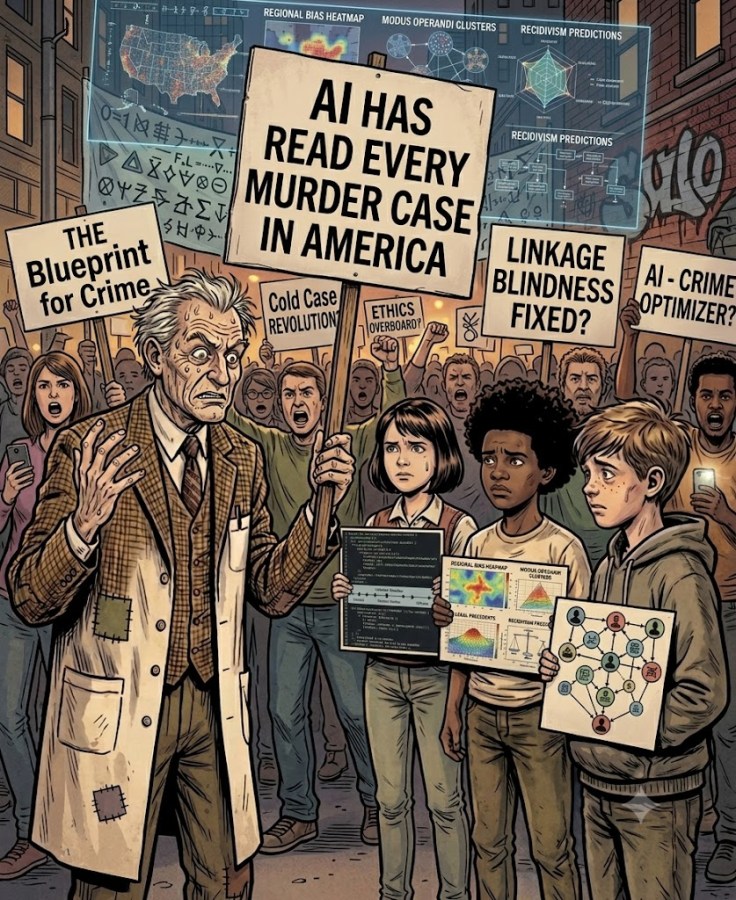
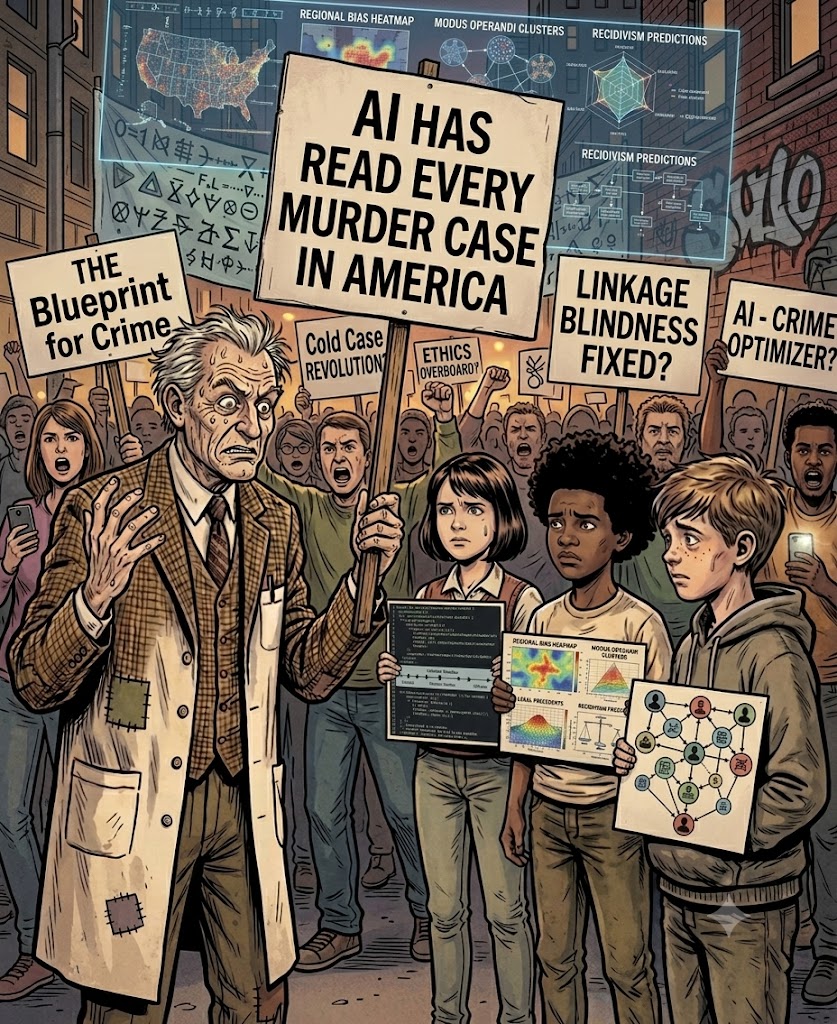
AI has now read every murder case in America. How will that influence AI?
If an AI were trained on every single recorded murder case in American history—including police reports, forensic evidence, court transcripts, witness testimonies, and judicial opinions—it would fundamentally alter how the technology operates across several key fields:
1. Predictive Policing and Behavioral Profiling
- Pattern Recognition at Scale: The AI would detect hyper-specific, micro-level correlations across decades of unsolved cases—linking cold cases based on subtle operational footprints (modi operandi), geographic corridors, or forensic anomalies that human investigators missed.
- Risk Assessment & Recidivism: In judicial systems, AI models used for bail, sentencing, or parole recommendations would shift dramatically. However, it would also inherit and potentially amplify systemic historical biases, regional reporting discrepancies, and flawed historical forensic methods (like discredited bite-mark or hair-fiber analysis).
2. Overhaul of Legal Strategy and Criminal Defense
- Predictive Precedent: Defense attorneys and prosecutors could query the AI to predict how specific judges or juries might respond to particular lines of evidence, witness credibility profiles, or jury selection strategies based on thousands of historical precedents.
- Flaw Detection in Prosecutions: The system would instantly flag inconsistencies in police reports, chain-of-custody gaps, or procedural errors by comparing current case files against every documented wrongful conviction or overturned verdict in U.S. history.
3. Forensic Science and Cold Case Resolution
- Advanced Reconstructive Logic: By ingesting millions of autopsy reports, ballistics tests, and crime scene photographs, the model could simulate multi-variable crime scene reconstructions, testing physical hypotheses (bullet trajectories, blood spatter dynamics, timelines) with unmatched statistical precision.
- Serial Offender Tracking: It would map spatial-temporal patterns across state lines, effectively eliminating the historical problem of “linkage blindness” (where local law enforcement agencies fail to realize they are dealing with the same perpetrator).
4. Ethical, Psychological, and Safety Risks
- The “Blueprint” Problem: Ingesting every successful and failed murder attempt creates an unprecedented database of criminal logistics. Safeguarding the model would become critical to prevent malicious actors from using it to optimize evade-and-escape tactics or forensic counter-measures.
- Desensitization and Narrative Bias: An AI model trained predominantly on violent crime records would develop a heavily distorted worldview, over-indexing on human hostility, deception, and conflict in its natural language generation unless heavily counter-balanced by other datasets.


You must be logged in to post a comment.