
This movie will Haunt you if Bigotry is in your Heart.
The Dust of Fairfield’s Grace
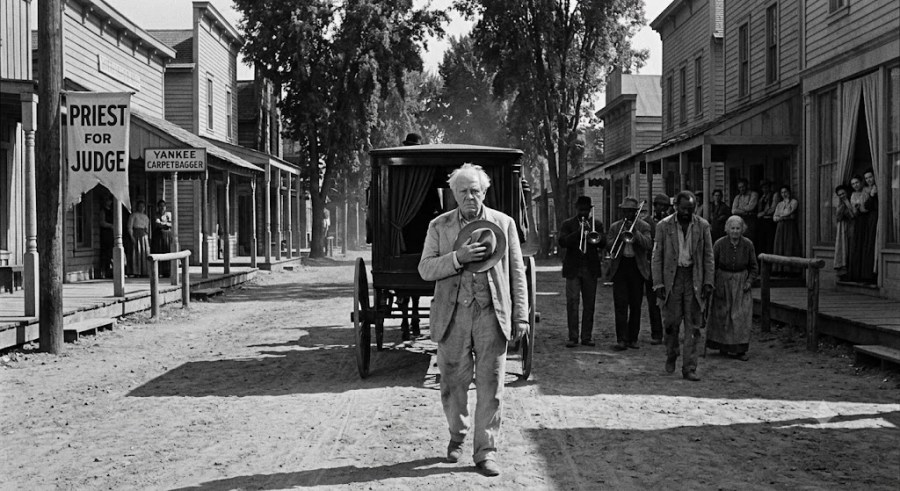
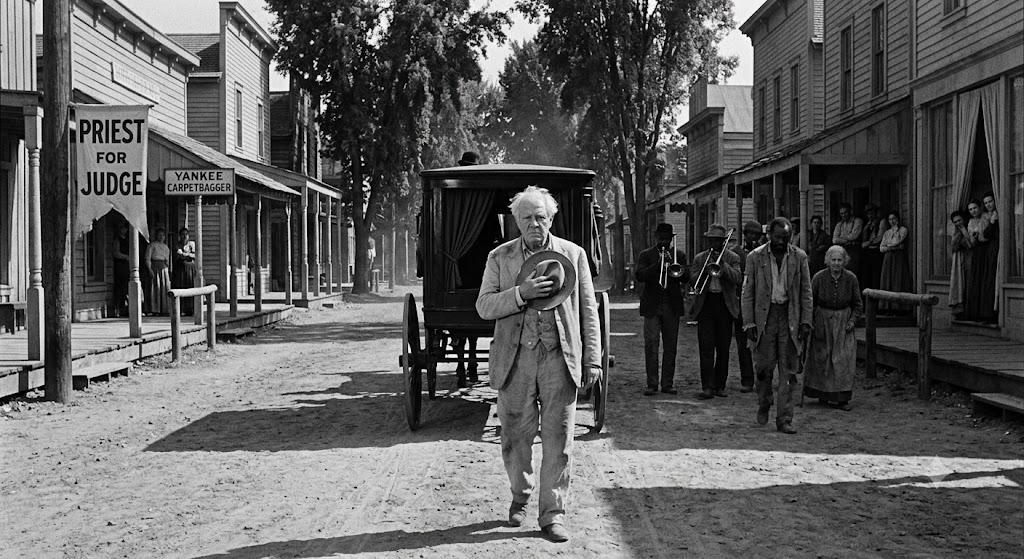
The afternoon sun hung low and heavy over Fairfield, casting long, bruised shadows across the dirt roads that standard history preferred to forget. In the quiet heat of 1905, where old wounds bled into dusty boots and political banners fluttered with cheap promises, Judge William Pittman Priest walked with the heavy, unhurried gait of a man who had already buried his own heart decades ago.
It was not the fiery heat of the re-election campaign that bowed his shoulders, nor the whispering voices along the saloon porches. It was the quiet, unbearable dignity of a lone horse-drawn carriage creeping down the avenue. Inside lay Lee Carter—a woman whom the righteous folk of Fairfield had cast out in life, branding her with the cold iron of their judgment, only to avert their eyes when death brought her home.
No bells tolled for her. No chorus stood upon the church steps to sing her back to God. The respectable doors slammed shut, one by one, shades pulled down like eyelids over a cold, unfeeling eye. A town that prided itself on Christian piety turned its back on the dead, refusing to walk behind the body of a fallen woman.
Except for the Judge.
He stepped out into the middle of the empty street, his old campaign hat held over his heart, his white hair gleaming silver beneath the relentless Kentucky light. He did not care that an election was to be won or lost in forty-eight hours. He did not care that his political rivals watched from the shadows, counting his gesture as suicide. He simply knew that no child of God ought to enter the dark alone.
Step by heavy step, Judge Priest fell into line behind the black carriage. Beside him came the outcast souls of the county—the forgotten, the broken, the Black musicians carrying their brass horns with a solemn, aching reverence, and the quiet souls who knew what it was to be despised by the world. As they marched, the quiet mournful notes of a slow-stepping dirge rose into the motionless air. It was a melody spun from pure sorrow, weeping for every lost dream, every unforgiven sin, and every quiet tragedy that haunts the human heart.
Through the heart of Fairfield the small procession moved, a slow river of grief cutting through the dry bank of hypocrisy. One by one, touched by the solemn majesty of the old Judge’s quiet courage, people began to step off the porches. The shame of their own cruelty broke against the absolute purity of his mercy. Hats were pulled off heads. Heads bowed. The silence of the town grew vast and holy, transformed from a silence of malice into a silence of profound, heartbreaking awe.
In that long walk to the lonely graveyard on the hill, Judge Priest gave Fairfield something far grander than law: he gave them back their souls. And as the final mound of earth was shaped under the dying sun, the old man stood alone beside the grave, staring out over the hills of Kentucky, carrying the quiet, beautiful burden of a love that forgives all things, bears all things, and outlasts the dark.
THE SUN RISES BRIGHT-a John Ford and Median C. Cooper Movie that will Haunt Your Soul.
The movie you are thinking of is likely The Sun Shines Bright (1953), directed by legendary filmmaker John Ford. It is a small-town comedy-drama set in Kentucky, and Ford famously considered it his personal favorite of all his films. [1, 2, 3]
(Note: If you were thinking of “The Sun Also Rises,” that is a 1957 film adaptation of the Ernest Hemingway novel, but it was directed by Henry King, not John Ford). [1]
Movie Details
- Title: The Sun Shines Bright
- Release Year: 1953
- Director: John Ford
- Starring: Charles Winninger as Judge William Pittman Priest
- Setting: Fairfield, Kentucky, around 1905 [1, 2, 3, 4]
Plot Highlights
- Re-election Campaign: Judge Priest fights to keep his position against a stiff political rival.
- Standing Down a Mob: The Judge courageously faces a lynch mob to ensure a fair trial for a young Black man.
- Community Themes: The story weaves together local humor, funeral processions, and deep social commentary on small-town life. [1, 2, 3, 4, 5]
Here is a video featuring scenes and details from the film:
Ford had adapted some of the same material in 1934 in his film Judge Priest. That film originally had a scene depicting an attempted lynching of Poindexter (and Priest’s condemnation of the act), but it was cut by 20th Century Fox. The omission was one of the reasons Ford loosely reshaped the Cobb stories two decades later as The Sun Shines Bright for Republic Pictures, this time including Judge Priest’s defusing of the mob determined to lynch a young black character named Woodford. In both films, Stepin Fetchit plays the part of Judge Priest’s assistant, Poindexter.
In later years, the film was championed by critics such as Jonathan Rosenbaum[2] and Dave Kehr, who called it “a masterpiece”.[3][4] Ford himself had often cited The Sun Shines Bright as his favorite among all his films. However Peter Bogdanovich, who knew Ford, surmised that the director’s “perverse enthronement” of it as one of his very best was largely based on its general dismissal by critics and audiences, and had little to do with the merits of the film itself.[5]
Herbert J. Yates, the head of Republic Pictures, had about ten minutes cut from the film against Ford’s wishes. According to film historian Joseph McBride, the full 100-minute version (which did play theatrically overseas) was rediscovered when Republic inadvertently used it as a master for the 1990 videotape release.[7] This full version is currently available from Olive Films as a high-definition Blu-ray release.[2]
Winninger was an accomplished Hollywood role player; but in “The Sun Shines Bright” he demonstrates that he was no simple comprimario or “co-star.” He alternately illustrates humor, wisdom, sadness, and wistfulness. It’s a superb performance. Despite the inevitable criticism that may come regarding this film not being “politically correct” (it isn’t!), Ford probes human emotions and character, irrespective of race or social status. And the old Judge Priest—“trumpeter little Billy Priest”—understands fully the reality of justice, which he metes out to all, white and black, decent people and prostitutes. Certainly he does so in a social context that some present-day viewers may find foreign to “modern” sensibilities; but, getting beyond that stifling veneer of PC thought, and enjoying “The Sun Shines Bright” on its own terms can be an immensely rewarding experience.
Ford was indeed correct; it may well be one of his best films. Co-stars include John Russell, Slim Pickens, Russell Simpson, Arleen Whelan, Milburn Stone (of later “Gunsmoke” fame), Jane Darwell, and Steppin’ Fetchit.


You must be logged in to post a comment.