
Analysis of U.S. Strategic Petroleum Reserve Dynamics: Historical Causes of Inventory Depletion and Structural Replenishment Frameworks
Executive Summary
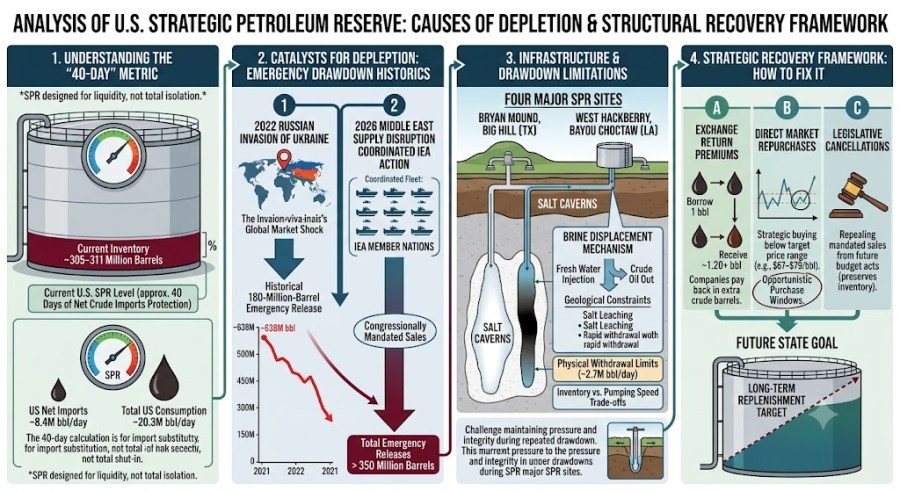
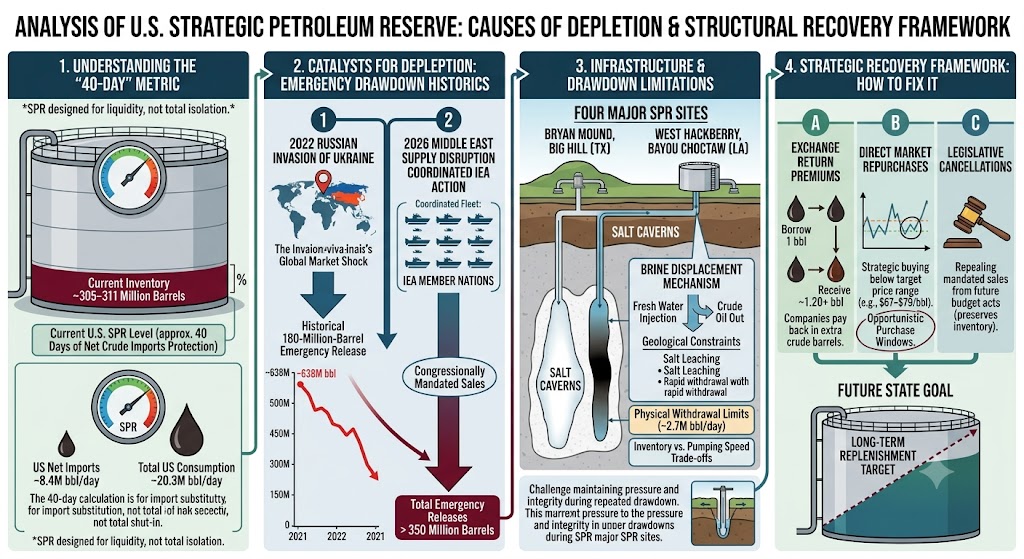
The U.S. Strategic Petroleum Reserve (SPR)—the world’s largest emergency stockpile of government-owned crude oil—stands near multi-decade lows of approximately 305 to 311 million barrels. This volume represents roughly 37 to 40 days of U.S. net crude import protection (or roughly 15 days of total gross domestic petroleum consumption).
Wikipedia
This paper examines the two primary geopolitical catalysts that drove the reserve from its peak capacity down to mid-1980s levels: the 180-million-barrel drawdown following the 2022 Russian invasion of Ukraine, and the 172-million-barrel emergency release coordinated with International Energy Agency (IEA) member nations during 2026 Middle Eastern maritime disruptions. It further analyzes the multi-pronged recovery strategy executed by the Department of Energy (DOE), utilizing exchange-premium returns, price-capped repurchases, and cavern geological maintenance.
Bipartisan Policy Center+ 1
I. Understanding the Metric: Net Import Cover vs. Gross Consumption
The “40-day reserve” metric often cited in energy security discussions refers to net import coverage under International Energy Agency guidelines, rather than total domestic shut-in capability.
┌─────────────────────────────────────────────────────────────────────────┐│ U.S. OIL INVENTORY METRICS │├───────────────────────────────────┬─────────────────────────────────────┤│ Total Authorized Capacity │ 714 Million Barrels ││ Current Inventory (Mid-2026) │ ~305 – 311 Million Barrels ││ Total Daily Domestic Consumption │ ~20.3 Million Barrels/Day ││ Daily Net Imports │ ~8.4 Million Barrels/Day │├───────────────────────────────────┼─────────────────────────────────────┤│ Net Import Protection Coverage │ ~37 – 40 Days ││ Total Consumption Cover (Isolated)│ ~15 Days ││ Maximum Drawdown Delivery Speed │ ~2.7 Million Barrels/Day │└───────────────────────────────────┴─────────────────────────────────────┘
Because the United States is a major producer of domestic crude oil (averaging over 13 million barrels per day), the SPR is not designed to power the nation in total isolation. Instead, it serves as a liquidity buffer to cushion against foreign supply chokepoints and severe geopolitical import shocks.
II. Primary Causes of Reserve Depletion
The drawdown from historical levels (~638 million barrels in 2021) to present inventory was driven by three major events:
1. The 2022 Post-Invasion Emergency Release
Following Russia’s invasion of Ukraine in February 2022, global oil supply chains suffered immediate disruptions. To counteract price spikes and stabilize global markets, the federal government authorized an emergency release of 180 million barrels over a six-month period—the largest single drawdown in SPR history.
Bipartisan Policy Center
2. Congressionally Mandated Budgetary Sales
Throughout the late 2010s and early 2020s, Congress routinely passed legislative acts (such as the Bipartisan Budget Act of 2015 and the FAST Act) that mandated crude sales from the SPR to finance non-energy federal legislation and deficit reduction. These statutory sales removed tens of millions of barrels independently of market emergencies.
3. The 2026 Middle East Supply Shock & IEA Coordinated Action
Supply disruptions stemming from conflicts affecting Middle Eastern shipping bottlenecks (notably near the Strait of Hormuz) prompted another major emergency intervention. In early 2026, 32 IEA member nations coordinated a global release. As part of this effort, the U.S. authorized a 172-million-barrel deployment to supply Gulf Coast refineries and prevent global energy deficits.
Wikipedia+ 1
SPR Storage Levels (2020–2026) 650M bbl ──┐ │ 500M bbl ──┼───────────┐ (2022 Russia-Ukraine Release: -180M) │ └───────────┐ 350M bbl ──┼───────────────────────┴─────────────┐ (2026 Middle East Action: -172M) │ └───► ~305M bbl (Current Floor) 0M bbl ──┴────────────────────────────────────────────────────────────────── 2020 2022 2024 2026
III. Geological and Operational Storage Constraints
The reserve is housed across four primary salt dome complexes located in Texas and Louisiana: Bryan Mound, Big Hill, West Hackberry, and Bayou Choctaw.
Wikipedia
                             GULF OF MEXICO SPR SITES

         LOUISIANA                          TEXAS
      ┌──────────────┐                 ┌──────────────┐
      │ Bayou Choctaw│                 │  Big Hill    │
      │ West Hackberry│                │  Bryan Mound │
      └──────────────┘                 └──────────────┘
Repeated, rapid drawdowns introduce mechanical and geological complications:
- Brine Displacement Mechanics: Oil is drawn out by injecting fresh water into the underground salt caverns, floating the lighter crude to the surface. Repeated injections leach away the salt walls, altering cavern integrity and lowering maximum withdrawal pressures.
- Physical Withdrawal Limits: Maximum theoretical drawdown is ~2.7 million barrels per day. However, as cavern inventories drop, the boundary layer between crude oil and underlying brine narrows, requiring slower extraction to prevent pumping heavy brine into commercial pipeline networks. Wikipedia+ 1
IV. The Replenishment Strategy: How the Reserve Is Fixed
Replenishing the SPR requires balancing fiscal prudence with market stability—buying back millions of barrels too quickly would drive global oil prices back up, defeating the original purpose of the drawdown.
                  REPLENISHMENT MECHANISMS
                             │
     ┌───────────────────────┼───────────────────────┐
     ▼                       ▼                       ▼
Exchange Return         Direct Market           Structural Cavern
Premiums (+20-25%)      Repurchases             Refurbishment
(Borrowers return       (Price cap buying       (Life Extension
 crude + extra)          at $67–$79/bbl)         Phase II work)
1. The Exchange-Return Framework with Premium Barrels
A primary tool used by the Department of Energy is the Crude Exchange Mechanism. Rather than outright selling oil, the government loans crude to commercial refineries during supply crunches.
The Energy Year
- Under the terms of these exchange contracts, energy companies are required to return the principal volume borrowed plus a premium in additional barrels (historically 20% to 24% extra). The Energy Year
- This mechanism steadily refills the salt caverns at zero net cost to taxpayers, incrementally expanding total physical inventory over a multi-year timeline.
2. Direct Price-Threshold Repurchases
When market prices fall below global supply targets, the Department of Energy executes direct repurchases on the open market.
- Target Price Floor: The DOE targets purchase windows when West Texas Intermediate (WTI) crude trades within the $67 to $79 per barrel range.
- Fiscal Arbitrage: Because emergency sales in 2022 were executed at elevated prices (~$95/barrel), repurchasing oil within the $70 range locks in a net fiscal surplus for federal energy management programs while restoring baseline volume.
3. Legislative Cancellations of Mandatory Sales
In late 2022 and subsequent budget cycles, Congress acted to repeal roughly 140 million barrels of previously mandated SPR sales that had been scheduled for fiscal years 2024 through 2027. Halting these mandatory liquidations preserves inventory baselines without requiring new open-market buybacks.
4. Cavern Infrastructure Upgrades (Life Extension Phase II)
To ensure the physical infrastructure can support future refilling, the DOE’s Office of Petroleum Reserves is carrying out modernization programs across its Gulf Coast facilities. These upgrades include replacing corroded piping, expanding brine disposal wells, and restoring pump pressure ratings across storage sites like Bryan Mound and West Hackberry to handle full capacity.
Wikipedia
Conclusion
The ~40-day net import reserve level reflects intentional, large-scale emergency deployments designed to insulate global consumer markets from severe geopolitical supply disruptions. Fixing the deficit requires a phased strategy: absorbing premium barrel returns from commercial exchanges, making opportunistic repurchases during low price cycles, and upgrading Gulf Coast storage infrastructure. While full replenishment to maximum capacity (714 million barrels) will take several years, these structural mechanisms ensure the SPR remains functionally sound as a national security safeguard.
The Energy Year


You must be logged in to post a comment.