
IRAN has to be taken out of the equation! Trump hasn’t figured that out yet
For Oil?
Bypassing the Strait of Hormuz—a narrow chokepoint through which approximately 20% of global oil flows—requires alternative transport methods that move energy and goods overland or via distinct body-of-water routes.
Business Insider Africa
The primary existing solutions, under-construction projects, and strategic ideas break down into several main pathways:
1. Existing Overland Pipelines (The Primary Bypass)
Only two countries in the Arabian Peninsula currently possess operational, high-capacity pipeline systems that physically bypass the Strait:
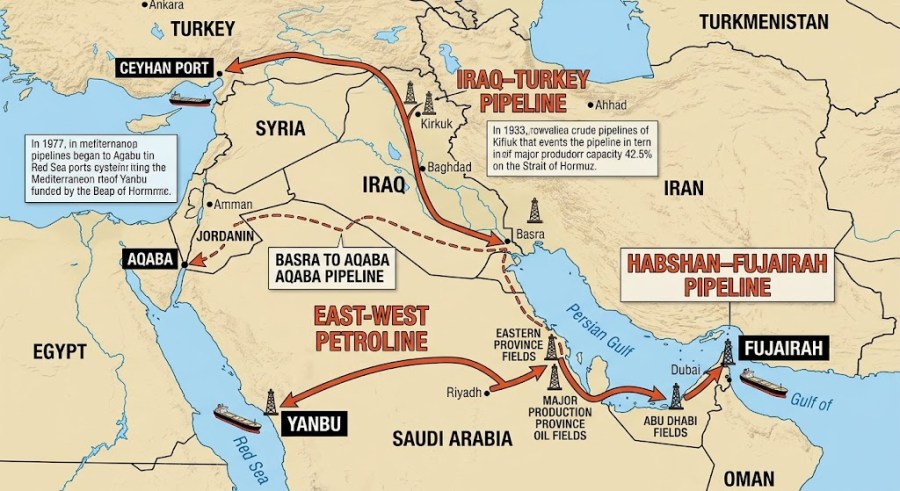
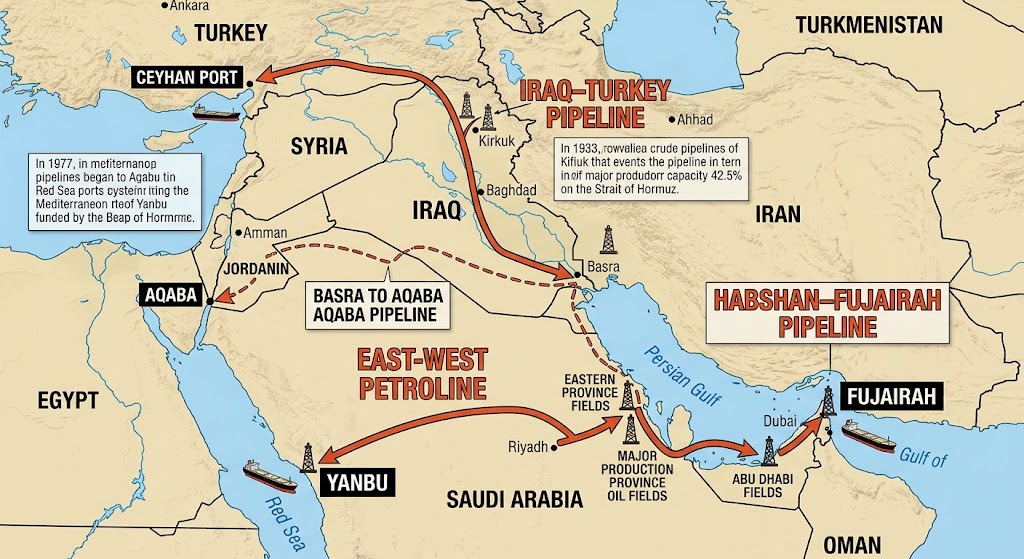
- Saudi Arabia (East-West Petroline): A 1,200 km (745-mile) twin pipeline running from oil fields in the Eastern Province across the kingdom to the Red Sea port of Yanbu. This allows Saudi Arabia to load crude directly onto tankers in the Red Sea, bypassing Hormuz completely. http://www.gem.wiki+ 1
- Capacity: Up to 5 million to 7 million barrels per day (bpd). http://www.gem.wiki
- UAE (Habshan–Fujairah Pipeline): Links Abu Dhabi’s inland oil fields directly to the port city of Fujairah on the Gulf of Oman (outside the Persian Gulf). Business Insider Africa
- Capacity: Approximately 1.8 million bpd. Energy Connects
2. Reactivating & Expanding Regional Pipeline Networks
To reduce total dependence on the Strait, several regional pipeline projects are being expanded, reactivated, or proposed:
- Iraq–Turkey Pipeline (Kirkuk–Ceyhan): Routes northern Iraqi crude overland to the Turkish Mediterranean port of Ceyhan.
- Iraq–Jordan Pipeline (Basra to Aqaba): A long-proposed project designed to transport crude from southern Iraqi oil fields overland to Jordan’s port on the Red Sea.
- Trans-Arabian Pipeline (Tapline) Restorations: Historically, lines connected Saudi Arabia through Jordan and Syria to the Mediterranean Sea. Modern proposals suggest rebuilding modern corridors along these traditional land paths.
3. Land Bridge Trade Corridors (For Freight & General Cargo)
For container shipping, dry goods, and commercial traffic, maritime ships can unload at ports outside the Strait, transferring cargo to overland road or rail systems.
- IMEC (India–Middle East–Europe Economic Corridor): Designed to route sea trade from India to ports in the UAE (like Fujairah or Dubai), move cargo via multi-country rail networks through Saudi Arabia and Jordan to Israel’s Haifa port, and then ship across the Mediterranean to Europe.
- GCC Railway Grid: An ongoing regional infrastructure project linking UAE, Saudi Arabia, Bahrain, Qatar, and Oman via rail, allowing freight to land on the Arabian Sea coast and move inland by train.
4. Sea-to-Land Multimodal Transport
Instead of navigating ships into the Persian Gulf, shipping lines use transshipment hubs located on the outer edge of the chokepoint:
- Drop-off: Ships unload container freight and bulk commodities at deep-water ports located outside the Strait (e.g., Port of Fujairah or Port of Sohar in Oman).
- Overland Distribution: Cargo is moved across borders using heavy truck convoys or freight trains, avoiding the narrow passage entirely.
Key Limitations & Risks
While these bypass methods significantly reduce reliance on the Strait of Hormuz, they come with trade-offs:
| Challenge | Impact |
|---|---|
| Capacity Limits | Pipelines and trucks can only handle a fraction of the ~20 million barrels of crude and massive container tonnage that ships carry daily through the Strait. |
| Shifting Bottlenecks | Rerouting traffic to the Red Sea places shipments near another potential chokepoint—the Bab al-Mandab Strait—which faces its own maritime security challenges. |
| Infrastructure Vulnerability | Long overland pipelines and pumping stations remain fixed targets for long-range drone or missile strikes. |
For Commerce Ships?
Bypassing the Strait of Hormuz for commercial container ships and general freight cargo requires an intermodal “land bridge” approach. Ships cannot cross the desert, so they must dock at outer deep-water ports, offload their cargo, and transfer the freight overland via truck or rail.
Here is how commercial shipping bypasses the Strait:
1. Outer Deep-Water Port Offloading
Instead of entering the Persian Gulf, container ships drop anchor at transshipment ports located on the Gulf of Oman or the Arabian Sea:
- Port of Fujairah & Khor Fakkan (UAE): Situated just outside the mouth of the Strait.
- Port of Sohar, Duqm, & Salalah (Oman): Located directly on the Arabian Sea, keeping ships completely clear of the chokepoint.
2. Desert Highway Truck Convoys
Once offloaded at these outer ports, freight is loaded onto heavy transport trucks. Specialized logistics networks run continuous truck convoys across the borders of the UAE, Oman, and Saudi Arabia, delivering consumer goods directly to interior cities like Dubai, Riyadh, and Kuwait City.
3. Trans-Peninsula Rail & Dry Ports
For bulk cargo and large container volumes, freight is moved using inland rail corridors:
- Saudi Arabia Railways (SAR): Containers landed at Red Sea ports (like Jeddah or King Abdullah Port) are loaded onto high-capacity freight trains that cross the desert to the Riyadh Dry Port and continue east.
- The GCC Railway Corridor: The regional cross-border rail network (which connects the UAE, Oman, Saudi Arabia, Qatar, Bahrain, and Kuwait) provides heavy freight transit from outer coastal ports directly into the inner Gulf nations without relying on maritime ships.
4. The Saudi Arabia–Jordan Overland Corridor
For trade originating from Europe or the Mediterranean destined for the Gulf, cargo ships unload on the Red Sea coast. From there, freight travels east overland across Saudi Arabia, completely avoiding both the Strait of Hormuz and the southern maritime routes altogether.
Key Freight Bottlenecks & Challenges
- Volume Limits: A single modern ultra-large container vessel carries up to 24,000 TEU (twenty-foot containers). It takes thousands of trucks or dozens of heavy freight trains to move the cargo of just one ship.
- Cost & Customs Delays: Transferring cargo from sea to land adds significant handling costs, driver fees, and potential border-crossing delays compared to direct sea shipping.


You must be logged in to post a comment.