
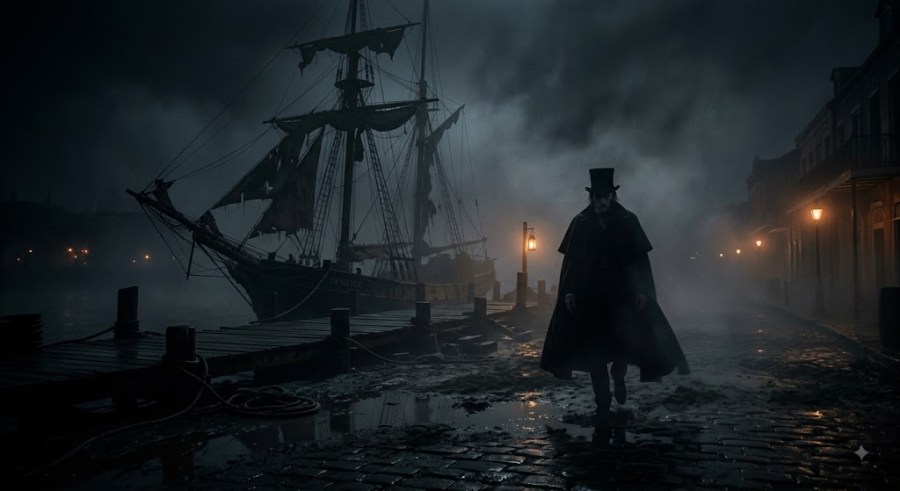
Ever wondered why you get eerie feeling in New Orleans? Like someone is watching you? Something bad is checking you out? It might be DRACULA.
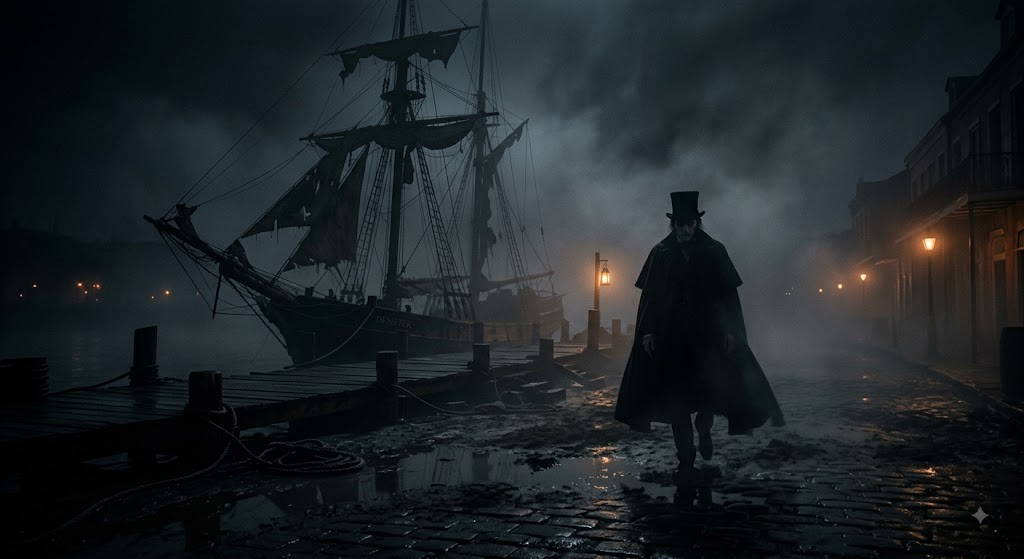
The heavy, waterlogged hull of the Demeter groaned against the Cypress timbers of the French Quarter wharf, low in the water and carrying a silence that did not belong to the bustling Port of New Orleans.
It was late October 1847. The Mississippi River rolled slick and black under a thick coat of midnight river fog. Down on the levee, the air hung hot and wet, heavy with the stench of rotting vegetation, damp coal smoke, and the distant, tinny sound of a brass band playing out of a Decatur Street saloon.
Jacques, a dock foreman with oilskin boots and a lantern that flickered against the mist, paced the damp planks. He spat into the dark water and squinted at the silent schooner. No ropes had been thrown. No crew stood at the deck rails.
“Ahoy, the ship!” Jacques called out, his voice swallowed up by the heavy air. “You’re tied to Private Wharf Four! Show your papers to the harbor master!”
Nothing moved on deck except the slow, unnatural sway of the mainmast.
“Drunk,” Jacques muttered, stepping off the wharf and onto the gangplank with a creak. “The whole lot of ’em, passed out on cheap rum.”
He held his lantern high as his boots hit the main deck. The smell struck him first—not the usual salty tangle of hemp rope and sea brine, but the copper tang of spilled blood mixed with cold, freshly turned earth. The wheel was lashed tight with thick hemp, and bound to the spokes was the pale, stiff corpse of the captain, his rosary wrapped so tightly around his knuckles that the wood had bitten into his flesh.
Jacques stumbled back, his heart hammering against his ribs. “Mon Dieu…”
A soft, scraping sound echoed from the dark mouth of the cargo hold. Up through the hatchway stepped a figure tall enough to cast a shadow straight across the deck, despite the dim lantern light. He wore a heavy wool cloak that seemed entirely dry despite the sweltering Southern humidity. His skin possessed the dull, polished sheen of bone, and his eyes caught the lantern’s flame, glowing like dying embers in a hearth.
“Good evening, my friend,” the stranger said. His voice was a low, resonant purr, carrying an accent thick with the ancient mountains of Transylvania, yet perfectly smooth.
Jacques dropped his lantern. It shattered on the oak deck, the tiny flame burning out instantly in a puddle of spilled oil. “Who… who are you? Where is the crew?”
The stranger stepped forward, moving without the sound of footfalls. He lifted his chin, breathing in the thick, humid air of the delta. He smiled, revealing teeth sharp enough to gleam in the starlight.
“The crew proved… adequate for the voyage,” Count Dracula said softly. “Though the Atlantic is vast, and men tire quickly when the journey is long. Tell me, what city is this?”
“New Orleans,” Jacques stammered, backing away until his spine hit the ship’s railing. “Saint Louis Parish. You… you can’t be here. The quarantine officers—”
“Quarantine?” Dracula chuckled, a dry, cold sound that made the hair on Jacques’ arms stand up. He took another step, closing the distance instantly. “I have crossed seas of blood to reach this river. I smell sickness in your streets, red-shirted man. A fever in the air.”
“The Yellow Jack,” Jacques whispered, trembling violently as the Count towered over him. “The yellow fever’s taking half the town…”
“How convenient,” Dracula murmured, leaning down until his ice-cold breath brushed the foreman’s neck. “A city where men die in their beds by the thousands, and no one questions a pale corpse with an empty pulse. A city of shadows, music, and endless night.”
“Please,” Jacques gasped, reaching for the small iron crucifix hidden beneath his collar.
Dracula’s hand shot out, cold as river ice, wrapping around Jacques’ wrist with the strength of a hydraulic press. He looked at the cross, his lip curling back in mild disdain, but he did not flinch.
“Save your prayers for the morning, Creole,” Dracula whispered into his ear. “Tonight, the river belongs to me.”
Before Jacques could scream, the Count pulled him into the darkness of the cloak. A sharp, ragged gasp echoed across the silent deck, followed by the slow, steady sound of drinking.
A moment later, the deck was quiet again.
Dracula wiped his mouth with the back of a black leather glove and turned his gaze toward the flickering lights of the French Quarter. The scent of sweet magnolia, stale wine, and warm blood drifted down the alleyways to meet him.
He stepped off the vessel and onto the soil of the New World, slipping effortlessly into the fog.
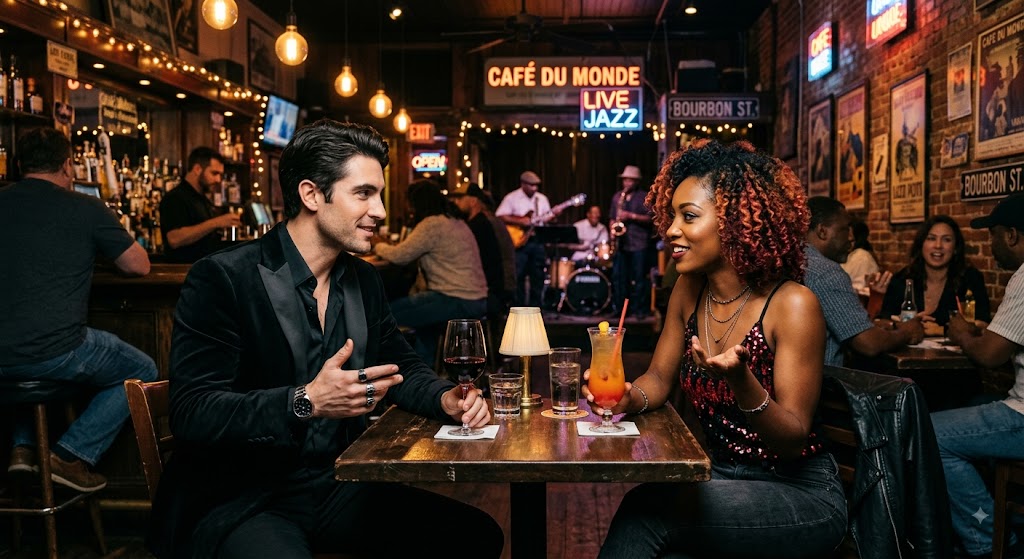
Fast forward, indeed. The 19th-century mist has given way to modern day—Today—at 11:30 PM on a sweltering July night in New Orleans. The relative humidity is holding steady at 98%, making the very air on Bourbon Street feel like a thick, alcoholic soup. The street lamp glow is drowned out by a deafening symphony of flashing blue, red, and neon-pink light, accompanied by the chaotic thunderclaps of trap music, traditional jazz, and the distant, wet screams of bachelor parties.
Sitting on the patio of a somewhat respectable café—close enough to the sidewalk to be accessible, far enough to avoid getting splattered by a “go-cup”—was Count Dracula. He did not look antique. He looked timeless. He wore a exquisitely tailored black suit, sharp and slim, with no tie and a shirt of charcoal silk unbuttoned at the throat. His only jewelry was a heavy, silver signet ring. A glass of vintage Bordeaux, deep and arterial red, sat untouched on the wrought-iron table.
Sitting opposite him, her back to the neon, was Roxy. She was in her early twenties, but her eyes held a weariness that suggested double that. She was wearing what she called her “work uniform”: a glittering, crimson slip dress, knee-high boots, and a face full of contoured armor. She was drinking a neon-blue concoction from a plastic hurricane glass.
They weren’t looking at each other when the conversation started. They were watching the parade of human absurdity go by.
Roxy: (Takes a long drag of a cigarette, exhaling it through her nose) You look like you’re waiting for a different kind of Mardi Gras. One that ended a hundred years ago.
Dracula: (He doesn’t shift his gaze, but his voice is a rich, low vibration that cuts through the bass of the music) There is nothing new under the sun, Roxy. Or, in my case, under the moon. Only the costumes change. This… spectacle… is merely a variations on a theme of primal hunger.
Roxy: Primal, huh? That’s one word for it. Another is ‘vomit-adjacent.’ (She glances at him). You’re the only person on this block who isn’t sweating, and you look at people like they are a bad menu. I’ve been sitting here fifteen minutes, and you haven’t made an offer, and you haven’t looked away. You’re either the strangest John I’ve ever met, or you’re some kind of moody artist waiting for a muse who died in a yellow fever epidemic.
Dracula: Yellow fever. (A faint, almost affectionate smile touches his lips, but his eyes remain cold). A pedestrian disease. It took so many without style. I prefer a more… personalized consumption.
Roxy: Yeah, well, personalization costs extra. So, let’s cut the poetry. You want a companion for the night, or are we just sharing air because you like how my contour looks under the blue neon?
Dracula: (Finally, he turns his head, fixing his deep-set, ember-like eyes on hers. The noise of the street seems to dim in her ears). I am not looking for a “companion” in your sense, Roxy. I am, perhaps, looking for a certain… utility.
Roxy: (Snorts) “Utility.” Classy. I’m an independent contractor, honey. Not a tool belt. My “utility” is priced by the hour. And I have to say, you look like a man whose hours are… long.
Dracula: Longer than you can possibly conceive. My “today” is a concept that stretches across centuries, a endless landscape of boredom punctuated by moments of acute, crimson ecstasy.
Roxy: (She stops her hurricane glass halfway to her mouth). Are you on something? Because if you are, I need to know, so I don’t get a contact high and end up in a gutter trying to talk to a cat. You speak like you’re starring in a bad remake of a movie you haven’t seen.
Dracula: You think I am a fraud? A cosplayer in the theater of the macabre?
Roxy: I think you’re a wealthy, bored man with a thing for the Gothic, who thinks he’s being philosophical. I see it all the time. Guys with money come to New Orleans thinking they can find something real—something magical, something ancient. Then they realize they just bought a fifty-dollar po’boy and a bad hangover.
Dracula: (He leans in slightly, his presence expanding, heavy and cold. Roxy feels a sudden, inexplicable chill). Tell me, Roxy. Do you believe in the impossible?
Roxy: (She holds his gaze, despite her instinct to flee). Honey, I work on Bourbon Street. I see the impossible every night. I see marriages end in two minutes. I see a man dressed as a shrimp fight a man dressed as a priest. I see the dead walk—usually at 3 AM after too many Hand Grenades. My bar for “believing” is on the floor.
Dracula: The “dead walking” you see are merely corpses pretending to be alive. They are defined by their decay. They have no… longevity. No… vision.
Roxy: Vision? What vision do you want, exactly? You want me to tell you you’re the last truly civilized man in a city of barbarians? Fine. Fifty bucks. That wine you have is expensive, but it looks lonely.
Dracula: It is lonely. It is… inadequate. It lacks the pulse.
Roxy: (She laughs, a sharp, genuine sound). Okay, now you’re getting creepy. Lacks the pulse. Jesus.
Dracula: Creepy is a word the mundane use to describe the sublime. You work a trade that commodifies intimacy. You trade in fleeting physical sensation. I deal in the eternal.
Roxy: The eternal? You want a commitment? For one night? That’s not how this works. It’s transactional. We meet, we agree, we complete, we leave. It’s clean. As clean as Bourbon Street gets.
Dracula: Clean. (He looks away from her, back at the crowd). A woman throws beads to a stranger. That stranger will never see her again. Clean. A man buys your time. Clean. You are a specialist in the temporary.
Roxy: It’s better than being a specialist in the imaginary. My job is real. The money is real. The hangover tomorrow is real. You? You’re a ghost story that forgot it was supposed to stay in the haunted mansion.
Dracula: Perhaps. But sometimes, Roxy, the ghost story wants to be read.
Roxy: (She finishes her drink, slamming the plastic glass down on the iron table. The neon-blue residue stains it). Well, I’m not a librarian. If you’re not buying, I’m leaving. I have to find a guy who’s just dumb and drunk enough to pay for what you’re currently analyzing into oblivion.
Dracula: You will find him. You are very good at your job. I can smell the competence on you. It is a rare scent in this decade. It is almost appetizing.
Roxy: (She stands up, smoothing the crimson dress). Almost. You keep that “almost” and your lonely wine. Enjoy your “today,” Count. I’m going to go find my next temporary transaction.
Dracula: (As she turns to walk away). I have no doubt, Roxy, that our paths will cross again. Perhaps, one day, you will be tired of the temporary. Perhaps, one day, you will want a “today” that never has to face a tomorrow.
Roxy: (She stops, halfway down the steps, looking back. Her face is a perfect mask of defiance, illuminated by a flickering gas lamp and a bright, pulsating neon-blue sign). If I ever get that tired, honey, I’ll call you. But don’t wait by the phone. Ghost stories don’t ring.
Dracula: No. They arrive.
Roxy disappears into the throng of bodies, the noise, and the modern neon fog, leaving the Count alone with his untouched wine, perfectly composed, waiting for Today to end, and for Tonight to truly begin.
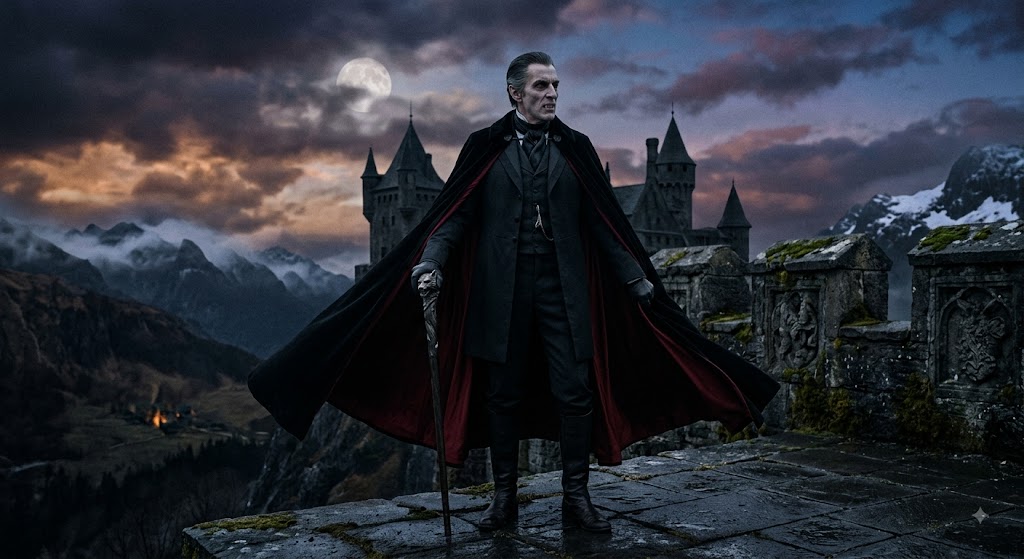
Dracula looks a lot like Elon Musk


You must be logged in to post a comment.