
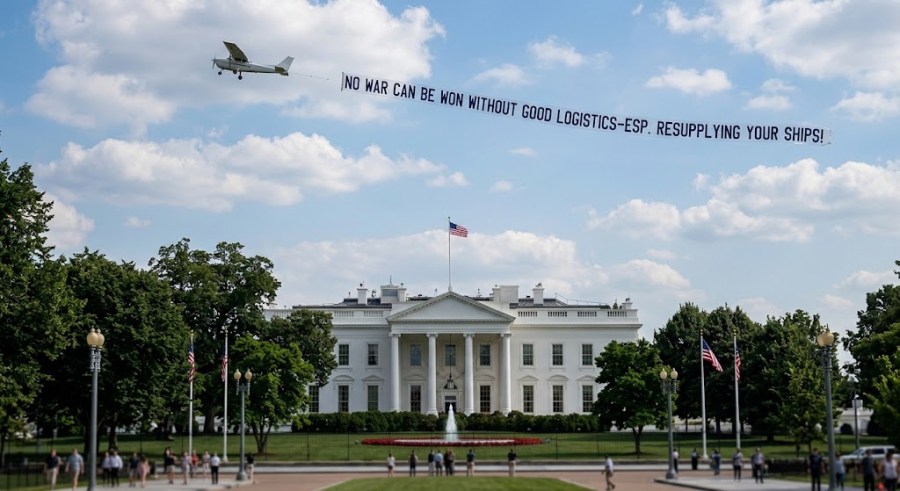

Some Folks are Military Ignorant. Hanging a Reef here and there once a Year is not Proving Your understanding of How to
- Prepare for a War.
- Prepare your Allies. Have them Help.
- Don’t Go it Alone unless you Love Alamo Battles.
- Prepare Good Logistics.
- Don’t Fight Wishy Washy Style unless you are deliberately trying to use up all of your sophisticated weapons.
Reports regarding the USS Abraham Lincoln (CVN-72) highlight severe logistical, living condition, and operational challenges stemming from an extended combat deployment in the Middle East.
YouTube
USS Abraham Lincoln (CVN-72). Source: Wikipedia
1. Resupply and Supply Chain Bottlenecks
- Disrupted Logistics Bases: Investigative reporting indicated that traditional replenishment hubs and supply nodes in the region faced severe disruptions from regional strikes and drone threats, significantly complicating standard underway replenishment (UNREP) cycles.
- Hygiene and Care Package Backlogs: Mail and personal care shipments were reported delayed or lost for months, leaving crew members without basic personal items like soap, toothpaste, and clean uniforms. Indiatimes
2. Food Shortages and Meal Quality Issues
- Rationing: Accounts from crew messages, congressional inquiries, and military family groups described instances of strict food rationing, with meals at times reduced to basic staples like small rice portions and tortillas. AP News
- Fresh Food Depletion: Fresh produce and milk were unavailable for extended stretches, and some reports described spoiled or poor-quality provisions during periods between resupply runs. YouTube
3. Shipboard Infrastructure and Sanitation Breakdowns
- Plumbing and Heads: The carrier’s wastewater systems suffered widespread failures, resulting in broken toilets, sewage backups, and long maintenance delays for essential facilities. Task & Purpose
- Laundry and Showers: Extended outages affected hot water and laundry services for weeks at a time, compounded by reports of mold in communal shower spaces. AP News
- Historical Potable Water Issues: The ship previously experienced water system issues, notably in late 2022 when E. coli contamination affected potable water tanks during a Pacific deployment. MyBaseGuide
4. Operational Fatigue and Crew Morale
- Record Time at Sea: The Lincoln has spent over 250 consecutive days at sea without significant port calls, making it one of the longest continuous underway periods for a U.S. carrier in modern history. The Guardian
- Deployment Extensions: Multiple extensions past its original scheduled return date—driven by combat operations—have placed acute psychological and physical strain on its roughly 5,000 sailors and Marines. AP News
- Mental Health Concerns: Military news outlets reported spikes in burnout, extreme sleep deficits from relentless operational tempos, and incidents prompting heightened mental health interventions and congressional scrutiny. AP News
Official Response
Navy officials and Defense leadership have pushed back against claims of systemic negligence, stating that emergency medical and psychological teams are active onboard and that basic nutritional and operational standards continue to be met. To alleviate the strain, the Pentagon has moved to prepare relief forces (such as the USS George Washington) to rotate into the theater.
AP News+ 1
Explore related aspects of carrier operations:
How Navy underway replenishment (UNREP) works
Deployment history of Nimitz-class carriers
How carrier strike groups manage potable water
How Underway Replenishment (UNREP) Works
Underway Replenishment allows naval vessels to receive fuel, ammunition, food, and parts while maintaining speed and heading, eliminating the need to return to port.
- The Approach and Station Keeping: The receiving ship approaches the supply vessel (usually a Military Sealift Command fleet replenishment oiler or dry cargo ship) from astern, matching its course and speed (typically 12 to 16 knots). The two ships maintain a lateral separation of 140 to 200 feet. Helmsmen must continuously counter the hydrodynamic Venturi effect (suction between two parallel moving hulls).
- Establishing the Rig: A line-throwing gun fires a messenger line across the gap. Crew members manually haul across heavier cables to establish a high-tension steel wire called a span-wire (for fuel) or highline (for cargo). The STREAM (Standard Tensioned Replenishment Alongside Method) system uses hydraulic tensioners (ram tensioners) on the supply ship to automatically keep the wire taut despite ship roll and swell.
- Connected Replenishment (CONREP):
- Fueling at Sea (FAS): Large fuel hoses (typically 7-inch diameter) ride along trolleys on the span-wire. A heavy receiver probe locks into a bell fitting on the receiving ship’s manifold, transferring tens of thousands of gallons per hour of JP-5 (aviation fuel) and DFM/F-76 (marine diesel).
- Replenishment at Sea (RAS): Palletized dry cargo, ordnance, and stores are suspended from a motorized trolley that rides the highline, transferring pallets across the open water in minutes.
- Vertical Replenishment (VERTREP): MH-60S Seahawk helicopters airlift cargo pallets and munitions via external cargo hooks directly to flight decks and fantails, often occurring simultaneously with CONREP.
2. Deployment History of Nimitz-Class Carriers
Commissioned between 1975 and 2009, the 10 hulls of the Nimitz class have served as the backbone of U.S. power projection across five decades.
| Hull & Name | Commissioned | Primary Operational Deployments & Milestones |
|---|---|---|
| CVN-68 Nimitz | 1975 | Operation Evening Light (Iran, 1980); Gulf of Sidra (1981); Desert Storm (1991); Southern Watch; Inherent Resolve (2020). |
| CVN-69 Dwight D. Eisenhower | 1977 | Desert Shield/Storm; Operation Deliberate Force (Bosnia); Enduring Freedom; Red Sea combat ops against Houthi forces (2023–2024). |
| CVN-70 Carl Vinson | 1982 | Desert Strike (1996); Launched first airstrikes of Operation Enduring Freedom (2001); Operation Unified Response (Haiti, 2010). |
| CVN-71 Theodore Roosevelt | 1986 | Desert Storm (500+ sorties); Operation Allied Force (Kosovo, 1999); Enduring Freedom; Iraqi Freedom; Middle East crisis responses. |
| CVN-72 Abraham Lincoln | 1989 | Operation Fiery Vigil (evacuation of Mt. Pinatubo, 1991); Southern Watch; Record 290-day deployment during Iraqi Freedom (2002–2003). |
| CVN-73 George Washington | 1992 | Southern Watch; Iraqi Freedom; First nuclear-powered carrier forward-deployed to Yokosuka, Japan (2008–2015, returning 2024). |
| CVN-74 John C. Stennis | 1995 | Southern Watch; Northern Watch; Extensive Arabian Sea combat sorties during Enduring Freedom and Iraqi Freedom. |
| CVN-75 Harry S. Truman | 1998 | Operations Southern Watch, Iraqi Freedom, and Inherent Resolve; Extensive Mediterranean and Arctic NATO strike exercises (2018–2022). |
| CVN-76 Ronald Reagan | 2003 | Operation Tomodachi (Japan earthquake relief, 2011); Forward-deployed flagship of 7th Fleet based in Japan (2015–2024). |
| CVN-77 George H.W. Bush | 2009 | Launched first airstrikes against ISIS in Iraq (2014); Mediterranean deter-and-defend operations following the Russian invasion of Ukraine (2022–2023). |
3. How Carrier Strike Groups Manage Potable Water
A Nimitz-class aircraft carrier houses over 5,000 personnel and requires roughly 400,000 gallons of fresh water daily. Managing this supply requires continuous distillation and strict usage hierarchies.
- Desalination Systems:
- Multistage Flash (MSF) Distillers & Plate Distillers: Nuclear carriers utilize waste steam from their two A4W nuclear reactor plants to boil incoming seawater at low atmospheric pressure. The vapor condenses into pure distilled water.
- Reverse Osmosis (RO) Plants: Escort ships (Arleigh Burke-class destroyers and Ticonderoga-class cruisers) and newer carriers rely heavily on electric high-pressure membrane RO units, which force seawater through semi-permeable membranes to remove salts.
- Allocation and Uses:
- Reactor Plant & Catapult Feedwater: The purest grade of distilled water (demineralized water) is diverted to the propulsion steam loop and the steam catapult accumulator systems. Impurities in steam catapults cause rapid corrosion and dangerous scaling.
- Aviation & Equipment Washing: Salt spray quickly corrodes aircraft airframes and jet engine turbine blades; daily fresh-water engine flushes and airframe washdowns consume substantial reserves.
- Hotel Services: Cooking, galley sanitization, laundry, and crew hygiene (showers, sinks, and scuttlebutts). Saltwater is routed through separate firemain systems for sewage flushing and firefighting to conserve fresh water.
- Water Conservation (“Water Hours”):
- Potable water is tested multiple times daily by the medical department for salinity, chlorine residual, and bacterial contamination.
- If a flash evaporator goes offline for maintenance or boiler demands surge during heavy flight operations, the ship enters “water hours”—temporarily securing fresh water to laundry, berthing showers, and wash racks while maintaining cooking and essential engineering systems.


You must be logged in to post a comment.