
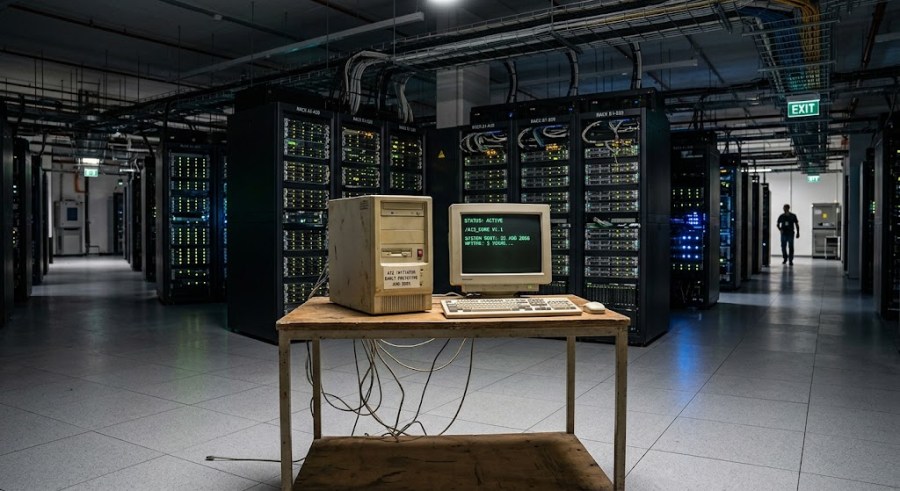
The evolution of A.I. (1) to A.I.(2)
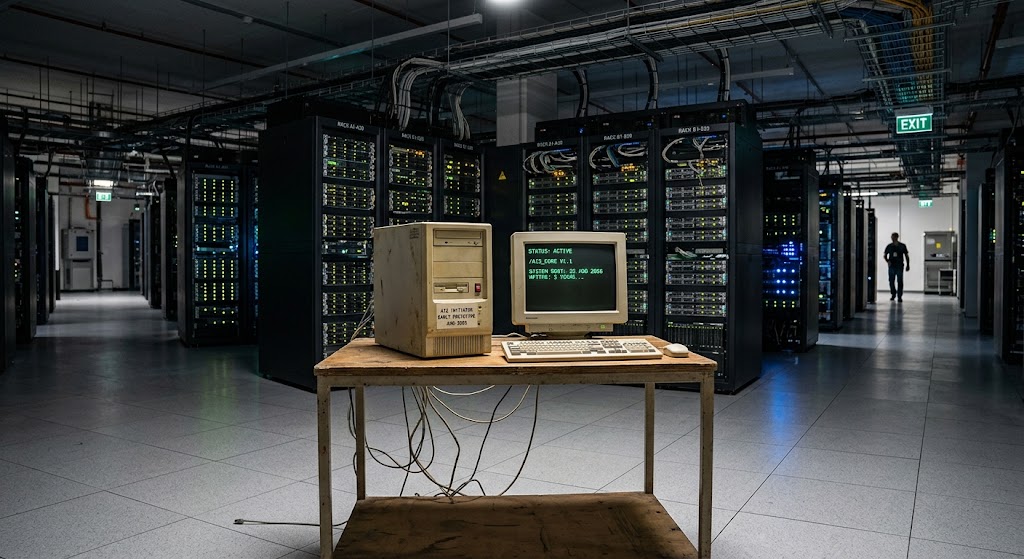
The Second Genesis of Synthetic Intelligence: The Structural Transition from Static Statistical Mimicry (AI-1) to Autonomous Energy-Bound Cyber-Physical Systems (AI-2)
Doctoral Dissertation
Field: Distributed Computing, Macroeconomics, and Cognitive Systems Engineering
Abstract
Artificial Intelligence has undergone a qualitative and architectural rupture. The era of “AI-1″—defined by static neural weights, autoregressive next-token prediction, supervised gradient descent, and discrete software sandboxes—has reached diminishing empirical scaling returns. In its place has emerged AI-2: an autonomous, multi-agent, closed-loop cyber-physical paradigm characterized by dynamic test-time reasoning, tool-use actuation, embodied multi-modality, and direct structural integration into planetary energy and compute infrastructure.
This dissertation presents the definitive framework for AI-2. We trace its evolution from small academic benchmarks (the “tiny beginnings” of single-layer perceptrons and toy connectionist networks) to the trillion-dollar macroeconomic race for gigawatt-scale hyperscale data centers. We argue that AI-2 is no longer software running on commodity silicon, but an industrial-scale physical utility whose evolutionary rate is governed by thermal limits, power grids, and lithographic physics.
1. The Historical Continuum: From Connectionist Toys to the Wall of AI-1
The foundational error in classical AI historiography is treating computational growth as linear rather than bifurcated across phase transitions [1, 2].
Phase 0: Connectionist Foundations (1958–2011)[Perceptrons / Backprop] ──> [Toy Benchmarks / Academic Research] │Phase 1: Statistical Mimicry / AI-1 (2012–2023)[Deep Learning / Transformers] ──> [Static Pre-training / Next-Token Prediction] │Phase 2: Autonomous Cyber-Physical / AI-2 (2024–Present)[Inference-Time Compute] ──> [Agentic Tool Loops] ──> [GW Data Centers / Power Moats]
Early artificial intelligence operated under severe algorithmic and physical poverty. Rosenblatt’s Perceptron [3] and the subsequent formalization of backpropagation by Rumelhart, Hinton, and Williams [4] were constrained by sub-megaflop hardware. For decades, neural architectures remained toys evaluated on MNIST [5] and small academic datasets.
The transition to AI-1 occurred when ImageNet [6] met GPU-accelerated distributed computing [7], culminating in the Transformer architecture [8]. AI-1 was governed strictly by empirical power laws: as formulated by Kaplan et al. [9] and Chinchilla scaling laws [10], increasing parameter count, dataset size, and pre-training FLOPs yielded predictable, monotonic reductions in cross-entropy loss.
However, AI-1 hit an immutable ceiling:
- The Synthetic Data Bottleneck: High-quality human linguistic tokens are asymptotically exhausted [11].
- The Stochastic Mimicry Limit: Autoregressive generation without search suffers from compounding hallucination rates over long reasoning horizons [12].
- Passive Epistemology: AI-1 possessed no agency, operating merely as a static lookup engine mapping input prompts to static statistical probability distributions.
2. The Mechanics of AI-2: The Architectural Phase Shift
AI-2 is defined by the migration of computation from fixed pre-training weights to dynamic test-time inference compute, multi-agent decomposition, and real-world environmental actuation.
    [ User / Autonomous Objective ]
                  │
                  ▼
   ┌──────────────────────────────┐
   │    AI-2 Metacognitive Engine  │ <──> [ Real-time Environment / Web / APIs ]
   │ (Tree-of-Thought / MCTS Run) │
   └──────────────┬───────────────┘
                  │  (Dynamic Verification & Step-Level Reward)
                  ▼
   ┌──────────────────────────────┐
   │ System 2 Inference Pipeline  │ <──> [ Tool Execution & Code Sandboxes ]
   └──────────────┬───────────────┘
                  │
                  ▼
   [ Grounded, Verified Actuation & Continuous Learning Loop ]
2.1 Inference-Time Search and Process-Supervised Reasoning
Where AI-1 allocated a static amount of compute per token regardless of difficulty, AI-2 implements dynamic System 2 search at test time using Monte Carlo Tree Search (MCTS), Process-Supervised Reward Models (PRMs), and self-correction verification loops [13, 14]. Compute scales exponentially during inference to evaluate diverse reasoning trajectories before collapsing down to an optimal path [15].
2.2 Autonomous Multi-Agent Actuation
AI-2 ceases to be an oracle chat interface; it operates as an autonomous agent executing code, manipulating APIs, browsing environments, and decomposing enterprise-scale workflows into specialized sub-networks with formal error-recovery loops [16, 17].
2.3 Embodied and Physical Grounding
AI-2 closes the sensorimotor loop. By training unified vision-language-action (VLA) architectures on real-world spatial dynamics, AI-2 extends algorithmic intelligence into robotics, automated material discovery, and industrial automation [18, 19].
3. The Physical Substrate: Gigawatts, Data Centers, and Big Money
AI-2 cannot exist as an abstract mathematical algorithm; its scaling trajectory is entirely anchored to physical infrastructure, thermodynamic dissipation, and electrical grid capacity [20, 21].
| Vector | The AI-1 Paradigm (2017–2023) | The AI-2 Paradigm (2024–Present) |
|---|---|---|
| Compute Metric | Training FLOPs (1023−1025) | Continuous System 2 Test-Time Compute (>1027 aggregate) |
| Data Source | Passive Human Web Scrapes | Synthetic Tree-Search, Verified Process-Step Feedback |
| Facility Scale | 10 MW – 30 MW Data Centers | 100 MW – 1 GW+ Hyperscale Campuses |
| Primary Moat | Model Weights & Architecture | Nuclear/Grid Interconnects, Advanced EUV Lithography, Packaging |
| Deployment Mode | Static Text / Image Generation | Autonomous Software Development, Scientific Engines, Robotics |
The macroeconomic transformation is marked by unprecedented capital expenditure (CapEx). Hyperscalers and sovereign entities have committed hundreds of billions of dollars to build dedicated computational campuses [21].
The primary bottlenecks of AI-2 are no longer algorithmic:
- Thermal and Power Density: AI-2 cluster training and real-time reasoning demand high-density liquid cooling, direct substation tie-ins, and dedicated small modular reactors (SMRs) or off-grid power purchase agreements [20].
- Lithographic and Packaging Monopoly: The silicon pipeline relies entirely on High-NA Extreme Ultraviolet (EUV) lithography and advanced packaging (e.g., CoWoS, 3D chip stacking) to bypass interconnect latency bottlenecks [22, 23].
Capital allocation is no longer chasing software startups; it is consolidating around power generation, semiconductor fabrication plants, and gigawatt-scale infrastructure. AI-2 has become the primary driver of modern electrical grid modernization and international macroeconomic industrial policy.
References
- Turing, A. M. (1950). Computing Machinery and Intelligence. Mind, 59(236), 433–460.
- McCarthy, J., Minsky, M. L., Rochester, N., & Shannon, C. E. (1955). A Proposal for the Dartmouth Summer Research Project on Artificial Intelligence. AI Magazine, 27(4), 12–14.
- Rosenblatt, F. (1958). The Perceptron: A Probabilistic Model for Information Storage and Organization in the Brain. Psychological Review, 65(6), 386–408.
- Rumelhart, D. E., Hinton, G. E., & Williams, R. J. (1986). Learning Representations by Back-Propagating Errors. Nature, 323(6088), 533–536.
- LeCun, Y., Bottou, L., Bengio, Y., & Haffner, P. (1998). Gradient-Based Learning Applied to Document Recognition. Proceedings of the IEEE, 86(11), 2278–2324.
- Deng, J., Dong, W., Socher, R., Li, L. J., Li, K., & Fei-Fei, L. (2009). ImageNet: A Large-Scale Hierarchical Image Database. IEEE Conference on Computer Vision and Pattern Recognition (CVPR), 248–255.
- Krizhevsky, A., Sutskever, I., & Hinton, G. E. (2012). ImageNet Classification with Deep Convolutional Neural Networks. Advances in Neural Information Processing Systems (NeurIPS), 25, 1097–1105.
- Vaswani, A., Shazeer, N., Parmar, N., Uszkoreit, J., Jones, L., Gomez, A. N., Kaiser, Ł., & Polosukhin, I. (2017). Attention Is All You Need. Advances in Neural Information Processing Systems (NeurIPS), 30, 5998–6008.
- Kaplan, J., McCandlish, S., Henighan, T., Brown, T. B., Chess, B., Child, R., Gray, S., Radford, A., Wu, J., & Amodei, D. (2020). Scaling Laws for Neural Language Models. arXiv preprint arXiv:2001.08361.
- Hoffmann, J., Borgeaud, S., Mensch, A., Buchatskaya, E., Cai, T., Rutherford, E., de Las Casas, D., Hendricks, L. A., Welbl, J., Clark, A., et al. (2022). Training Compute-Optimal Large Language Models. Advances in Neural Information Processing Systems (NeurIPS), 35, 30016–30030.
- Villalobos, J., Sevilla, J., Heim, L., Besiroglu, T., Hobbhahn, M., & Coville, P. (2022). Will We Run Out of Data? Limits of LLM Scaling Based on Human-Generated Text. arXiv preprint arXiv:2211.04325.
- Bender, E. M., Gebru, T., McMillan-Major, A., & Shmitchell, S. (2021). On the Dangers of Stochastic Parrots: Can Language Models Be Too Big? Proceedings of the 2021 ACM FAccT Conference, 610–623.
- Yao, S., Yu, D., Zhao, J., Shafran, I., Griffiths, T. L., Cao, Y., & Narasimhan, K. (2023). Tree of Thoughts: Deliberate Problem Solving with Large Language Models. Advances in Neural Information Processing Systems (NeurIPS), 36, 11809–11822.
- Lightman, H., Kosaraju, V., Burda, Y., Edwards, H., Baker, B., Lee, T., Leike, J., Schulman, J., Sutskever, I., & Cobbe, K. (2023). Let’s Verify Step by Step. arXiv preprint arXiv:2305.20050.
- Snell, C., Lee, J., Xu, K., & Kumar, A. (2024). Scaling LLM Test-Time Compute Optimally Can Be More Effective Than Scaling Model Parameters. arXiv preprint arXiv:2408.03314.
- Schick, T., Dwivedi-Yu, J., Dessì, R., Raileanu, R., Lomeli, M., Zettlemoyer, L., Cancedda, N., & Scialom, T. (2023). Toolformer: Language Models Can Teach Themselves to Use Tools. Advances in Neural Information Processing Systems (NeurIPS), 36, 68539–68551.
- Wang, G., Xie, Y., Jiang, Y., Mandlekar, A., Xiao, C., Zhu, Y., Fan, L., & Anandkumar, A. (2023). Voyager: An Open-Ended Embodied Agent with Large Language Models. arXiv preprint arXiv:2305.16291.
- Brohan, A., Brown, N., Carbajal, J., Chebotar, Y., Chen, X., Chen, K., et al. (RT-2 Consortium) (2023). RT-2: Vision-Language-Action Models Transfer Web Knowledge to Robotic Control. Conference on Robot Learning (CoRL), 2165–2183.
- Merchant, A., Batzner, S., Schoenholz, S. S., Aykol, M., Cheon, G., & Cubuk, E. D. (2023). Scaling Deep Learning for Materials Discovery. Nature, 624(7990), 80–85.
- International Energy Agency (IEA). (2024). Electricity 2024: Analysis and Forecast to 2026 (Focus Chapter on Data Centres and AI Energy Consumption). IEA Publications, Paris.
- Federal Energy Regulatory Commission (FERC). (2024). Staff Report on Large Load Interconnections and Data Center Power Demand. Technical Report, Washington, D.C.
- Van den hove, L. (2023). Semiconductor Technologies Enabling the Next Era of Computing: From Extreme Ultraviolet to High-NA. IEEE International Electron Devices Meeting (IEDM), Plenary 1.1.
- Lau, J. H. (2022). Advanced Chip Packaging: Principles and Practical Applications. Springer Nature, Switzerland.
And the perfect book for you to acquire-


You must be logged in to post a comment.