
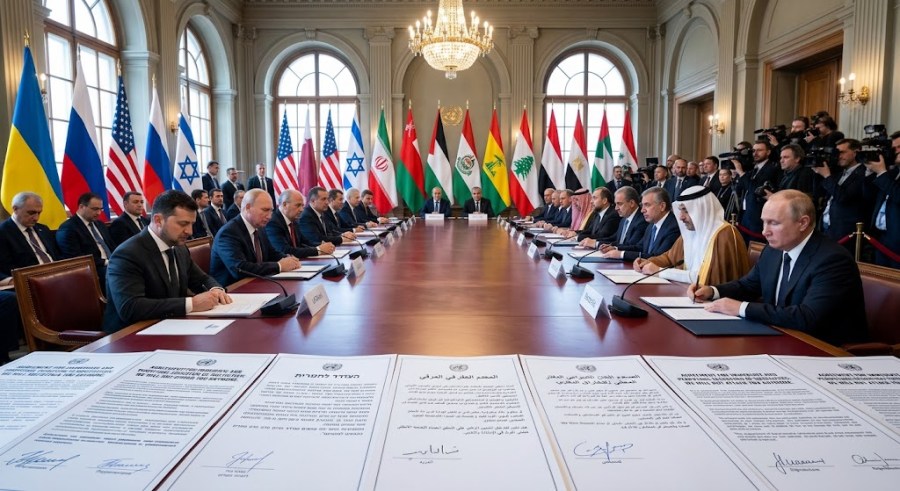
It’s over. Just be men and End it. It’s simply done. All sides just Walk Away. No more War Talk. It ends when everyone signs. There are No Winners.
Whatever propaganda you tell your people is up to each of you. Time to talk less and figure out how to live right.
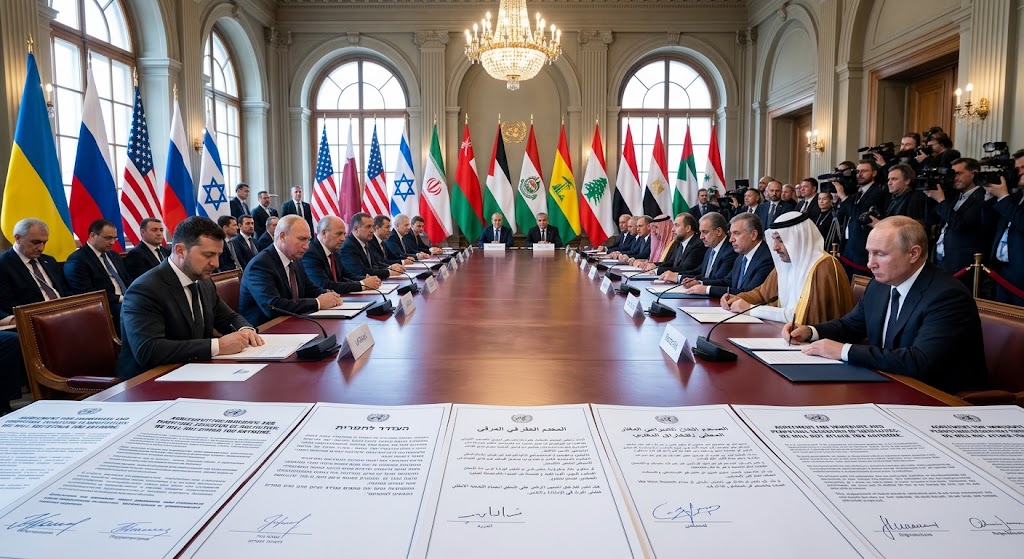
The Zero-Point Armistice: A Philosophical Argument for Absolute Mutual Disengagement
Modern statecraft operates on an unexamined assumption: that every conflict possesses a transactional resolution where concessions, indemnities, and mutual admissions of fault produce equilibrium. Yet historical reality reveals the opposite. The pursuit of “just terms” invariably sustains a self-reinforcing cycle of retaliatory violence, trapped in the sunk cost fallacy of blood and capital.
The radical alternative is the Axiom of Absolute Disengagement—the collective, simultaneous decision to simply walk away.
The Anatomy of the Sunk Cost Trap
War persists largely because combatants confuse the justification for continuing with the cost of having fought.
- The Retributive Spiral: Actor A demands restitution from Actor B; Actor B requires guarantees against Actor A’s future retaliation. Every concession demanded creates a new pretext for continuation.
- The Fallacy of Total Victory: In modern asymmetric and nuclear-shadowed warfare, total victory is mathematically impossible. A protracted conflict does not lead to resolution; it merely distributes ruin evenly over time.
- The Paralyzing Demand for Apology: Requiring an adversary to admit fault forces existential resistance. Pride and political survival compel leaders to fight rather than submit to formal humiliation.
When the price of extracting terms exceeds the value of any concession gained, continuing the conflict ceases to be strategy—it becomes ideological inertia.
The Mechanics of the “Walk Away” Framework
The “Just Walk Away” doctrine is not surrender; it is the deliberate, universal refusal to play an iterated negative-sum game. It rests on four non-negotiable principles:
                      [ UNIVERSAL DISENGAGEMENT ]
                                   │
         ┌─────────────────────────┼─────────────────────────┐
         ▼                         ▼                         ▼
  Total Physical             Zero Concession          Mutual Silence
    Withdrawal                  Exchange              (No Admissions)
(Return to Borders)        (No Land/Reparations)      (Cycle Severed)
- Total Physical Withdrawal: Combatants return to sovereign, pre-conflict territorial baselines (Russia withdrawing entirely from Ukrainian territory including Crimea; Israel withdrawing fully from Gaza). Territorial ambition is neutralized as an operational goal.
- Zero-Concession Parity: Neither side receives indemnities, tributes, buffer strips, or strategic carve-outs. Because no party is rewarded and no party is legally subjugated, the pretext for future revanchism is stripped away.
- Mutual Silence (No Admissions): The treaty requires no confessions of war guilt, no public declarations of defeat, and no formal apologies. Removing the requirement of humiliation removes the primary obstacle to signing.
- Universal Non-Aggression Compact: The agreement functions as an absolute negative pledge: We will not attack. Sovereignty over shared corridors—such as the Strait of Hormuz—reverts strictly to standard maritime law and coastal demarcation (Iran and Oman), removing pretextual blockades.
The Game-Theoretic Logic of Absolute Cessation
In classical game theory, the iterated Prisoner’s Dilemma defaults to perpetual defection when trust is zero. Conventional diplomacy attempts to build trust incrementally—a process that routinely collapses under frontline friction.
Absolute disengagement solves this by making the exit strategy unilateral in execution, but universal in application:
Net Utility of Peace≫Marginal Gain of War−Cumulative Destruction
By fixing the terms to an absolute zero baseline (no land gained, no concessions paid, no words admitted), the negotiation surface shrinks from infinite contentious variables to a single binary choice: perpetual ruin or immediate cessation.
The Moral Courage of the Void
The traditional warrior ethic demands a conclusion crowned with victory or vindication. Yet the highest exercise of sovereign reason is recognizing when an entire paradigm has become obsolete.
To “just walk away” demands a harder discipline than waging war: it requires leaders to absorb the silence of an unresolved past to secure the existence of a viable future. It rejects commercial opportunism, territorial conquest, and historic grievances in favor of an unadorned truth: peace begins the moment both hands drop their weapons and walk in the opposite direction.
 thelivingbreathingjamesbrown.com
You must be logged in to post a comment.