
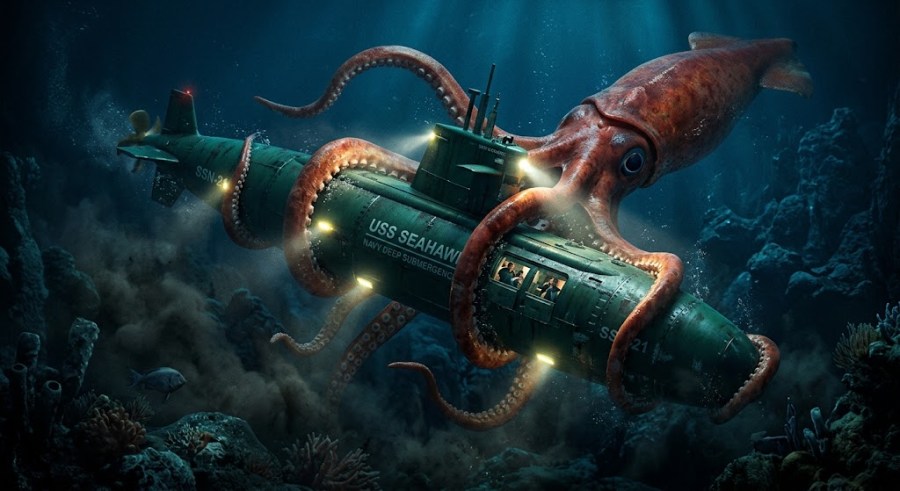
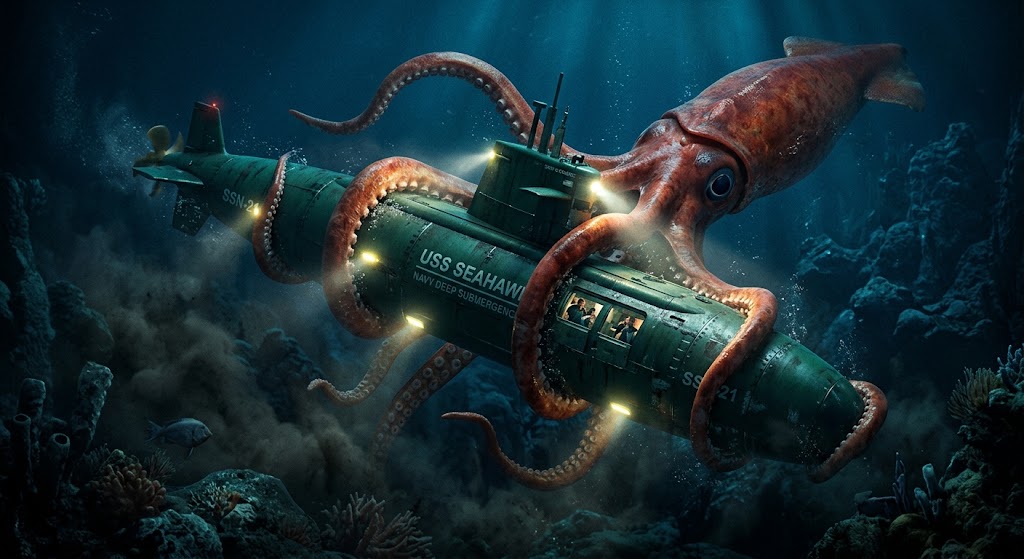
In one part of the Oceans, submarine crews fill with great fear because of deadly creatures that can capture and hold their sub for weeks.
The Dry Dock Deficit: U.S. Navy Submarine Maintenance Backlogs and Fleet Readiness
Between 30% and 40% of the U.S. Navy’s fast-attack submarine (SSN) fleet is non-operational at any given moment due to depot maintenance overhauls or extended delays waiting to enter dry docks. A decade-long analysis by the Government Accountability Office (GAO) reveals that attack submarines lost over 15,000 operational days between 2016 and 2025, costing taxpayers $3.4 billion to support stranded crews and idle hulls that provided zero deployable capability.
GAO
SSN undergoing maintenance in dry dock. Source: Facebook
The Scale of the Fleet Backlog
Out of an inventory of approximately 49 to 50 operational attack submarines (Los Angeles, Seawolf, and Virginia classes), the Navy has consistently struggled to keep its target force generation rate above 60–70%.
| Metric | Measured Impact (2016–2025) | Near-Term Projection (2026–2030) |
|---|---|---|
| Lost Operational Days | Over 15,000 days | >14,000 days (inactive subs only) |
| Direct Sunk Costs | $3.4 billion (sustaining idle crews/boats) | $3.1 billion projected |
| Active Submarines Non-Operational | 30%–40% of total SSN inventory | Persistent backlogs through the late 2020s |
| Decommissioning Bottleneck | $722 million in inactive idle delays | 15 attack submarines awaiting defueling |
Active vs. Inactive “Idle Time”
The submarine maintenance crunch is divided into two structural bottlenecks:
- Active Idle Time: Occurs when an operational submarine’s safety or dive certification expires, but it cannot enter a dry dock because the depot facility is occupied. The submarine sits pier-side with a full crew. Defense News+ 1
- Los Angeles-class active idle time costs ~$220,000/day per cohort. Navy Times
- Virginia-class active idle time costs ~$237,000/day per cohort. Navy Times
- Inactive Idle Time: Occurs when a submarine is retired and slated for decommissioning, but must wait years pier-side for an open dry dock slot to defuel its nuclear reactor. Navy Times
- Case Study: The USS Pasadena (SSN-752) went inactive in January 2025 but cannot enter Norfolk Naval Shipyard until late 2028—costing more than $300 million over four years just to maintain the pier-side hulk and nuclear safety watch teams. Navy Times
Root Causes of the Shipyard Bottleneck
[4 Public Shipyards: Norfolk, Portsmouth, Puget Sound, Pearl Harbor] │ ┌───────────────────┼───────────────────┐ ▼ ▼ ▼Dry Dock Capacity Workforce & Labor Supply Chain & Parts • Century-old • Loss of senior • Cannibalizing parts infrastructure nuclear artisans from sister hulls • SIOP modernization• Private sector • Delays in high-spec taking decades wage competition nuclear components
- Capacity Overload: Public shipyards prioritize Ballistic Missile Submarines (SSBNs) to ensure the sea-based nuclear triad remains active, and Aircraft Carriers (CVNs) for power projection, leaving fast-attack boats at the bottom of the priority list.
- Workforce Gaps: Nuclear-qualified trades (welders, pipefitters, radiation health technicians) have suffered high attrition and lengthy security-clearance pipelines.
- Cannibalization Practices: To get deploying submarines out the door, mechanics routinely strip valves, circuit boards, and pumps from submarines awaiting dry dock maintenance, deepening the repair scope once those hulls finally enter the yards.
Strategic Consequences for Navy Readiness
The submarine force represents the United States’ primary asymmetric advantage against peer adversaries. The loss of 15,000 operational days creates distinct operational vulnerabilities:
- Erosion of Deterrence in the Indo-Pacific: USINDOPACOM war plans rely heavily on undetected SSNs operating inside anti-access/area-denial (A2/AD) envelopes (such as the Taiwan Strait and First Island Chain). A 35% reduction in available hulls limits rotational deployments and reduces continuous theater intelligence gathering.
- Deployment Fatigue & Creep: With fewer hulls operational, deployed submarines are subjected to 7-to-9-month patrols rather than the standard 6-month cycles. Extended operational tempo accelerates wear-and-tear on propulsion systems and causes retention drops among nuclear-trained crew members.
- Wasted Defense Capital: Spending billions to fund fully crewed vessels tied up at piers strips capital from procurement programs, directly impacting the Navy’s goal of building two Virginia-class submarines per year. Navy Times
Path Forward and Mitigation Strategies
The Navy and Congress are pursuing several structural reforms:
- Shipyard Infrastructure Optimization Program (SIOP): A multi-decade, $21+ billion recapitalization project modernizing public dry docks, capital equipment, and internal layout efficiency.
- Alternative Decommissioning Concepts: Evaluating pier-side nuclear defueling and floating dry docks to keep fixed, permanent dry docks open exclusively for operational submarine overhauls.
- Private Yard Outsourcing: Transferring select intermediate and depot-level overhauls of Virginia-class subs to private builders (General Dynamics Electric Boat and HII Newport News Shipbuilding), though this risks competing with new-construction throughput. Navy Times
Explore deeper analysis on the submarine industrial base:
Analyze the Shipyard Infrastructure Optimization Program (SIOP)
Compare US and Chinese submarine fleet availability rates
The operational availability of the U.S. Navy attack submarine fleet is constrained by depot maintenance backlogs, while the People’s Liberation Army Navy (PLAN) achieves higher regional force generation through a large, dual-tier fleet of conventional and nuclear submarines operating on internal lines of communication.
RUSI
Fleet Composition and Availability Dynamics
The U.S. Navy operates an all-nuclear fast-attack submarine (SSN) force, whereas China maintains a mixed fleet consisting predominantly of diesel-electric/Air-Independent Propulsion (AIP) submarines alongside a growing nuclear inventory.
RUSI
| Feature | U.S. Navy Attack Fleet (SSN) | China PLAN Submarine Force (SSN/SSK) |
|---|---|---|
| Fleet Structure | ~50 SSNs (Los Angeles, Seawolf, Virginia) | ~60+ total (~12 SSNs/SSBNs, ~48 AIP/SSKs) |
| Operational Availability | 60%–65% (35%–40% in dry dock/maintenance backlogs) | 70%–80% (estimated across conventional and nuclear force) |
| Maintenance Complexity | High (depot nuclear overhaul, deep submergence certification) | Moderate to High (SSKs are simpler/faster to overhaul than SSNs) |
| Deployment Range | Global blue-water expeditionary patrols | Primarily regional (First/Second Island Chain, South China Sea) |
Key Drivers of the Availability Gap
1. Maintenance Turnaround and Hull Simplicity Nuclear overhauls require certified public dry docks, strict radiation safety protocols, and complex reactor maintenance. China’s large fleet of Type 039A/B/C Yuan-class and Song-class AIP submarines utilize non-nuclear yards, allowing shorter maintenance intervals and quicker turnarounds between deployments.
The International Institute for Strategic Studies
2. Shipyard Capacity and Industrial Output
- United States: U.S. submarine construction and depot maintenance are constrained across four public naval shipyards and two private yards, struggling with labor shortages and parts cannibalization. U.S. Virginia-class build rates average 1.2 to 1.3 hulls per year. Army Recognition
- China: The expansion of Bohai Shipyard (Huludao) and commercial shipbuilding infrastructure allows China to build both nuclear and conventional hulls simultaneously. Between 2021 and 2025, China launched 10 nuclear submarines (both SSNs and SSBNs), achieving a sustained construction cadence matching or exceeding U.S. output. Breaking Defense+ 1
3. Operational Geometry and Transit Burdens U.S. submarines must transit thousands of miles across the Pacific or Atlantic before reaching patrol stations in the Western Pacific or Middle East, consuming weeks of endurance and hull life purely in transit. In contrast, China’s submarine force operates on interior lines, deploying directly from bases such as Yulin Naval Base on Hainan Island or Qingdao into contested waters without requiring extended ocean crossings.
Asymmetric Strengths
- U.S. Qualitative Superiority: U.S. SSNs maintain significant advantages in acoustic quieting, sensor processing, reactor endurance (never requiring mid-life refueling on Virginia hulls), and combat management systems.
- China’s Numerical Density: China can generate a higher concentration of attack boats in the East and South China Seas on short notice due to lower maintenance downtimes across its conventional submarine flotillas.
For a visual overview of Beijing’s expanding fleet and future force structure goals, watch this breakdown on China’s expanding submarine fleet. This resource is useful for contextualizing the numerical projections and shipyard modernization driving China’s underwater force generation.
YouTube

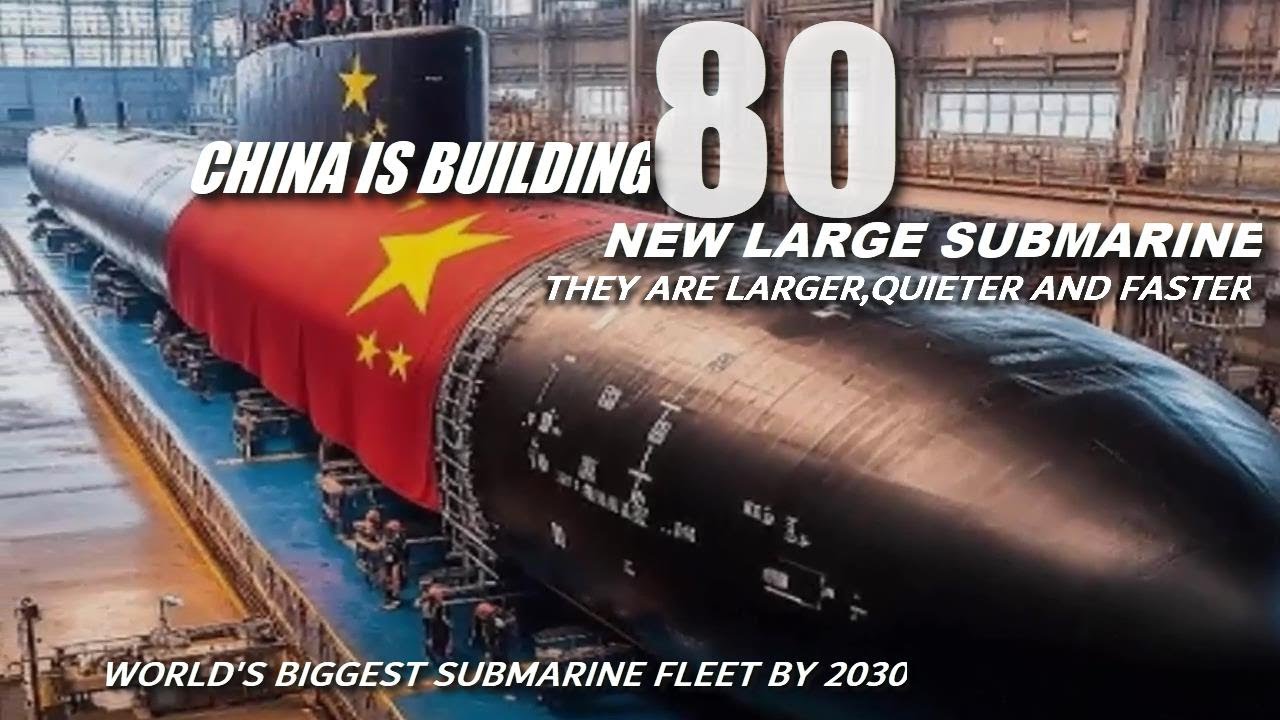
China’s Big Plan For growing its submarine force to 80 units by 2035 They are larger,quieter, faster
MILITARY NEWS UPDATE · 3.5K views Open in China’s Big Plan For growing its submarine force to 80 units by 2035 They are larger,quieter, faster
The Russian submarine force presents a sharp dichotomy: it remains the most modernized, lethal, and prioritized branch of the Russian Navy, yet it suffers from deep maintenance backlogs, severe shipyard bottlenecks, and an aging legacy fleet.
Fleet Overview and Availability Rates
Russia maintains roughly 55 to 60 commissioned combat submarines, divided across the Northern, Pacific, Baltic, and Black Sea Fleets.
| Category | Typical Classes | Total In-Service Hulls | Estimated Deployable / Ready | Key Mission |
|---|---|---|---|---|
| SSBN (Ballistic Missile) | Borei-A, Delta IV | ~12 | 8 – 10 (~75%) | Strategic nuclear deterrence (Arctic / Pacific “Bastions”) |
| SSGN / SSN (Nuclear Attack / Guided Missile) | Yasen-M, Akula, Sierra II, Oscar II | ~23 | 12 – 14 (~55%) | Anti-shipping, land-attack (Kalibr/Zircon), tracking NATO subs |
| SSK (Conventional / Diesel-Electric) | Improved Kilo (Varshavyanka), Lada | ~22 | 14 – 16 (~65%) | Regional patrol, coastal defense, cruise missile strikes |
Key Strengths and High-End Capabilities
- Priority Funding: While surface shipbuilding programs have been repeatedly delayed, Russian leadership shields nuclear submarine construction (Sevmash shipyard in Severodvinsk) from severe budget cuts.
- Modern Borei-A and Yasen-M Boats: New Borei-A ballistic missile subs (e.g., Knyaz Pozharsky) and Yasen-M guided missile subs (e.g., Kazan, Krasnoyarsk) are quiet, heavily armed, and considered near-peer competitors to Western equivalents.
- Special Mission and Undersea Warfare (GUGI): Russia fields specialized nuclear platforms (such as Belgorod and Khabarovsk) designed to carry long-range Poseidon nuclear torpedoes and deep-sea spy submersibles targeting seabed infrastructure and fiber-optic communication cables.
Major Bottlenecks and Challenges
             [Russian Submarine Readiness Strain]
                              │
    ┌─────────────────────────┼─────────────────────────┐
    ▼                         ▼                         ▼
Legacy Overhauls          Sanctions Impact          Geography & Basing
 • Decade-long refits       • Scarcity of high-spec   • Barents & Sea of Okhotsk
   (Akula & Oscar II)         microelectronics          containment by NATO
 • Limited nuclear dock     • Delays in domestic      • GIUK gap monitoring
   slots at Zvezdochka        sensor components         and choke points
- Protracted Overhauls for Soviet Hulls: Legacy third-generation hulls (Akula and Oscar II) frequently spend 8 to 12 years in refit yards like Zvezdochka or Zvezda. Many remain technically “in service” on paper while being stuck pier-side with expired certifications.
- Component and Technology Sanctions: Tightened export controls on advanced machine tooling, high-grade ball bearings, and specialized microelectronics have lengthened construction timelines and delayed refits for ongoing submarine batches.
- AIP Development Failures: Russia struggled for years with the domestic Air-Independent Propulsion (AIP) program for the Project 677 Lada class, forcing the navy to continue relying heavily on conventional lead-acid battery Kilo-class boats for regional waters.
Strategic Posture
Rather than attempting broad global sea control, the Russian submarine doctrine focuses on “Bastion Defense”—securing protected sanctuaries in the Barents Sea and the Sea of Okhotsk to ensure SSBN survival—while deploying long-range Yasen-M and Akula units past the Greenland-Iceland-UK (GIUK) Gap to threaten Atlantic lines of communication and launch standoff cruise missile strikes.
The deterioration of U.S. naval submarine maintenance into multi-year backlogs is the result of compounding systemic decisions spanning three decades. Rather than a single point of failure, analysts, the Government Accountability Office (GAO), and congressional oversight committees attribute the crisis to several interconnected structural factors:
1. Post-Cold War “Peace Dividend” Reductions
Following the dissolution of the Soviet Union in 1991, the Department of Defense downsized the defense industrial base to capture budget savings:
- Closure of Public Shipyards: The Base Realignment and Closure (BRAC) rounds in the 1990s permanently shuttered major public naval shipyards, including Philadelphia Naval Shipyard, Mare Island Naval Shipyard, and Long Beach Naval Shipyard.
- Loss of Surge Capacity: Downsizing left the Navy with only four public shipyards (Norfolk, Portsmouth, Puget Sound, and Pearl Harbor) to handle the nuclear depot maintenance for all aircraft carriers and submarines, eliminating the slack needed to absorb unexpected repair delays.
2. Aging, Century-Old Infrastructure
The four remaining public shipyards were constructed in the 19th and early 20th centuries and were originally optimized for steam- and sail-powered surface ships rather than modern nuclear submarines:
- Obsolete Layouts: Dry docks, machine shops, and radiological support buildings are often separated by long distances across yards, adding thousands of wasted transit hours for mechanics and engineers every week.
- Capital Neglect: For decades, Navy funding prioritized new ship construction and operational deployments over capital improvements to dry docks and crane systems, leading to deferred maintenance crises that the ongoing Shipyard Infrastructure Optimization Program (SIOP) is only now attempting to fix over a multi-decade timeline.
3. Skilled Workforce Attrition and High Turnover
Nuclear-certified shipbuilding and repair require highly specialized skills (such as precision nuclear welding, non-destructive testing, and pipefitting) that require years of apprenticeship:
- The “Silver Tsunami”: A large cohort of experienced, Cold War-era master tradespeople retired over the last 15 years, taking institutional knowledge with them.
- Compensation and Retention Gaps: Public shipyards have struggled to recruit and retain young technicians due to strict security clearance requirements, intense working conditions, and wage competition from the private commercial sector.
4. Flawed Maintenance Forecasting and Cannibalization
- Unplanned Work: As older Los Angeles-class submarines age and Virginia-class boats enter their first major depot overhauls, shipyard inspectors routinely uncover structural corrosion, hydraulic degradation, and component fatigue that were not factored into initial schedules.
- Parts Cannibalization: When high-demand replacement parts are unavailable due to long supply chain lead times, maintainers frequently strip parts from submarines awaiting dry dock space to deploy boats on the schedule. This practice significantly increases the maintenance backlog for the cannibalized boats once they finally enter dry dock.
5. Budgetary Instability and Continuing Resolutions
- Fiscal Uncertainty: Frequent reliance on short-term Continuing Resolutions (CRs) by Congress disrupts long-term procurement of long-lead nuclear materials, delays maintenance contract awards, and prevents shipyards from maintaining stable hiring pipelines.
- Underfunding Depot Sustainment: Congressional and Pentagon budget allocations have historically favored visible procurement metrics (such as the total hull count) over less visible sustainment and depot modernization accounts.
Allocation of Institutional Responsibility
- Congress: Cited for decades of boom-and-bust funding cycles, budget sequestration impacts, and prioritizing new-hull construction funding over depot repair capacity.
- Navy Leadership: Criticized by oversight bodies like the GAO for overly optimistic maintenance scheduling, insufficient investment in shipyard facilities, and failing to maintain detailed inventory control on supply chains.
- Defense Industrial Base: Struggled with fragile sole-source supply chains, sub-tier vendor attrition, and private yard capacity bottlenecks that directly compete with new submarine production.


You must be logged in to post a comment.