
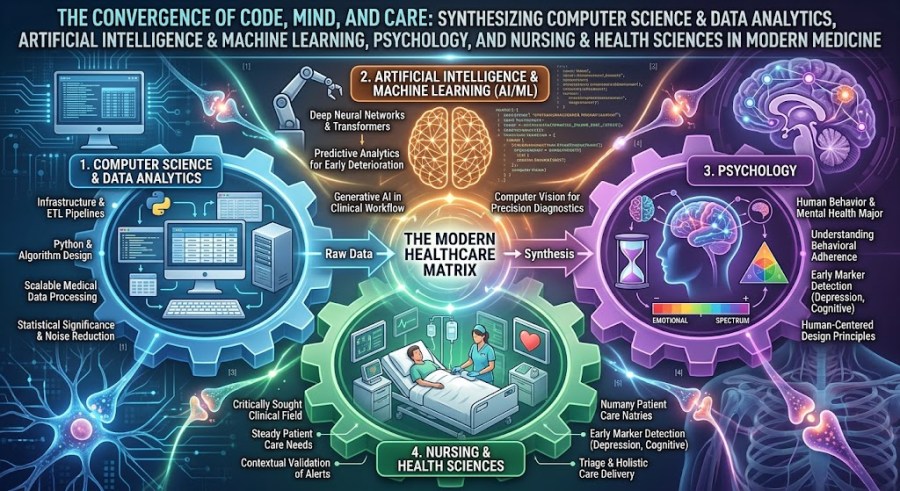
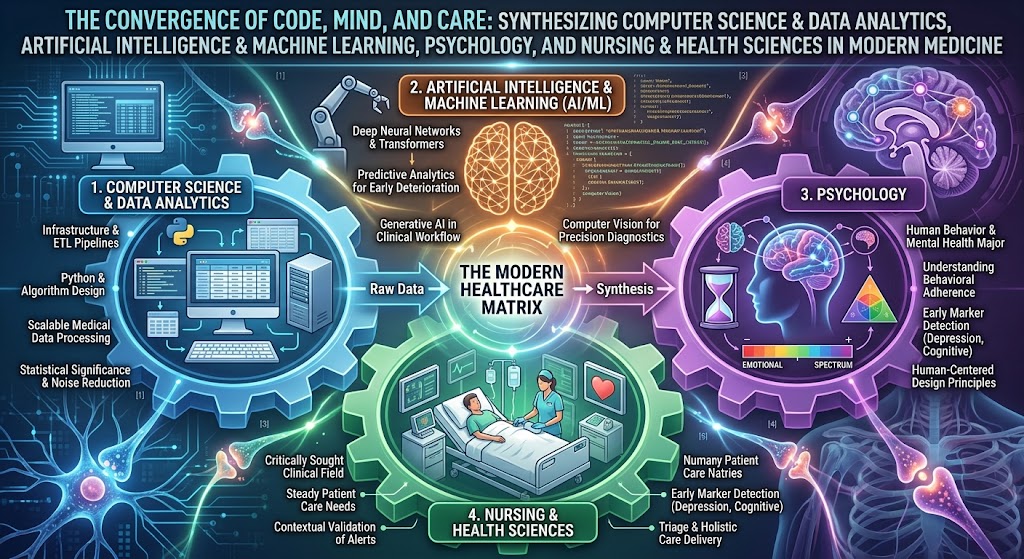
The Convergence of Code, Mind, and Care: Synthesizing Computer Science & Data Analytics, Artificial Intelligence & Machine Learning, Psychology, and Nursing & Health Sciences in Modern Medicine
The future of human health will not be built solely at the bedside or inside a server farm, but at the exact intersection where computational power meets the human psyche. Historically, the pursuit of scientific progress segregated technical disciplines from humanistic and clinical care. Today, that boundary is dissolving.
By unifying Computer Science & Data Analytics, Artificial Intelligence & Machine Learning (AI/ML), Psychology, and Nursing & Health Sciences, we enter an era of intelligent, compassionate healthcare capable of solving problems that no single field could address in isolation.
+-----------------------------------------------------------------------------+| The Healthcare Matrix |+------------------------------------+----------------------------------------+| Computer Science & Data Analytics | Infrastructure, ETL pipelines, Python || Artificial Intelligence & ML | Predictive models, neural nets, GenAI || Psychology | Behavioral context, cognitive nuance || Nursing & Health Sciences | Clinical bedside delivery, triage |+------------------------------------+----------------------------------------+
The Computational Backbone: Computer Science & Data Analytics
Every medical breakthrough relies on robust data architecture. Modern hospitals generate millions of telemetry signals, electronic health record (EHR) entries, lab results, and genomic sequences daily.
- Data Pipelines & Engineering: Python algorithms and scalable data structures transform fragmented hospital records into standardized, high-integrity streams.
- Statistical Analysis: Rigorous exploratory data analysis strips away noise, allowing researchers to spot epidemiological trends and patient risk factors long before symptoms manifest.
Without this computational spine, clinical data remains siloed, unstructured, and clinically inert.
The Predictive Engine: Artificial Intelligence & Machine Learning
Where computer science organizes the data, AI and machine learning interpret it. Deep neural networks identify patterns across high-dimensional datasets that exceed human cognitive bandwidth.
- Early Deterioration Detection: Recurrent neural networks monitor real-time vital signs to forecast septic shock or cardiac arrest hours in advance.
- Generative AI in Clinical Workflows: Transformer models summarize complex medical histories into concise clinical briefs, reducing documentation fatigue and letting practitioners focus on patient interaction.
- Precision Diagnostics: Computer vision models analyze radiology scans alongside demographic datasets to surface micro-anomalies early.
The Behavioral Compass: Psychology
Data and algorithms cannot heal without understanding human motivation, perception, and emotional resilience. Purely technological interventions often fail when they ignore how human beings process trauma, illness, and recovery.
- Behavioral Adherence: Psychological models explain why patients follow—or resist—treatment regimens, informing user-centered design in health technologies.
- Cognitive & Mental Health Synthesis: AI algorithms trained on natural language patterns detect early markers of clinical depression, PTSD, or cognitive decline through changes in speech cadence and syntax.
- Ethical Human-Centered Design: Understanding cognitive bias prevents algorithmic discrimination and ensures diagnostic interfaces support clinician intuition rather than overwhelming it.
The Clinical Touchstone: Nursing & Health Sciences
Nurses and clinical practitioners represent the critical interface between abstract data and the lived experience of suffering. A model can calculate a 94% risk of pulmonary edema, but it requires a nurse’s clinical judgment to evaluate the patient’s breathing posture, skin temperature, and emotional state.
- Contextual Validation: Bedside practitioners provide the essential qualitative reality check against algorithmic false alarms, grounding automated recommendations in real-time physical assessments.
- Holistic Intervention: Health science ensures that patient care treats the human, not just the telemetry monitor, combining pharmacological therapies with empathetic bedside care.
- Translational Feedback: Clinical teams identify edge cases and institutional blind spots, feeding frontline insights back to data engineers to continuously refine predictive algorithms.
The Unified Paradigm: A Closed-Loop Ecosystem
When these four pillars synchronize, healthcare shifts from reactive triage to proactive, personalized healing:
[ Clinical Data Streams ] │ ▼[ CS & Data Analytics: Ingestion, Cleaning & Transformation ] │ ▼[ AI & Machine Learning: Neural Networks & Predictive Inference ] │ ▼[ Psychology: Behavioral Profiling & Cognitive Alignment ] │ ▼[ Nursing & Health Sciences: Empathetic, Real-World Clinical Action ]
- Ingestion: Computer Science pipelines collect and clean continuous biometric signals.
- Inference: Machine Learning models forecast physiological or mental health anomalies.
- Contextualization: Psychological principles shape the communication strategy to fit the patient’s emotional state.
- Execution: Nursing professionals deliver high-touch, empathetic care backed by real-time computational intelligence.
The future of healthcare does not belong to the algorithm alone, nor does it rely solely on manual bedside craft. It belongs to the synthesis: systems built on sound code, elevated by machine intelligence, informed by human psychology, and delivered through dedicated clinical practice.
Clinical Case Study: Averting Sepsis and Delirium in the ICU
To see these four fields synchronize in real time, consider the case of Patient 402, a 68-year-old recovering from emergency abdominal surgery in an intensive care unit (ICU).
Step 1: The Foundation (Computer Science & Data Analytics) Bedside monitors, automated IV pumps, and lab feeds stream thousands of data points per minute.
- ETL Data Pipelines: A backend architecture built with Python and Apache Kafka continuously extracts, transforms, and loads raw telemetry—mean arterial pressure, heart rate variability, oxygen saturation, and white blood cell counts—into a unified, low-latency database.
- Data Cleaning & Normalization: Statistical filters strip out motion artifacts (such as sensor disruption caused by coughing) to ensure high-fidelity signal processing without data corruption.
Step 2: Predictive Detection (Artificial Intelligence & Machine Learning) Four hours before any overt clinical crash, the patient’s vitals appear deceptively stable on the surface monitor.
- Neural Network Inference: A recurrent neural network (RNN) trained on millions of ICU admissions detects subtle micro-patterns across the telemetry stream: slight decoupling of heart rate and respiration, combined with rising lactate levels.
- Early Deterioration Warning: The AI flags a 91% probability of impending septic shock within 6 hours, issuing a prioritized, non-intrusive alert directly to the unit’s dashboard along with confidence intervals and key contributing factors.
Step 3: Behavioral Nuance (Psychology) As physiological stress mounts, the patient exhibits subtle behavioral shifts.
- Cognitive State Assessment: Psychological frameworks integrated into the electronic record flag that the patient is at high risk for acute ICU delirium due to sleep fragmentation and sensory overload.
- Communication & Behavioral Strategy: Using principles of trauma-informed care and cognitive psychology, the system cues the care team on how to approach the patient—recommending clear, orienting language and low-stimulus interaction rather than aggressive physical restraint, which could escalate panic and spike heart rates.
Step 4: Bedside Execution (Nursing & Health Sciences) The bedside nurse receives the AI alert and enters the room to assess the patient holistically.
- Contextual Validation: The nurse checks the telemetry, verifies capillary refill, palpates skin temperature, and notes subtle confusion during conversation. The nurse confirms the machine’s prediction aligns with clinical reality.
- Intervention & Holistic Care: The nurse immediately initiates the hospital’s sepsis protocol (drawing blood cultures, titrating fluids, alerting the attending physician for targeted antibiotics) while simultaneously executing behavioral de-escalation strategies to soothe the patient’s agitation.
[ Bedside Telemetry Streams ] │ ▼[ Computer Science: Cleaned & Structured Data Pipelines ] │ ▼[ AI / ML: Early Sepsis Alert Generated 4 Hours Early ] │ ▼[ Psychology: Delirium Risk Identified & Approach Tailored ] │ ▼[ Nursing & Health Sciences: Rapid Antibiotic Protocol & Grounded Bedside Care ] │ ▼[ Patient Stabilized: Crisis Averted ]
Without the data pipeline, the information is trapped. Without the AI, the sepsis goes unnoticed until organ failure begins. Without psychology, the patient’s delirium compounds physiological strain. Without nursing, the alert remains an inert signal on a screen. Together, the four pillars close the loop to save a life.
The Quad-Pillar Engine: How Generative AI, Data Analysis, Cybersecurity, and Project Management Drive Modern Transformation
These four core capabilities represent the engine of current enterprise transformation. While each is independently valuable, their convergence creates an operational loop: Generative AI accelerates creation and automation, Data Analysis provides empirical ground truth, Cybersecurity hardens systems against threats, and Project Management aligns execution with business value.
+-----------------------------------------------------------------------------+| The Modern Enterprise Skill Matrix |+------------------------------------+----------------------------------------+| 1. Generative AI | Workflow automation, prompt design, LLM|| 2. Data Analysis | Quantitative validation, SQL, BI, KPIs || 3. Cybersecurity | Threat defense, compliance, zero-trust || 4. Project Management | Agile delivery, stakeholder alignment |+------------------------------------+----------------------------------------+
1. Generative AI: The Innovation & Velocity Multiplier
- Synthetic Content & Code Generation: Automates repetitive scripting, drafts technical documentation, and rapidly prototypes applications.
- Workflow Augmentation: Integrates LLMs and agentic workflows to handle high-volume data retrieval, summarizing unstructured text, and generating real-time business insights.
2. Data Analysis: The Empirical Foundation
- Informed Decision-Making: Transforms raw logs, user telemetry, and operational metrics into actionable KPIs using SQL, Python, and BI dashboards.
- Model Validation: Audits generative AI outputs and statistical anomalies to prevent hallucinations, reduce drift, and verify financial ROI.
3. Cybersecurity: The Resilience & Governance Shield
- Defending Attack Surfaces: Protects enterprise architectures against AI-driven threats, automated exploit pipelines, and data exfiltration.
- Data Privacy & AI Governance: Enforces Zero Trust policies, secure API endpoints, and compliance frameworks around proprietary data fed into machine learning pipelines.
4. Project Management: The Strategic Orchestrator
- Agile & Hybrid Execution: Translates complex technical capabilities into structured sprints, milestones, and deliverable business outcomes.
- Cross-Functional Alignment: Bridges technical developers, security auditors, and executive stakeholders to ensure projects deliver on budget and on schedule.
How the Four Interlock in Practice
[ Generative AI: Creates & Automates ] ──► [ Data Analysis: Validates & Optimizes ] │ │ ▼ ▼[ Cybersecurity: Protects & Governs ] ◄── [ Project Management: Executes & Delivers ]
- Data Analysis defines the exact problem through telemetry.
- Generative AI builds the automated pipeline or solution.
- Cybersecurity establishes the safeguards and guardrails.
- Project Management ensures cross-team adoption, budget control, and delivery to end users.
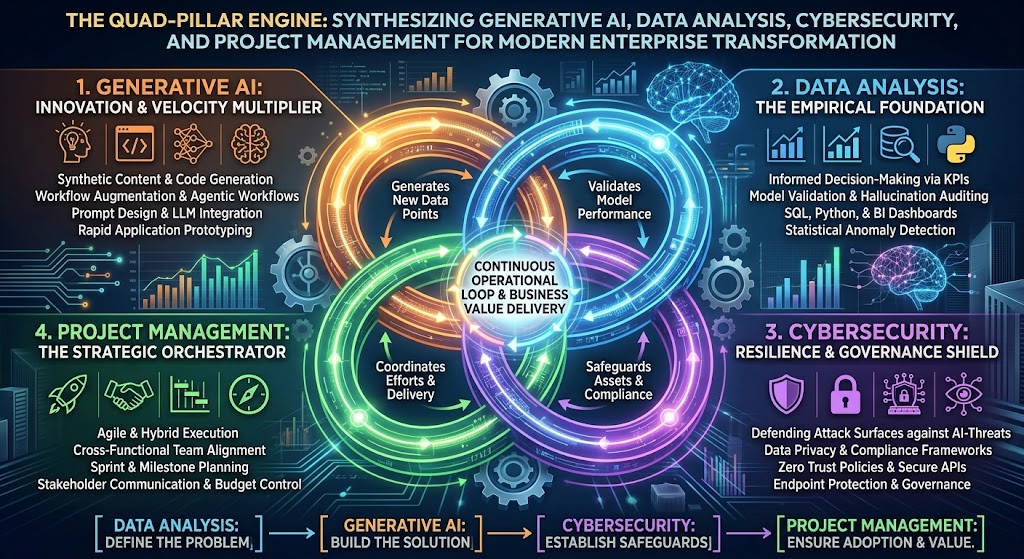
The Quad-Pillar Architecture: Orchestrating Generative AI, Data Analysis, Cybersecurity, and Project Management for Sustainable Enterprise Transformation
Modern technological transformation has outgrown single-discipline solutions. The enterprise landscape no longer rewards isolated technical mastery; instead, it demands an integrated operational framework capable of rapid innovation, empirical validation, systemic resilience, and disciplined execution. This operational synthesis is driven by four core pillars: Generative AI, Data Analysis, Cybersecurity, and Project Management.
When deployed in harmony, these disciplines form a self-reinforcing engine that converts raw complexity into measurable enterprise value while minimizing organizational risk.
+-----------------------------------------------------------------------------------+| The Quad-Pillar Enterprise Matrix |+----------------------+------------------------------------------------------------+| Generative AI | Velocity multiplier: code generation, synthesis, workflows || Data Analysis | Empirical foundation: statistical validation, telemetry || Cybersecurity | Defensive perimeter: zero trust, model governance, defense || Project Management | Strategic orchestrator: roadmap, cadence, cross-team ROI |+----------------------+------------------------------------------------------------+
Generative AI: The Velocity Multiplier
Generative AI (GenAI) has fundamentally altered the economics of production and automation. Leveraging large language models (LLMs), multimodal transformers, and autonomous agentic workflows, GenAI accelerates development lifecycles and eliminates operational friction.
- Accelerated Prototyping: Transformer architectures automate boilerplate code creation, script generation, and technical documentation, reducing feature deployment timelines from months to days.
- Knowledge Synthesis: Agentic search frameworks digest massive unstructured internal document repositories, enabling instantaneous decision support for frontline personnel.
- Workflow Augmentation: Natural language interfaces bridge non-technical users directly to underlying enterprise software, democratizing technical capabilities across business units.
Data Analysis: The Empirical Anchor
Generative systems operating without empirical boundaries generate hallucinations, stochastic drift, and systemic errors. Data analysis provides the mathematical rigor, diagnostic precision, and validation layer required to ground generative intelligence in objective reality.
- Diagnostic & Exploratory Telemetry: SQL pipelines, Python statistical suites, and interactive BI dashboards isolate operational bottlenecks and quantify user engagement.
- Algorithmic Verification: Quantitative analysts construct validation benchmarks to audit LLM outputs, measure drift across model updates, and monitor precision/recall metrics.
- ROI Quantification: Rigorous regression modeling and A/B testing establish whether algorithmic automations deliver net positive financial and operational yields.
Cybersecurity: The Resilient Defense and Governance Shield
As enterprises integrate automated generative engines and ingest high-volume telemetry, attack surfaces expand exponentially. Cybersecurity establishes the zero-trust architecture, identity governance, and threat detection necessary to protect critical assets.
- Defending the Expanded Perimeter: Securing endpoints and enterprise APIs against automated cyber threats, model inversion attacks, prompt injections, and data exfiltration pipelines.
- Data Governance & Model Compliance: Enforcing strict data-loss prevention (DLP) protocols to ensure proprietary corporate IP and sensitive customer data are never exposed to public training sets.
- Automated Threat Hunting: Deploying behavioral anomaly detection algorithms to identify intrusions, lateral movement, and unauthorized access across distributed infrastructure in real time.
Project Management: The Strategic Orchestrator
World-class algorithms, data pipelines, and security protocols produce zero enterprise value if they fail to align with business objectives or stall during operational rollout. Modern project management translates complex technical capabilities into structured, high-yield delivery cycles.
- Agile Governance & Cadence: Establishes sprint structures, milestone tracking, and cross-functional synchronization between machine learning engineers, data teams, and security auditors.
- Resource & Risk Allocation: Balances technological debt against feature velocity, ensuring computational budgets (cloud compute, token costs) stay aligned with projected business returns.
- Change Management & Adoption: Designs training frameworks and feedback loops that guide enterprise end-users through transition states, ensuring long-term adoption of new automated tools.
The Operational Closed Loop in Action
The real strength of this quad-pillar model lies in its continuous, closed-loop feedback mechanism:
[ Problem Definition & Telemetry ] ──► (Data Analysis) │ ▼[ Solution Generation & Automation ] ──► (Generative AI) │ ▼[ Threat Hardening & Zero-Trust ] ──► (Cybersecurity) │ ▼[ Alignment, Adoption & Value ] ──► (Project Management) │ └───► [ Continuous Operational Loop ]
- Identify: Data Analysis detects operational inefficiencies, customer churn markers, or throughput bottlenecks through empirical metrics.
- Build: Generative AI develops automated pipelines, code modules, or customer-facing solutions to address the identified challenge.
- Protect: Cybersecurity audits the generated code, sets role-based access policies, and validates data compliance boundaries.
- Deploy: Project Management coordinates cross-departmental integration, aligns executive stakeholders, and tracks KPI realization.
Organizations that view these four skills as disconnected verticals face stalled initiatives, vulnerable infrastructure, and untracked spending. Organizations that synthesize them into a single, unified operating model build resilient, scalable systems that consistently outperform the market.
 thelivingbreathingjamesbrown.com
You must be logged in to post a comment.