
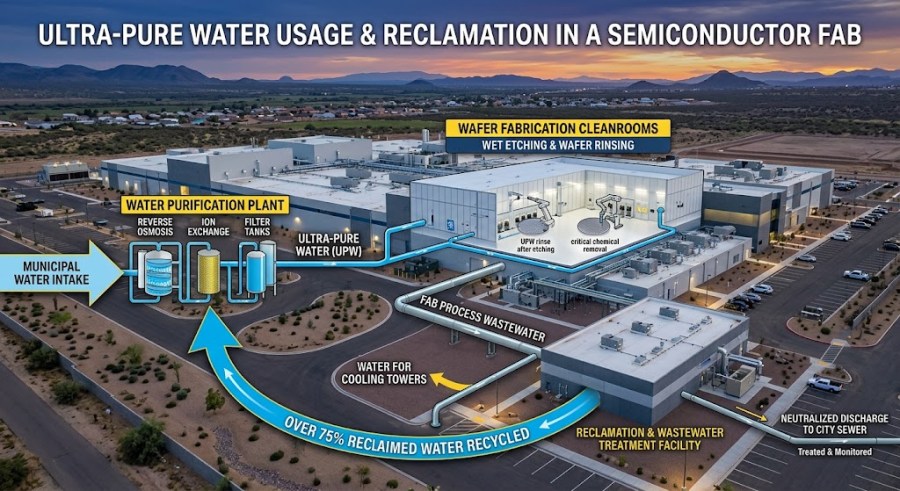
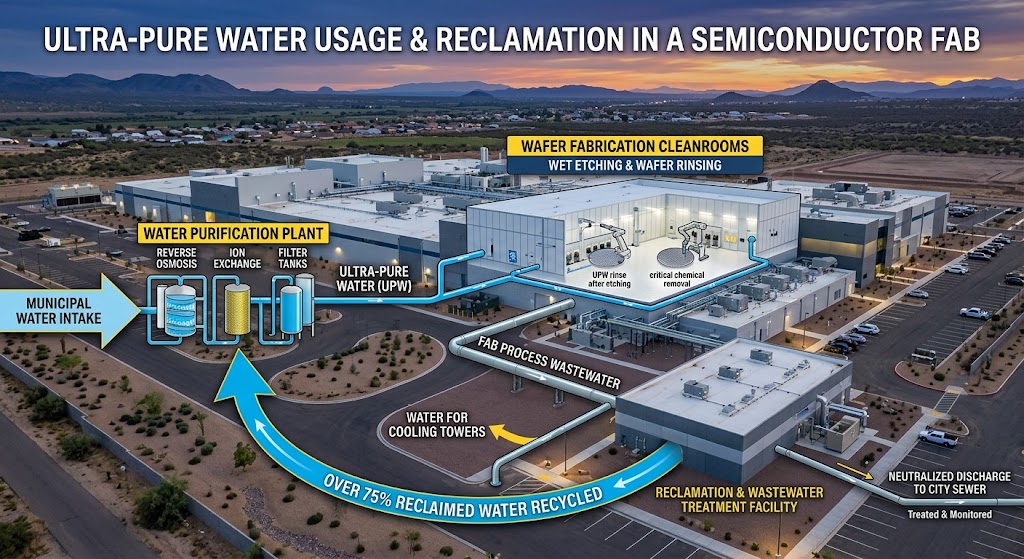
The collision between Texas’s rapid boom in semiconductor fabrication and its recurring drought cycles makes water reclamation a central policy flashpoint.
A modern semiconductor fabrication plant (“fab”) uses between 2 million to 10 million gallons of ultra-pure water (UPW) per day to rinse silicon wafers between etching and layering steps. In high-density tech hubs like Austin, Taylor, Sherman, and Richardson, that level of withdrawal puts severe strain on shared aquifers and municipal surface supplies.
The Reality of Mandating Water Recycling
Why Texas Relies on Market and Infrastructure Pressures
- State Regulatory Environment: The Texas Commission on Environmental Quality (TCEQ) regulates water discharge quality and municipal withdrawal permits, but the state has historically avoided across-the-board operational recycling mandates on private industry. State-level initiatives (like the Texas CHIPS Act) prioritize capital incentives and economic expansion over statutory process restrictions.
- Local Utility Constraints: Rather than state mandates, pressure usually comes from municipal utility contracts. Cities like Taylor (supplying Samsung) and Austin (supplying NXP and Infineon) must balance industrial allocations against resident water security, often embedding recycling benchmarks or surcharges into local service agreements.
- Voluntary High Targets: Because water supply volatility poses a direct operational risk to billions in fab investments, companies voluntarily target circular systems. Major players operating in Texas (such as Texas Instruments, Samsung, and NXP) aim to reclaim between 60% and 90% of their process water, primarily through multi-stage reverse osmosis, ion exchange, and closed-loop cooling towers.
Challenges of an Absolute State Mandate
| Policy / Operational Factor | Implication for Fabs & Regulators |
|---|---|
| High Treatment Energy Demand | Treating wastewater laden with heavy metals, solvents, and fluorinated compounds back into UPW requires significant energy, competing with Texas’s already strained ERCOT electric grid. |
| Hazardous Waste Concentration | Higher recycling rates yield concentrated brine and chemical sludge (such as PFAS and heavy metal byproducts) that require specialized disposal or hazardous waste landfilling. |
| Capital Thresholds for Older Fabs | While greenfield sites (new fabs) can easily engineer closed-loop UPW systems from the ground up, retrofitting legacy 200mm fabs requires massive capital expenditures and operational downtime. |
| Interstate Competition | Texas lawmakers frequently voice concern that strict environmental mandates could push future multibillion-dollar fab expansions toward states offering fewer operational restrictions. |
The Epstein Dossier Disclosures
Your referenced briefing details the post-2025 landscape regarding the Jeffrey Epstein case:
- Statutory Releases vs. Withholding: The tensions between the Epstein Files Transparency Act disclosures and ongoing federal records withholding reflect standard post-statutory FOIA disputes, where executive-branch redaction claims clash with legislative mandates.
- Jurisdictional & Evidentiary Hurdles: The shift toward civil claims, peripheral financial fraud, and state-level investigations illustrates the fundamental procedural limits of criminal prosecution decades after alleged predicate offenses—especially where expired statutes of limitations and historic non-prosecution agreements constrain federal action.
The proposed SpaceX and Tesla “Terafab” semiconductor plant in Grimes County is projected to use anywhere from 1 million to 8 million gallons of water per day once operational, depending on the scale and phase of production. [1, 2, 3]
Water Usage Details
- Standard Baseline: A typical standard semiconductor fabrication plant uses about 1 to 2 million gallons daily. [1]
- Projected Scale: Due to the massive planned size of the Terafab project at the Gibbons Creek Reservoir site, industry projections scale demand as high as 8 million gallons per day. [1, 2]
- Source: Project plans indicate water for the facility will be pulled from the Gibbons Creek reservoir rather than local groundwater supplies, alongside promises of self-sustaining power and on-site water recycling. [1, 2]
If you’re tracking local industrial developments or resource impacts in the area, would you like information on:
- Water recycling or power generation plans for the Gibbons Creek site
- Timeline and construction phases of the Terafab project
- Economic or tax abatement details discussed by Grimes County officials

SPACEX TO BUILD $16.8B SEMICONDUCTOR PLANT IN TEXAS …
SPACEX TO BUILD $16.8B SEMICONDUCTOR PLANT IN TEXAS Gov. Greg Abbott announced that SpaceX will build a vertically integrated semiconductor fabrication plant in…


YouTube·Interesting Engineering Explains


1:20
Elon Musk’s Terafab: Inside the $16.8 billion AI chip plant Tesla and SpaceX are …

KBTX News 3
KBTX requested public records about SpaceX. Now, Grimes County …
Jul 1, 2026 — State records show water rights at the Terafab site were quietly expanded years ago. Meanwhile, Grimes County is asking the Texas Attorney General to weigh in o…


Interesting Engineering
SpaceX to build on-site natural gas plant for $55b Texas semiconductor site
Aug 7, 2026 — SpaceX promises self-sustaining power and water recycling for $55b Grimes County project. For Grimes County, the arrival of Terafab could permanently alter the …


You must be logged in to post a comment.