
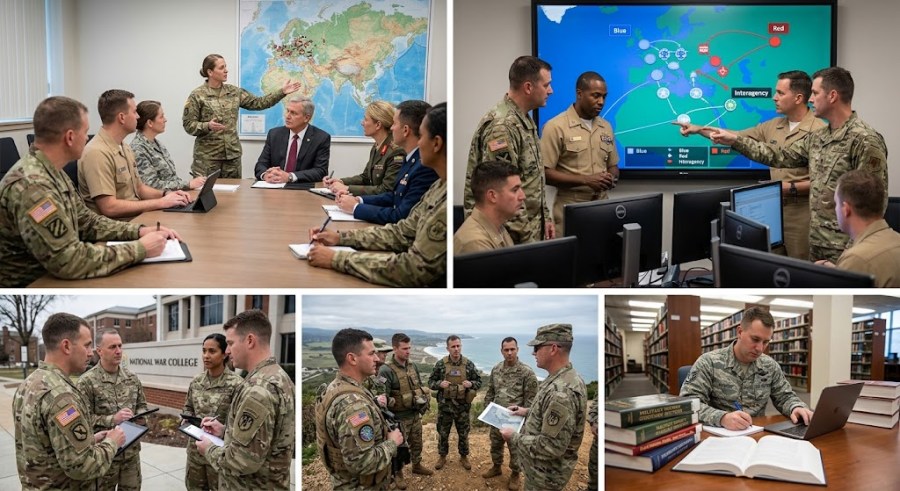
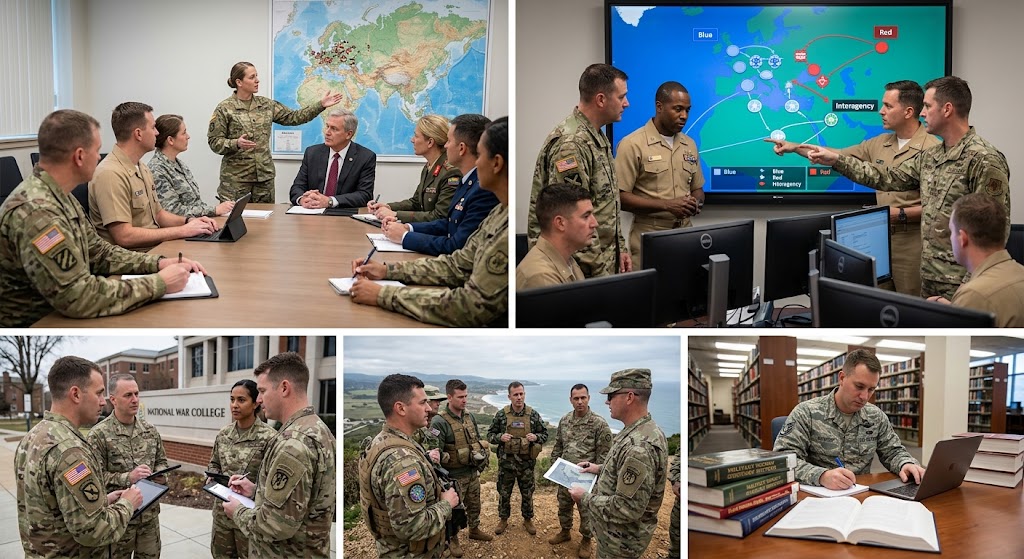
The U.S. War College—most prominently embodied by the U.S. Army War College at Carlisle Barracks, Pennsylvania, alongside its sister senior service institutions (the Naval War College, Air War College, and the National War College)—is the intellectual crucible of American grand strategy. It does not train men and women to command a tank platoon, pilot a fighter, or clear a trench. It teaches senior leaders how to align the raw destructive power of the military with the political, economic, and moral objectives of the nation.
Carlisle Barracks, Pennsylvania. Source: Kevin Dietsch / Getty Images
What the War College Does
Founded originally in 1901 by Secretary of War Elihu Root under the mandate “not to promote war, but to preserve peace by intelligent and adequate preparation to repel aggression,” the college bridges the gap between tactical combat and national security policy.
The institution functions across four primary pillars:
- Graduate-Level Strategic Education: Students earn a fully accredited Master of Strategic Studies (MSS). The curriculum strips away branch-centric thinking, immersing officers in global landpower doctrine, international relations, joint-force integration, civil-military relations, and theater campaign design. Wikipedia+ 1
- The Strategic “Think Factory”: Through specialized centers like the Strategic Studies Institute (SSI) and the Center for Strategic Leadership, faculty and fellows research real-time geopolitical crises, publishing unvarnished assessments directly for the Joint Chiefs of Staff and the Department of Defense. Army University
- High-Level Wargaming and Simulations: Seminars routinely stress-test crisis response plans against near-peer adversaries, non-state threats, and regional economic collapse, testing theories against volatile friction points.
- Interagency and Coalition Cohorts: Seminars do not consist solely of Army officers. They mix active-duty leaders across all military branches, interagency civilians (from the State Department, CIA, NSA, and USAID), and international military fellows from allied nations. Britannica
Duration and Attendance Formats
Admission to the War College is highly competitive, reserved for hand-selected Lieutenant Colonels, Colonels, and equivalent civilian senior executives (GS-14/15). The college operates on two primary tracks:
- Resident Education Program (10 Months): An intensive, full-time academic year running from late summer to late spring at Carlisle Barracks. Officers are pulled entirely from operational duties to focus solely on reading, writing, seminar debate, and strategic analysis.
- Distance Education Program (2 Years): A rigorous program designed for operational senior commanders, National Guard, Reserve officers, and federal civilians. It requires continuous online seminar coursework capped by two intensive two-week resident phases on campus. dcp.psc.gov
Why War Planners Need This Knowledge
War at the tactical level is concrete: seizing high ground, maintaining lines of supply, destroying armor, and securing sectors. Strategy, however, is abstract, ambiguous, and non-linear.
The War College forces planners to master the fundamental relationship defined by Carl von Clausewitz: War is the continuation of politics by other means.
- Synchronizing the “DIME” Instruments: Planners learn that military force (M) cannot succeed in a vacuum. It must operate alongside Diplomatic (D), Informational (I), and Economic (E) power. A planner who only knows how to maneuver divisions will never understand how currency reserves, sanctions, allied diplomacy, and information networks determine victory.
- Mastering “Ends, Ways, and Means”: The core Carlisle model requires planners to identify the desired end-state (Ends), formulate the operational concept (Ways), and allocate the actual resources (Means). If any of these three legs is out of balance, the plan is bankrupt before the first shot is fired.
- Navigating the Civil-Military Interface: Senior officers must advise civilian elected leaders candidly without crossing into insubordination. Planners need the historical and ethical grounding to explain military realities to political leadership and translate political guidance into sound military campaigns.
Why Planners Without Strategic Depth Fail
History is littered with armies that won every single battle on the ground, yet lost the war. When war planners lack strategic education, operational brilliance becomes a highway to strategic defeat:
- Confusing Operational Velocity with Victory: A tactician measures success by enemy casualties or territory seized. In Vietnam, tactical victories in every major engagement did not prevent strategic failure because tactical dominance was disconnected from local political dynamics and long-term domestic will.
- The “What Then?” Blindspot: Untrained planners plan the invasion and ignore the aftermath. The 2003 march on Baghdad was a textbook display of rapid tactical combined-arms maneuver; yet the absence of strategic post-conflict planning (Phase IV operations) unleashed chaos, insurgency, and decades of regional instability.
- Overestimating Military Force Alone: Leaders who lack strategic rigor treat military action as a universal hammer. They assume firepower can force political reconciliation or invent governance where none exists, bleeding national treasure against intractable cultural realities.
Without the breadth of study provided by a War College, a planner remains a mechanic of destruction rather than an architect of durable peace. At the tactical level, mistakes cost lives; at the strategic level, mistakes cost nations.
Want to look at the differences between the Army, Navy, and National War Colleges? Yes
While all three institutions educate senior leaders for joint, high-level command, they differ significantly in academic culture, strategic lens, and organizational parentage.
| Institution | Location & Parent Body | Core Strategic Focus | Student Body Breakdown | Signature Hallmark |
|---|---|---|---|---|
| U.S. Army War College (USAWC) | Carlisle Barracks, PA (Department of the Army) | Landpower & Theater Campaign Planning: Translating national policy into large-scale ground and joint operational campaigns. | Plurality Army (active, Guard, Reserve), balanced with sister services, interagency civilians, and allied international fellows. | Deep focus on civil-military relations, senior executive leadership, and the “Ends-Ways-Means” framework for theater design. |
| Naval War College (NWC) | Newport, RI (Department of the Navy) | Maritime Strategy & Global Commons: Freedom of navigation, littoral and blue-water operations, and sea-control deterrence. | Plurality Navy and Marine Corps, alongside sister services, State Department, and international naval officers. | Heavy emphasis on historical case studies, classical strategy (Mahan, Corbett, Sun Tzu), and complex wargaming traditions. |
| National War College (NWC) | Fort McNair, Washington, D.C. (National Defense University / JCS) | Grand Strategy & Interagency Power: Direct synthesis of all instruments of national power (DIME) at the highest presidential and cabinet level. | Mandated 60/40 or 50/50 balance: roughly half military (all services equally divided) and half civilian interagency (State, CIA, Treasury, DoD). | Intense focus on diplomacy, foreign policy formulation, and direct proximity to the Pentagon and Capitol Hill policymakers. |
Key Differences in Practice
- Operational vs. Grand Strategic Scope: The Army and Naval War Colleges are Service War Colleges. While joint-accredited, they view global problems through the operational employment of their respective domains—land and maritime power. The National War College is a Joint/National institution operating one tier higher; it focuses almost entirely on grand strategy, statecraft, and diplomatic-military alignment rather than theater military campaign execution.
- Classroom Dynamic: At Carlisle (Army) and Newport (Navy), military operational culture remains the baseline vernacular. At Fort McNair (National), a State Department diplomat, an intelligence analyst, an infantry colonel, and a naval aviator sit together in equal measure, intentionally forcing military planners to justify assumptions to civilians who manage the diplomatic and economic levers of power.
- Strategic Thinkers: The Naval War College leans heavily into naval theorist Alfred Thayer Mahan and Julian Corbett; Carlisle builds heavily upon Carl von Clausewitz and theater-level logistics; the National War College concentrates on diplomatic historians, geopolitical theorists, and real-time National Security Council decision-making.
Would you like to explore how wargaming differs between these institutions, or how their curricula evolved after the Goldwater-Nichols Act? Yes
Wargaming design and post–Goldwater-Nichols curriculum reforms showcase exactly how these senior institutions train strategic minds differently.
How Wargaming Differs Across the Colleges
While each institution uses simulations to stress-test doctrine, the scale, rulesets, and primary friction points reflect their unique strategic purviews.
- Naval War College (The Cradle of Wargaming):
- Origin & Heritage: Newport has run wargames since 1887, famously credited by Admiral Chester Nimitz for anticipating every operational move in the Pacific during WWII except the kamikazes.
- Focus: Global maritime commons, choke points (e.g., Malacca, Hormuz, Taiwan Strait), distributed maritime operations, and multi-domain fleet engagement.
- Mechanics: Highly analytical, data-driven, and often operational-to-tactical in nature. Games rigorously model logistics chains, missile magazines, sonar coverage, and sensor-to-shooter delays across vast oceanic distances.
- Army War College (Campaigning & Sustainment):
- Focus: Theater-level campaign design, land domain dominance, contested logistics, and coalition integration.
- Mechanics: Centered on the Center for Strategic Leadership (CSL), Carlisle’s wargames place heavy emphasis on theater opening, port access, supply lines, and deep ground sustainment.
- The Human Friction: Carlisle’s games intentionally force students to navigate non-combatant evacuation operations (NEO), urban warfare friction, civilian displaced persons, host-nation political constraints, and the messy reality of consolidating gains post-combat.
- National War College (Cabinet-Level Crisis Simulation):
- Focus: Grand strategic crisis management, National Security Council (NSC) dynamics, and whole-of-government synchronization.
- Mechanics: Almost entirely political-military (Pol-Mil). Troops on a map matter far less than economic sanctions, diplomatic backchannels, cyber operations, United Nations resolutions, and congressional authorization.
- The Red Team Dilemma: Rather than testing weapon capabilities, scenarios test whether the U.S. can deter aggression without escalating into direct nuclear confrontation or bankrupting global alliances.
The Goldwater-Nichols Watershed (1986)
The passage of the Goldwater-Nichols Department of Defense Reorganization Act of 1986 triggered the largest overhaul of military education in modern U.S. history.
Prior to 1986, service war colleges were largely tribal. The Army studied land warfare in isolation, the Navy focused on maritime dominance, and the Air Force prioritized strategic bombing. Cross-service cooperation was notoriously plagued by rivalry, communication failures, and incompatible command structures—flaws laid bare during the Vietnam War, the failed 1980 Iran hostage rescue attempt (Operation Eagle Claw), and the 1983 invasion of Grenada.
Goldwater-Nichols fundamentally altered the colleges in three ways:
- Mandated Joint Professional Military Education (JPME): The law created JPME Phase II accreditation standards. To make General or Admiral (O-7), officers were legally required to complete joint education and serve in joint billet assignments outside their parent service.
- Cross-Pollination of Classrooms: Congress broke the branch monopolies. A Carlisle or Newport classroom could no longer consist solely of soldiers or sailors. Every seminar was restructured to enforce cross-service representation, ensuring airmen, sailors, soldiers, and Marines were forced to plan alongside one another.
- Shift from Service Doctrine to Joint Doctrine: The curricula shifted focus toward combatant commands (COCOMs) like INDOPACOM and CENTCOM. Students were no longer taught merely how their service fought; they were trained to serve on a unified joint staff, planning unified campaigns where air, land, sea, cyber, and space operate under a single joint force commander.
The result transformed senior war colleges from branch-specific finishing schools into rigorous incubators for joint theater commanders and strategic advisers to the civilian leadership.


You must be logged in to post a comment.