
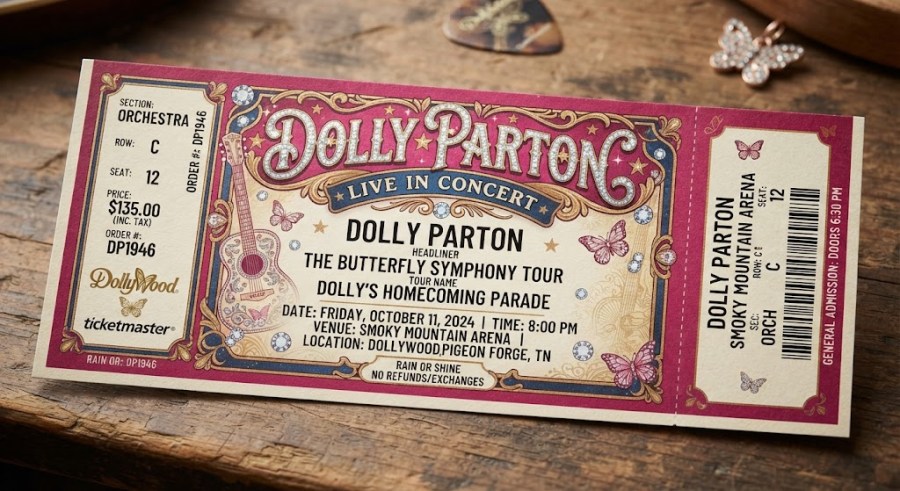
The Great Smoky Mountains don’t just touch the sky; they breathe. They shimmer in layers of blue mist, hold secrets in their ancient hollows, and for one particular family in Locust Ridge, Tennessee, they were a lullaby.
In 1946, in a tiny, one-room cabin nestled on the banks of the Little Pigeon River, Dolly Rebecca Parton was born. She was the fourth of twelve children—a beautiful, chaotic, and loving flood of siblings that would become both her foundation and her inspiration.
Life in the mountains was hardscrabble, but it was rich in song. Her mother, Avie Lee, was a wellspring of mountain ballads and folklore, while her grandfather, Jake Owens, was a fiddling preacher who filled the house with melody and faith. From her earliest days, Dolly wasn’t just listening to music; she was absorbing it, understanding that a song wasn’t just notes on a page—it was a lifeline.
Her first instrument, before she ever held a guitar, was a shiny, five-pound lard tin that served as a drum. By the age of six, she was making her own instruments, stretching a single wire across the front porch board to create a makeshift “do-bro.” By eight, her uncle had gifted her a real guitar, and she was already crafting her own songs, pouring the big emotions of a little girl into three chords and the truth.
But even a little girl with a lard tin drum knows there’s a bigger world beyond the peaks. Dolly carried a dream as large as the mountains themselves. The world, however, didn’t always see the giant talent hidden in a wisp of a girl in rhinestones and towering wigs.
Her journey began on the local radio station, WIVK, in Knoxville. She was barely big enough to reach the microphone, standing on a box to belt out tunes. But she was magnetic. From there, she conquered the local TV show, The Cas Walker Farm and Home Hour. Cas Walker, a cantankerous local celebrity, told her she wasn’t good enough to sing country music, that she was too “skinny and high-pitched.”
Dolly, who already possessed the spine-straight resilience of a mountain pine, didn’t just prove him wrong; she danced past him on her way to the Grand Ole Opry.
The pivotal moment came not with applause, but with a polite knock on a hotel room door. It was 1964. Porter Wagoner, the star of the most popular syndicated country music show in America, was searching for a new “girl singer” to replace his retiring duet partner. Dolly got the gig.
For seven years, Dolly and Porter were a country music phenomenon. They shared stages, toured the nation, and their voices intertwined seamlessly. But Dolly was not a second fiddle; she was a symphony waiting for its own stage. Porter wanted her to be the charming “sweetheart of country,” but Dolly’s ambitions were soaring.
The struggle to be heard, to be taken seriously as a songwriter, was fierce. She penned “Coat of Many Colors,” a song about a tiny jacket stitched with love and rags by her mother. When she sang it, the room fell silent. Even Porter couldn’t argue with that kind of magic. It was a song about pride, resilience, and the simple, transformative power of love—themes that would define her entire career.
But perhaps her defining moment as a businesswoman and artist was her decision to leave the Porter Wagoner Show. It was painful, professionally and personally, but Dolly knew she couldn’t fly while tethered to someone else’s star.
When she left, she went home and wrote “I Will Always Love You.” Not for a lover, but as a heartfelt, professional goodbye to Porter. It was a farewell with dignity, respect, and an unwavering sense of self-worth.
That song, and the subsequent album, Jolene, launched her into the stratosphere. Dolly wasn’t just singing country; she was redefining it, adding pop sensibilities, glitter, and a heart-stopping vulnerability that transcended genres. She became a global superstar, a household name, and an icon of the American spirit.
Yet, the truest measure of Dolly Parton is not her Grammy awards, her songwriting prowess (3,000 songs and counting), or her business acumen. It is her humanity.
In 1988, channeling the memory of her father, Robert Lee Parton—a hardworking, illiterate man who could never read the songs his daughter wrote—she launched the Imagination Library. The program sends a free, high-quality book every month to children from birth until they enter kindergarten, regardless of their family’s income.
It began in her home county, but like everything Dolly touches, it grew. The Imagination Library now spans five countries and gifts over 2 million books every single month. It is a staggering legacy of literacy and love, a gift given to millions of children who, thanks to Dolly, can dream bigger and see farther than they ever thought possible.
Today, Dolly Parton is so much more than a singer. She is a cultural touchstone, a beacon of kindness in a sometimes-cynical world, and a living testament to the power of staying true to your roots while keeping your eyes on the stars.
From that tiny cabin on the Little Pigeon River to the global stage, she never lost sight of the girl who wore a coat of many colors. She is our glittery, guitar-strumming Saint of the Smoky Mountains, a woman who proved that talent, hard work, and, above all, a generous heart, can make a life that is nothing short of super wonderful.


You must be logged in to post a comment.