
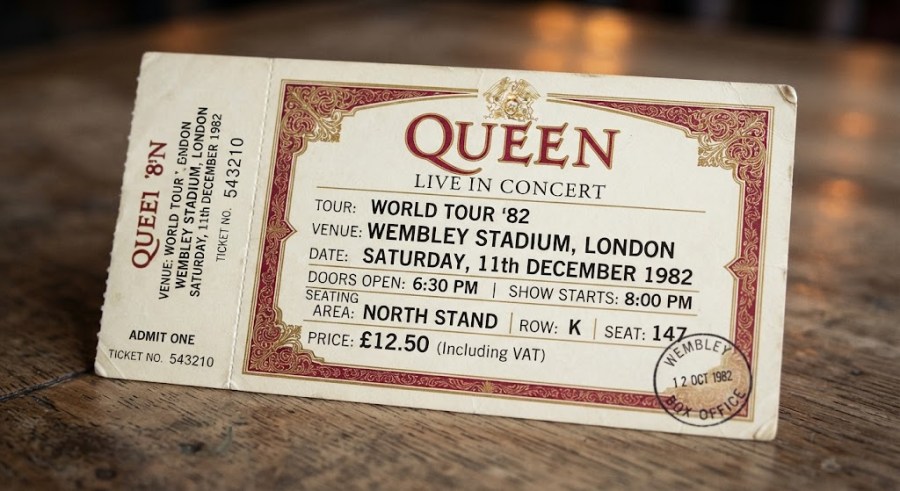
The Voice That Echoed Through Eternity
The air in Wembley Stadium hung thick and heavy with electricity. It was July 13, 1985. Backstage, behind the sprawling sea of seventy-two thousand waiting souls, a slight man in a white tank top and studded leather belt stretched his vocal cords.
To the world, he was Freddie Mercury—the flamboyant, larger-than-life frontman of Queen, a creature of neon lights, starlight, and theatrical bravado. But in the quiet moments before stepping into the blinding London sun, Farrokh Bulsara felt the crushing weight of a shy boy born in Zanzibar, a piano player who had chased a dream across oceans.
“Five minutes, Freddie!” a stage manager called out, his voice trembling slightly with the gravity of the moment.
Freddie nodded, adjusting his collar. He didn’t just want to sing; he wanted to command time itself.
When he finally bounded onto the stage, the roar was deafening—a physical shockwave that could have knocked a lesser man flat. Yet, with a single, sweeping gesture of his arm, Freddie seized the crowd. For the next twenty minutes, he didn’t just perform Live Aid; he defined it.
As his fingers hammered out the opening chords of Bohemian Rhapsody and his voice soared effortlessly from a raspy growldown into celestial heights, time seemed to bend. In that fleeting fragment of history, decades of human triumphs and heartbreaks coalesced into a single, unified chorus of “Radio Ga Ga.” For millions watching across the globe, the universe narrowed down to a piano bench, a microphone stand held like a sceptre, and a man who refused to let his music—or his spirit—ever fade away.
The Markers of Time: Understanding Historical Eras
Just as Freddie Mercury left an indelible stamp on musical history, humanity has spent millennia inventing ways to mark and measure the passage of time itself. When looking back at the timeline of human civilization, you will frequently see abbreviations like BC, AD, BCE, and CE.
Here is what these additions to past history mean and how they work:
- AD (Anno Domini): Latin for “in the year of the Lord.” It refers to the years following the estimated birth of Jesus of Nazareth. For example, the year Freddie Mercury was born—1946—can technically be written as 1946 AD.
- BC (Before Christ): Refers to the years counted backward before the estimated birth of Jesus. For example, the construction of the Great Pyramid of Giza around 2500 BC happened 2,500 years before that baseline epoch.
- BCE (Before Common Era) & CE (Common Era): These are secular alternatives to BC and AD. CE replaces AD, and BCE replaces BC. They use the exact same numerical years and timeline, but strip away the religious terminology to make the dating system globally inclusive for academic and cross-cultural use (e.g., 2026 CE is the same as 2026 AD).
- BP (Before Present): Frequently used in archaeology and geology, this counts backward from a fixed scientific baseline (specifically, January 1, 1950).
Unlike a musical score with a clear beginning and end, human history is an ongoing symphony, anchored by these systems to help us understand where we stand in the grand progression of time.


You must be logged in to post a comment.