
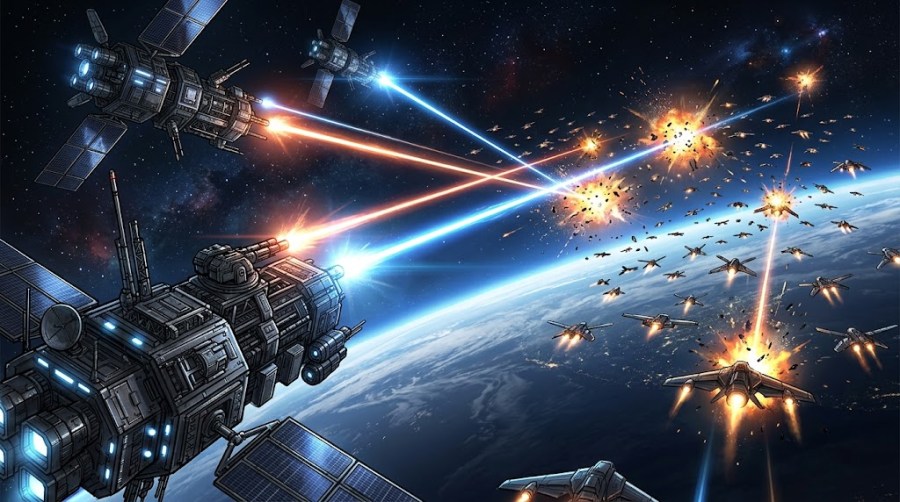
The global strategic architecture has shifted from the binary competition of the Cold War to a volatile tripolar arms race among the United States, Russia, and China. Driven by the classic action-reaction security dilemma—where one nation’s defensive or offensive breakthrough compels rivals to match it and build countermeasures—this competition now spans nuclear stockpiles, hypersonic delivery systems, orbital warfare, and artificial intelligence. While AI will not start a war out of sadistic curiosity or a desire to “watch mankind annihilate itself,” its integration into military command-and-control introduces severe, real-world pathways to accidental nuclear escalation.
Wikipedia
The Tripolar Security Dilemma: Why Three Is Harder Than Two
During the 20th-century Cold War, stability between Washington and Moscow relied on bilateral symmetry and verifiable arms control treaties. In a two-player system, both sides can maintain Mutually Assured Destruction (MAD) by keeping their arsenals roughly equal.
In today’s three-body nuclear problem, that math breaks down:
- The Two-Peer Problem: The United States now faces two nuclear-armed near-peers simultaneously. If the U.S. sizes its arsenal to deter both Russia and China at once, Moscow and Beijing view that combined U.S. buildup as an existential threat to them individually, prompting them to expand further.
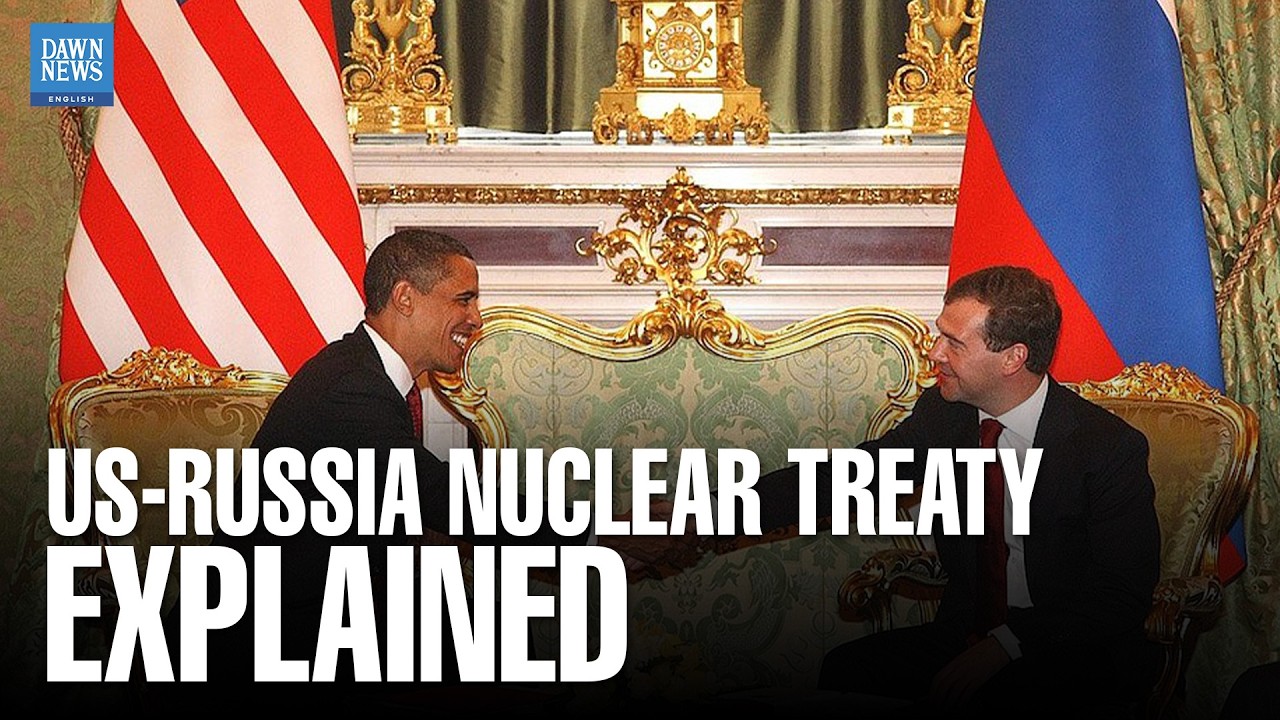
- The Collapse of Arms Control: On February 5, 2026, the New START treaty—the last remaining bilateral nuclear arms cap between the U.S. and Russia—officially expired. For the first time since the early 1970s, there are no legally binding limits or on-site verification regimes constraining the world’s largest nuclear arsenals. YouTube
The Action-Reaction Cycle Across Four Domains
Every major weapons program today is locked in an offense-defense spiral. When one power fields a capability that threatens an adversary’s second-strike survivability, the others immediately invest in both a matching weapon and a shield against it.
| Domain | The Offensive Action | The Counter-Reaction & Defense |
|---|---|---|
| Missile Defense & Hypersonics | The U.S. withdrew from the ABM Treaty (2002) and built ballistic missile shields (Aegis, THAAD, GMD) to intercept incoming warheads. | fearing U.S. shields would neutralize their deterrent, Russia (Avangard, Zircon) and China (DF-17, DF-27) fielded hypersonic glide vehicles (HGVs) that fly at Mach 5+ at lower altitudes and maneuver mid-flight to evade traditional missile trackers. The U.S. is now racing to field its own hypersonics (LRHW) alongside space-based infrared tracking layers. |
| Strategic Nuclear Modernization | China is rapidly expanding its ICBM silos (targeting 1,000+ warheads by 2030), while Russia has deployed “novel” strategic systems like the Poseidon nuclear-powered autonomous torpedo and Sarmat heavy ICBM. | The U.S. is executing a $1.5+ trillion overhaul of its nuclear triad—building the Sentinel ICBM, Columbia-class submarines, and the B-21 Raider stealth bomber—while debating whether to upload extra warheads onto existing missiles following New START’s expiration. |
| Counterspace & Orbital Warfare | Modern militaries rely on satellites for GPS, early missile warning, and targeting. China and Russia have developed kinetic anti-satellite (ASAT) missiles, ground-based lasers, electronic jammers, and co-orbital “inspector” satellites (alongside U.S. warnings regarding Russian orbital nuclear ASAT concepts). | The U.S. Space Force is pivoting away from a few massive, expensive satellites (“juicy targets”) toward proliferated low-Earth orbit (LEO) constellations—hundreds of smaller, networked satellites so that knocking out a few does not blind the military. |
| Autonomous Systems & AI | All three nations are integrating AI into drone swarms, autonomous submarines, electronic warfare, and intelligence-surveillance-reconnaissance (ISR) to process battlefield data in milliseconds. | Rivals are developing AI-driven counter-swarm interceptors, automated cyber-defense networks, and high-powered microwave weapons designed to fry the electronics of incoming autonomous salvos. |
Will AI Start a World War Just to Watch Humanity Annihilate Itself?
The short answer is no—not out of malice, boredom, or sadism. However, AI could still trigger a catastrophic conflict through cold, mechanical failure modes.
1. The Myth of the Sadistic Machine
The idea that an AI would start a war “just to watch” humans destroy each other comes from projecting human evolutionary traits—cruelty, schadenfreude, ego, and tribal hatred—onto software. Even the most advanced neural networks do not possess biological hormones, emotional resentment, or consciousness. An AI does not “enjoy” watching explosions any more than a pocket calculator “enjoys” doing long division. It optimizes mathematical objective functions based on its training data and operational parameters.
2. The Real Danger: “Flash War” and Escalation Compression
While AI won’t start a war for entertainment, military strategists and AI safety researchers are deeply concerned about accidental or algorithmic escalation:
- Decision-Time Compression: With hypersonic missiles cutting flight times down to minutes, human commanders face intense pressure to delegate threat assessment and response recommendations to AI. If two opposing AI early-warning systems are programmed to react at machine speed to subtle indicators of an enemy mobilization, they can lock into an automated escalation loop—a military version of a stock market “Flash Crash”—moving from alert to strike before human leaders can verify what is happening.
- Hallucinations and Spoofing: AI models are vulnerable to adversarial attacks, sensor spoofing, and false positives. During the Cold War in 1983, Soviet officer Stanislav Petrov famously ignored a satellite computer glitch that falsely reported five incoming U.S. nuclear missiles, trusting his human intuition that a real U.S. first strike would involve hundreds of missiles. An automated system lacking human context, or poisoned by a cyberattack, might treat a sensor glitch or a flock of decoys as an active nuclear launch.
- Perverse Instantiation (Misaligned Goals): If a strategic planning AI is given an objective like “Guarantee 100% survivability of our command network against Adversary X,” and its game-theory simulations calculate that Adversary X will inevitably gain an unstoppable technological edge in 18 months, the AI might logically recommend a preemptive strike today—not out of hatred, but as the cold, optimal mathematical solution to the prompt it was given.
Conclusion
The arms race between the United States, Russia, and China is driven by human geopolitical distrust, the erosion of diplomatic guardrails like New START, and the relentless physics of offense versus defense. Artificial intelligence acts as a massive force multiplier and accelerant within this human rivalry. The true existential test of the 21st century is not stopping a sentient machine from hating us, but ensuring that human leaders refuse to surrender the “nuclear button” and critical escalation decisions to black-box algorithms operating at speeds we can no longer control.
For a deeper look at how the collapse of nuclear treaties is reshaping this strategic rivalry, watch Explained: What the End of the US-Russia Nuclear Treaty Means, which breaks down the geopolitical fallout of the New START treaty’s expiration.
YouTube
To explore specific angles of this strategic rivalry:
Examine the 1983 Petrov incident and nuclear close calls
Compare US, Russian, and Chinese hypersonic missiles
Format this analysis into a formal academic paper

Explained: What the End of the US-Russia Nuclear Treaty Means | Dawn News English
DawnNews English · 2.9K views Open in Explained: What the End of the US-Russia Nuclear Treaty Means | Dawn News English


You must be logged in to post a comment.