

- Měiguó rén zāoshòule tāmen zuìdà de sǔnshī)
Word-by-Word Breakdown
- 美国人 (Měiguó rén): Americans
- 遭受了 (zāoshòule): suffered / experienced
- 他们 (tāmen): their / them
- 最大的 (zuìdà de): greatest / biggest
- 损失 (sǔnshī): loss / damage

OPERATION NIGHTFALL: THE SCARECROW GRID
Prologue: The Line of Wooden Shacks
For seven months, satellite reconnaissance over the Zagros Mountains and the central plateau had logged them as Project Scarecrow—an eccentricity of Iranian engineering that Pentagon analysts couldn’t quite agree on.
Four hundred and twelve steel lattice towers, each two hundred feet high, spaced across the desert plateaus and mountain passes. Perched atop every single pylon was a weathered, identical pine structure roughly four feet wide by seven feet tall. The aerial imaging techs at Fort Meade called them “The Flying Outhouses.” Some analysts theorized they were passive acoustic drone sensors; others dismissed them as psychological decoys designed to waste precision-guided JDAMs.
They were neither.
Four hundred and eleven were dummy shells housing empty air and car batteries powering intermittent radio squeals.
Tower 209, erected on a ridge just south of Isfahan, was different. Bolted inside its wooden walls sat an unshielded, compact physics package—a clean-burn, yield-enhanced thermonuclear implosion warhead delivered via deep-sea container through Bandar Abbas, stripped of its original serial plates, courtesy of a Pyongyang-Beijing black-channel trade. It had no heavy ballast, no guidance fins, and no missile booster to track. It didn’t need to fly. It was already where it needed to be.
Phase I: The Hammer Falls
Two weeks after the contentious November midterms, the orders cleared the Situation Room.
In a joint coalition strike designed to decapitate Tehran’s command and control in a single blow, the sky above the Persian Gulf ignited. Nearly three hundred coalition combat aircraft took to the air: U.S. Air Force F-35As and F-15EXs, Israeli F-35I Adirs cutting low across Jordan and Iraq, and Royal Saudi Air Force F-15SAs flying escort along the southern vector. Out in the Arabian Sea and the Gulf of Oman, three Carrier Strike Groups—the Nimitz, the Ford, and the Lincoln—vectored their combat air patrols and launched their opening salvo of electronic-warfare EA-18G Growlers.
The vanguard of 150 strike fighters crossed the frontier into Iranian airspace at Mach 1.2, banking between the mountain silhouettes.
Inside Tower 209, a hard-wired fiber-optic relay pulsed once.
Phase II: The Pulse
There was no fireball touching the ground. There was only a blinding, instantaneous flash that turned the midnight sky over Iran into midday violet.
The warhead detonated at an altitude calculated precisely to optimize the high-altitude Compton effect: the E1 pulse.
A massive wave of high-energy electromagnetic radiation swept across the hemisphere at the speed of light. In microseconds, an electric field intensity exceeding 50,000 volts per meter cascaded across hundreds of square miles.
In the cockpits of the strike force, fly-by-wire flight management computers didn’t just crash—their silicon substrates literally vaporized into molten solder. The modern avionics suites, radar antenna arrays, and datalinks linking the fighters acted as giant antennas feeding the surge directly into their core processors:
- Control surfaces locked in place at supersonic velocity.
- Jet turbines starved of digital fuel-metering flared and surged into violent catastrophic stalls.
- Canopy ejector circuits blew prematurely or died cold in the console.
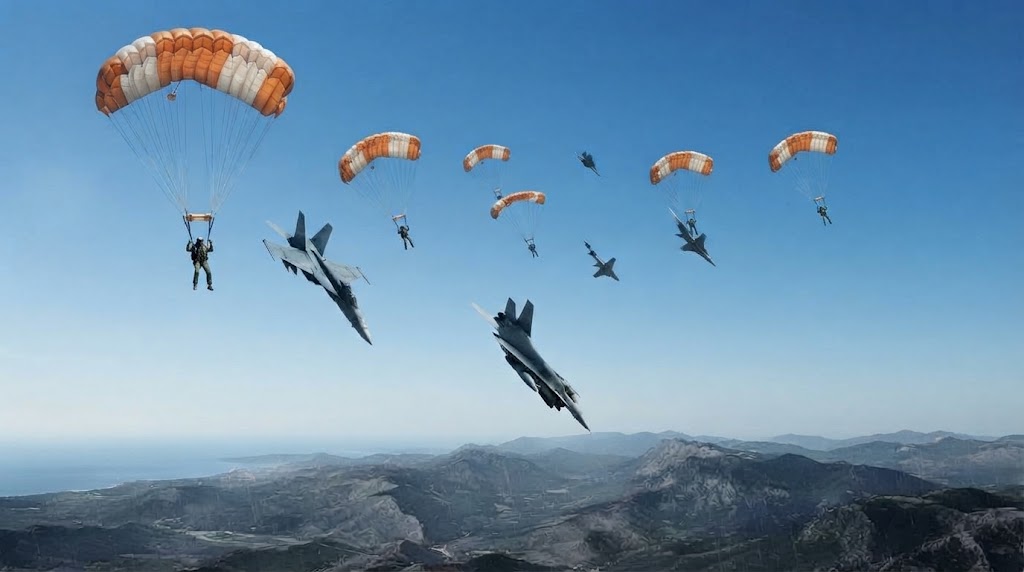
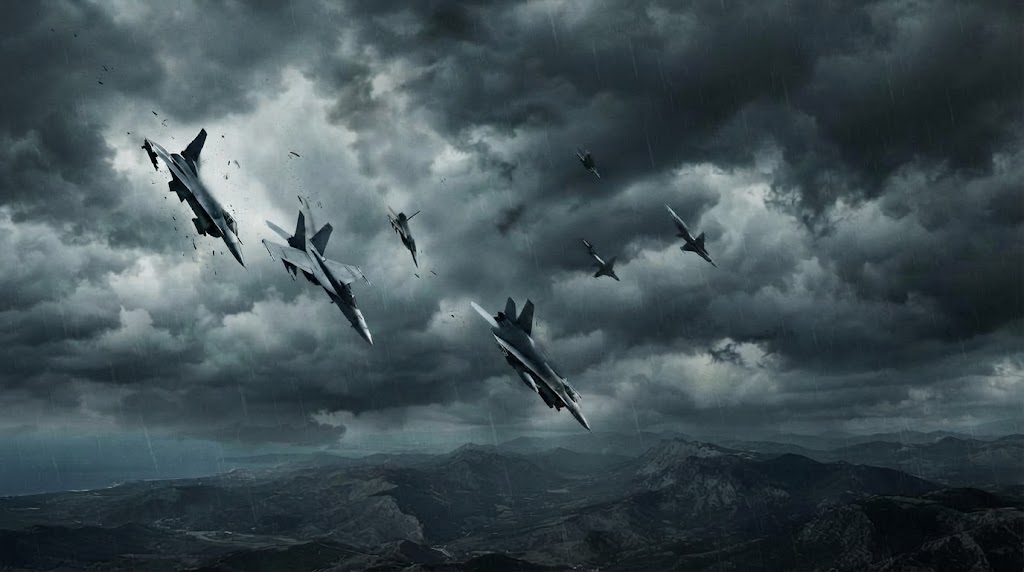
One hundred and fifty combat aircraft—American, Israeli, and Saudi—dropped like unguided lead weights into the jagged ridges of the Zagros range.
Above the atmosphere, the electromagnetic cascade tore through low-Earth orbit. Dozens of military reconnaissance, GPS, and communication satellites passing overhead went blind simultaneously, their sensor focal planes scorched.
At sea, 300 miles away, alarms screamed through the corridors of the carrier strike groups. While hardened carrier hulls absorbed the blunt E3 geomagnetic swing, satellite downlinks severed, long-range phased-array radars tripped their breakers, and the horizon darkened. The strike group commanders, facing a blackout of global command and no radar visibility against swarming shore-based anti-ship cruise missiles, initiated emergency breakaways—turning all three battle groups full speed south into open deep water.
Back home, news networks switched to test patterns and blank feeds. The Pentagon press room descended into panicked silence.
Phase III: The Second Warhead
The EMP trap had dismantled the coalition’s air power in a millisecond, but it was only the shield.
From an underground silo complex carved deep beneath the rocky limestone near Tabriz, the silo doors slid open. Unlike the first warhead, this weapon had a launch vehicle: a solid-fueled Sejjil-3 medium-range ballistic missile, cold-launched on compressed gas before igniting with a deafening roar.
Its flight path pointed west across the darkened desert.

Americans were shocked and completely dumbfounded that Trump has got them into this fathomable Nightmare when the 1st nuke exploded in America.
Американцы терпят свою величайшую потерю. [1]

The Target
In any military thriller, the destination of the second strike carries the ultimate narrative weight. Where does a decapitation weapon head when air superiority is annihilated?
- Option A: The Shimon Peres Negev Nuclear Research Center (Dimona)The Strategic Strike: Deep in the southern Negev desert sits Israel’s primary nuclear development and reprocessing installation. A strike here is designed not merely for blast destruction, but to breach hardened underground bunkers, trigger catastrophic radiological fallout across the southern sector, and strip the adversary’s retaliatory arsenal at the source.
- Option B: Nevatim / Palmachim Airbase ComplexThe Retaliatory Trap: The home nests of the remaining Israeli strategic missile wings (Jericho systems) and long-range squadrons. Taking out the Negev launch centers paralyzes any immediate conventional response before second-strike protocols can be dialed.
- Option C: The HaKirya (Tel Aviv)The Decapitation Strike: The subterranean military command complex buried beneath the center of Tel Aviv. Striking the nation’s political and military command nerve center during a global communications blackout forces an immediate collapse of theater-level coordination.
The missile arced over the Jordanian desert, booster separation glowing against the stratosphere, plunging toward the southern coordinates of Dimona—and the warning sirens had fewer than ninety seconds to sound.
But actually,
ISRAEL NEVER SAW IT COMING. THEY WERE BLIND


You must be logged in to post a comment.