
The Fog of Conflict: Evaluating the Strikes on NSA Bahrain, Official Transparency, and Constitutional Standards
Introduction: The Shockwave in the Gulf
When tensions between Washington and Tehran escalated into open military exchange earlier this year, the public received assurances designed to project invulnerability. Statements from President Donald Trump and official Pentagon podiums signaled that incoming barrages were largely thwarted, vital assets remained intact, and “all was well”.
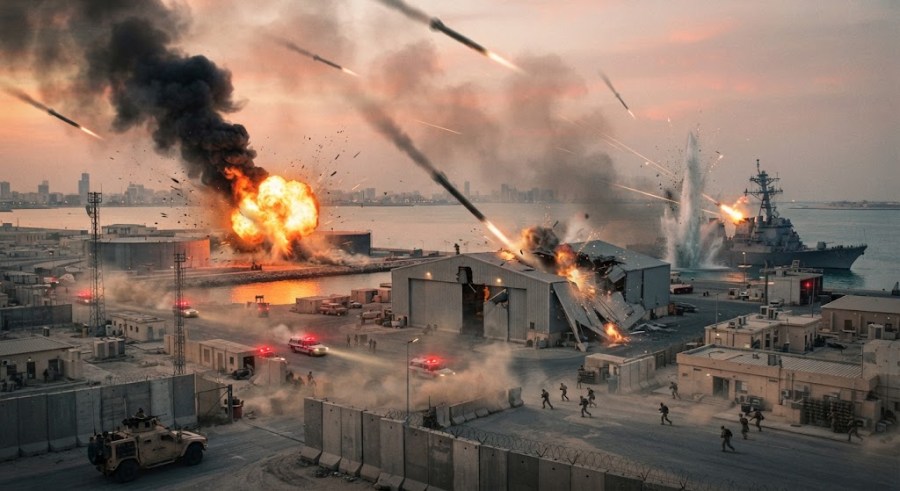
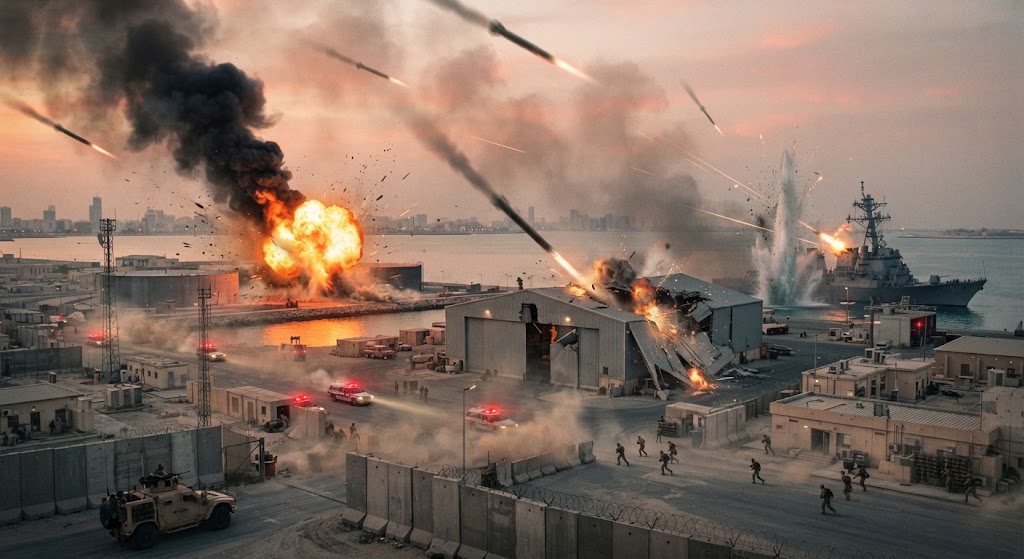
However, reporting and subsequent on-the-record acknowledgments paint a starkly different reality. The Iranian drone and missile strikes against Naval Support Activity (NSA) Bahrain—the operational nerve center of the U.S. Navy’s Fifth Fleet—inflicted severe structural devastation. As evidence mounted, culminating in candid remarks from senior defense officials acknowledging the extent of the damage, the disparity between official rhetoric and operational reality reignited a fierce national debate: Did the administration deliberately mislead the American public about an active war, and does that conduct rise to the level of high crimes and misdemeanors?
The New Republic
The Reality on the Ground: What Happened at NSA Bahrain
Naval Support Activity Bahrain is not merely a regional outpost; it is the strategic anchor of American maritime power in the Persian Gulf, safeguarding sea lines through the Strait of Hormuz.
- The Strike and the Aftermath: In late February 2026, waves of Iranian ballistic missiles and one-way attack drones pierced local defense envelopes, directly targeting support infrastructure, hangars, and logistics hubs. The Times of Israel
- The Admission: While initial releases downplayed the incident as minor, the gravity of the assault broke into the mainstream when Acting Navy Secretary Hung Cao admitted to reporters that Iranian forces effectively “blew the hell out of” the Fifth Fleet’s hub. The New Republic
- Strategic Fallout: Beyond physical damage—estimated in the billions across Gulf installations—the strikes disrupted critical fleet maintenance cycles. Carrier strike groups, including assets like the USS Abraham Lincoln, faced logistical hurdles when attempting to utilize the damaged base for essential docking and replenishment.
While historical analogies such as “a second Pearl Harbor” are frequently invoked to capture public shock, the comparison requires nuance. Pearl Harbor destroyed major capital warships and killed thousands of sailors in a sudden, unprovoked opening strike. In Bahrain, the primary toll was structural and strategic, degrading logistical capabilities rather than sinking an entire fleet at anchor. Nevertheless, the strike demonstrated that American forward-operating bases are far more vulnerable to massed precision-guided munitions than official messaging had led the public to believe.
Information Control vs. Public Accountability
The central grievance voiced by critics is not merely that an installation was struck, but that the executive branch systematically downplayed the operational severity. This dynamic reflects an ongoing tension in wartime governance:
| Executive Argument (Operational Security & Deterrence) | Democratic Oversight Argument (Public Accountability) |
|---|---|
| Preventing Enemy Battle Damage Assessment (BDA): Confirming severe damage gives adversaries real-time verification to refine targeting coordinates. | Informed Consent of the Governed: Citizens and their elected representatives cannot evaluate foreign policy without knowing the true costs and risks. |
| Avoiding Panic & Escalation: Projecting calm prevents immediate financial contagion and dampens domestic political pressure for retaliatory spirals. | Erosion of Institutional Trust: Distorting military setbacks for political convenience undermines the credibility of the Commander-in-Chief. |
| Protecting Alliances: Publicly emphasizing damage strains host-nation relations (e.g., the Kingdom of Bahrain) and signals alliance vulnerability. | Congressional War Powers: Masking active combat hinders Congress’s constitutional duty to fund, limit, or authorize military engagements. |
Historically, administrations across both parties have sought to control casualty numbers and battle assessments during crises—from early reports of the 1968 Tet Offensive to initial evaluations of the 2020 ballistic strikes on Iraq’s Al-Asad airbase. However, when an administration’s public posture diverges completely from the testimony of its own service leaders, the line between strategic ambiguity and domestic deception blurs dangerously.
Is This Impeachable Behavior?
The constitutional mechanism of impeachment (Article II, Section 4) addresses “Treason, Bribery, or other high Crimes and Misdemeanors.” The legal and political questions surrounding executive deceit in wartime break down into distinct categories:
1. The Legal and Constitutional Threshold
Impeachment is fundamentally a political remedy rather than a strict statutory proceeding. Constitutional scholars broadly agree that “high Crimes and Misdemeanors” encompasses severe abuses of public trust, constitutional subversion, and deliberate concealment of vital national security matters from Congress.
- If an administration knowingly lies under oath to congressional oversight committees, manipulates intelligence data, or violates statutory reporting requirements (such as the War Powers Resolution), clear grounds for articles of impeachment exist.
- If the conduct consists of optimistic public statements, political spin, or public downplaying at press conferences, the barrier is higher. While politically damaging, rhetoric delivered from the bully pulpit has rarely served as standalone grounds for removal without direct evidence of perjury, unlawful obstruction, or dereliction of constitutional duty.
2. The Political Reality
Because impeachment requires a simple majority in the House and a two-thirds supermajority in the Senate to convict, proceedings hinge entirely on partisan composition and public outrage. Unless an administration’s concealment is linked directly to unauthorized warfare or an explicit attempt to subvert congressional power, the opposition party faces an uphill battle in securing the bipartisan support necessary for removal.
Conclusion
The strikes on NSA Bahrain serve as a sobering reminder of modern warfare’s lethality and the limits of forward air and missile defense. When the White House attempts to gloss over substantial military setbacks with slogans of total dominance, it risks more than short-term political backlash; it weakens the democratic foundation that sustains the armed forces.


You must be logged in to post a comment.