
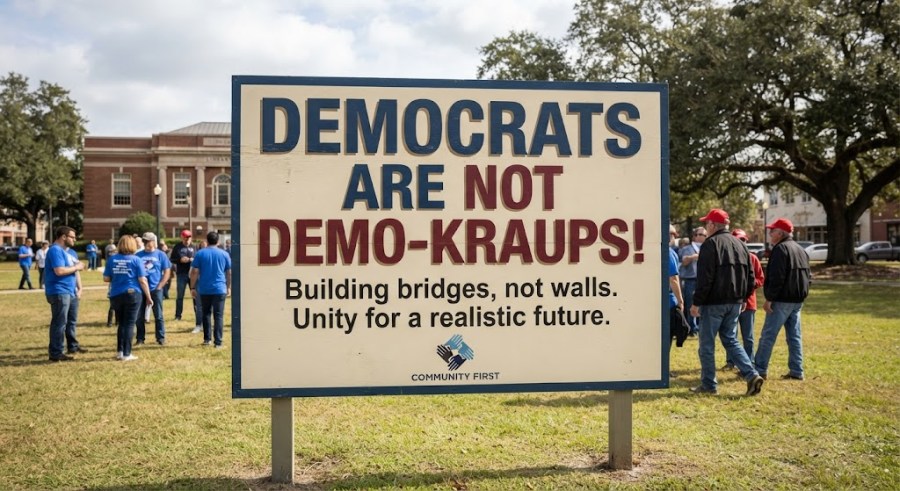
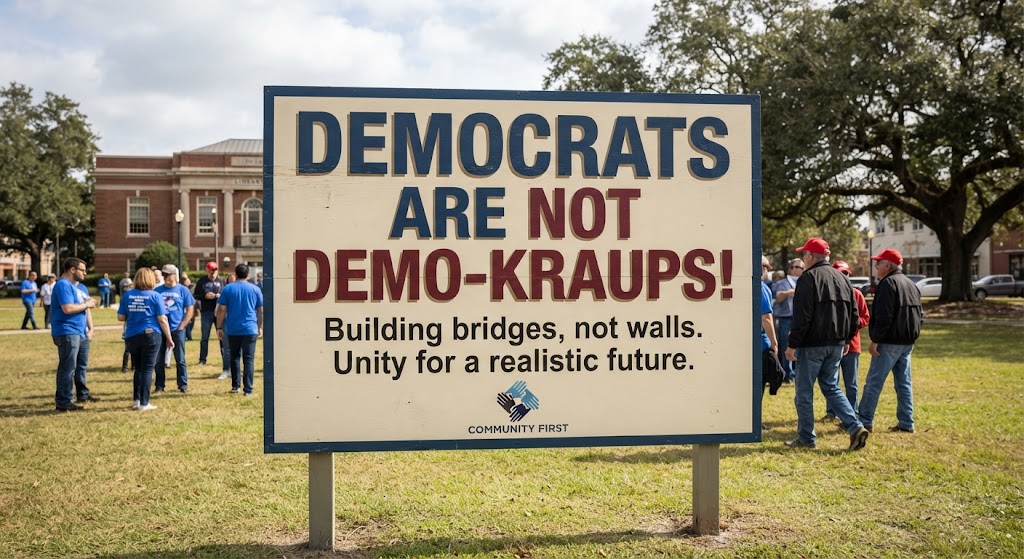
DEMOCRATS ARE NOT DEMO-KRAUPS!
The morning after the election, the street outside the town hall was quiet. There was no blare of triumphant horns, no taunting parade, and no mockery across the lawn.
Inside the precinct, Marcus—a lifelong Democrat who had spent weeks knocking on doors—folded the folding chairs and stacked them against the wall. A younger volunteer bounced on his heels, eyes glued to a phone screen showing national headlines.
“We won,” the young man grinned, his voice trembling with an eager, sharp edge. “We crushed them. We should put billboards up in every county that voted the other way. Let them see what happens when they back that kind of chaos.”
Marcus paused, set the steel chair down with a firm, deliberate clack, and looked up.
“No,” Marcus said softly. “That is not who we are. That is what broke this country in the first place.”
What Democrats Are Not
For years, toxic rhetoric tried to paste caricatures onto millions of Americans. Pundits and partisan agitators reduced public servants, neighbors, and organizers into crude slurs and sneering stereotypes—painting every Democrat as an enemy of tradition, an elite out of touch with the working person, or a cynical partisan aiming to tear down the fabric of society.
Marcus shook his head. “Democrats are not vengeful. We are not sneering elites waiting to humiliate our neighbors. We are not demolition crews aiming to dismantle the Republic. We are school bus drivers, nurses, engineers, farmers, veterans, and factory workers who believe government should be a bridge, not a battering ram.”
To claim the mantle of leadership in a constitutional republic means explicitly rejecting the politics of personal vengeance.
The Trap of Aggressive Joy
When voters gave Donald Trump the torch, the nation endured years of deep disruption: attacks that marginalized minority communities, volatile rhetoric that eroded institutional guardrails, and erratic decisions—such as Pete Hegseth clearing out senior generals and admirals, shaking the foundational trust of nonpartisan military command.
The exhaustion cut across political lines. Families on both sides of the aisle watched the public square devolve into shouting matches, media feeds turned into engines of rage, and foundational civic norms treated as disposable.
Because of that toll, victory cannot look like revenge. Aggressive, triumphalist joy—gloating, taunting, and treating neighbors like conquered adversaries—is simply adopting the playbook that poisoned American politics.
If winning only produces a mirror image of the cruelty it sought to replace, nothing has been healed. The moment a party behaves like a victor celebrating over a defeated populace, it validates every fear its opponents harbored.
Reconnecting Across the Aisle
The path forward requires Democrats to do something far more demanding than gloating: reconnect with Republican voters on common ground.
- Listen to the Grievances Behind the Vote: Millions turned to anti-establishment politics not out of malice, but out of genuine frustration with decaying towns, rising costs of living, and institutions that seemed deaf to working families. A durable future requires addressing these underlying struggles directly, without condescension.
- Depoliticize the Core Institutions: The military, the judiciary, and civil service must belong to the Constitution, not a political party. Restoring stability means ensuring national security and defense leadership are grounded in professional merit, steady leadership, and nonpartisan service, not ideological loyalty tests.
- Refuse to Copy GOP Mistakes: Democrats must deliberately avoid the missteps that deepened the divide:
- Do not centralize power around personalities.
- Do not treat the free press or public platforms merely as weapons to weaponize or suppress.
- Do not view political opponents as permanent enemies of the state.
The Rearview Mirror
Putting past chaos in the rearview mirror does not mean pretending it never happened; it means starving the outrage machine of the oxygen it needs to survive.
Demagogues thrive on spectacle, grievance, and 24-hour media amplification. When platforms prioritize sensationalism over factual discourse, lies spread rapidly, keeping the country locked in perpetual conflict.
The most effective way to render that noise obsolete is not through authoritarian censorship—which only fuels suspicion and feeds claims of persecution—but through steadfast accountability under the law, algorithmic responsibility from tech platforms to curb viral falsehoods, and above all, competent, unshakeable governance.
When a bridge is rebuilt, when a local clinic opens its doors, when a veteran receives their benefits without red tape, and when local leaders sit down over coffee with those who voted against them, the volume of grievance politics drops.
Marcus stepped out of the town hall into the crisp autumn air. Across the street, Arthur, a neighbor whose yard had held opposing campaign signs for eight years, was raking leaves near the sidewalk.
Marcus didn’t cross the street with a slogan. He walked over, stepped onto the grass, and reached out a hand.
“Arthur,” Marcus said. “Looks like you could use a hand with the bags before the rain hits.”
Arthur hesitated, looked at Marcus’s calm, steady expression, and nodded. “Appreciate that, Marcus.”
Healing the country is quiet, unglamorous work. It begins when the noise fades, the arrogance is set aside, and Americans choose to rebuild together.
What specific issues in your community do you think offer the best common ground for bridging these political divides?
Answer truthfully. How can all of us get back to enjoying Life and not Hating Our Government?

