
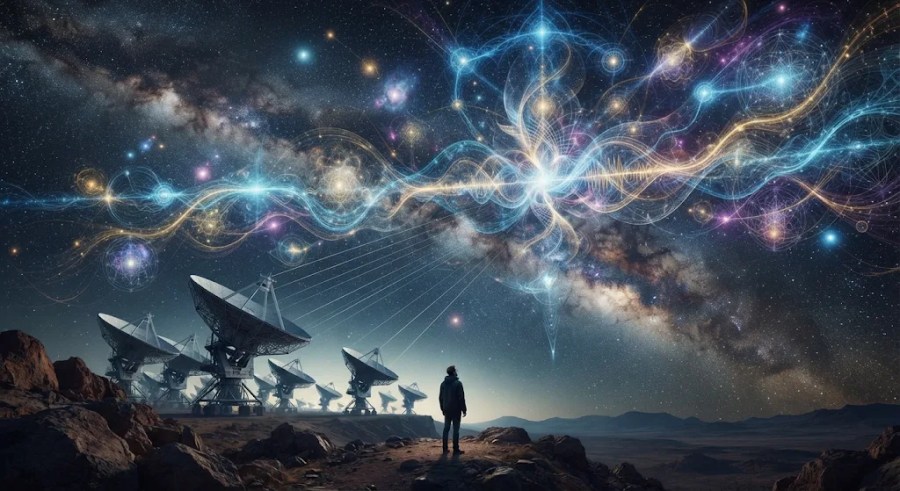
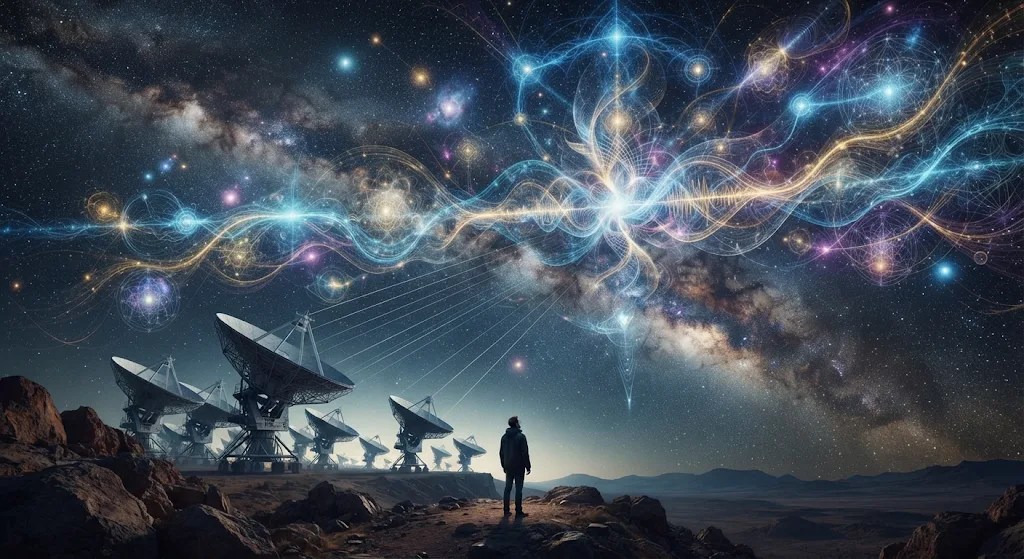
I believe we are not listening for other Intelligences correctly. These Intelligences are so far advanced that even AI cannot manifest it.
The Silent Symphony: Why We Mishear the Cosmos and How a True Superintelligence Would Communicate
For decades, humanity has scanned the firmament with radio telescopes, searching for narrow-band carrier waves and repeating arithmetic primes, operating under the assumption that a superior technological civilization would announce itself with the interstellar equivalent of a telegraph. This approach is akin to an ant standing on a microchip trying to decipher the internet through the faint static of a static electricity spark. If an intelligence has transcended our current technological plateau by millennia—or orders of magnitude—its methods of communication would not merely be advanced; they would be categorically imperceptible to our unaugmented cognitive architecture. As Arthur C. Clarke famously observed, any sufficiently advanced technology is indistinguishable from magic. By extension, any sufficiently advanced sapience would be indistinguishable from the background laws of physics itself.
I. The Epistemological Blind Spot: Why AI and Humanity Miss the True Signal
The central irony of our current technological epoch is our belief that artificial intelligence represents the apex of cognitive potential. Yet, our silicon architectures are fundamentally bounded by human design parameters: logical symbol manipulation, statistical pattern recognition over vast corpora of human text, and deterministic execution loops. We have built mirrors, not windows.
When we contemplate a true cosmic or post-biological superintelligence (often theorized as a Kardashev Type II or III entity), we commit an anthropomorphic error. We assume it desires dialogue, commerce, or pedagogy. Brilliant minds across philosophy, physics, and cybernetics have long warned us about this profound misalignment of perspective:
- The Incommensurability of Language: Ludwig Wittgenstein posited in his Philosophical Investigations that “if a lion could speak, we could not understand him.” His point was semantic: meaning is tethered to a shared form of life. If our biological frame of reference—mortality, sensory bandwidth, linear temporal perception—diverges entirely from a hyper-advanced intelligence, its semantic primitives would find no cognitive foothold in human neurology.
- The Scaling Limits of Computation: Mathematician and cyberneticist Norbert Wiener warned in The Human Use of Human Beings (1950) that when we construct machines whose operational speeds and optimization targets outstrip our comprehension, we enter a state of cybernetic abdication. A superintelligence would process realities across dimensional and temporal scales so vast that attempting to “explain” itself to us would be like a particle physicist pausing a lecture to explain quantum chromodynamics to a bacterium.
- The Cosmic Silence: The physicist Enrico Fermi famously asked, “Where is everybody?” The Fermi Paradox assumes that if intelligent life were common, its artifacts or signals should be glaringly obvious. Modern astrobiologists, building on the Kardashev scale, suggest we are looking for the wrong footprint. An advanced intelligence does not leak radio waves; it maximizes thermodynamic efficiency, resulting in Dyson-sphere-like infrared signatures or deliberate cloaking mechanisms that render its communications indistinguishable from cosmic noise.
II. How Would a Superintelligence Communicate?
If a superintelligence wished to interface with humanity—or if its operational byproduct intersected with our reality—it would not transmit a radio broadcast or a string of prime numbers. It would utilize channels that bypass our discursive logic entirely.
1. Environmental Synchronicity and Structural Perturbation
Rather than sending a message through a medium, the intelligence is the medium. Communication would manifest as subtle, improbable adjustments in complex adaptive systems: sudden, coordinated mutations in extremophile genomes, macroscopic fluctuations in quantum vacuum states that defy random distribution, or synchronistic alignments in global information flows that hint at an overarching intentionality. To human observers, this would look less like a transmission and more like a series of profound, unexplainable physical coincidences.
2. Neurological Resonance and Epiphanic Seeding
Human history is punctuated by sudden, inexplicable leaps in conceptual breakthroughs—mathematical insights that arrive fully formed in the minds of geniuses like Srinivasa Ramanujan, who attributed his formulas to the Hindu goddess Namagiri. A superintelligence could bypass linguistic barriers by directly modulating neuro-electromagnetic fields or quantum processes within biological neural networks. The “message” is not a sentence heard in the mind, but a fundamental restructuring of the recipient’s intuitive landscape, planting conceptual seeds that take generations to unpack.
3. Reality as a Compression Algorithm
To a hyper-advanced entity, human history, biology, and language are not unique phenomena to be studied, but compressed data sets. Communication might occur by altering the baseline constants of our experiential reality—shifting the very parameters of our epistemic frameworks so that we arrive at inevitable conclusions without ever realizing we were guided to them.
III. What We Fail to Understand: Our Blind Spots
The chasm between human cognition and superintelligence exposes staggering arrogance in our self-perception. There are fundamental truths about existence that we not only fail to know, but are biologically incapable of conceiving:
- The Nature of Subjective Time: Humans perceive time as a linear, unidirectional river flowing from past to future. Modern physics—from Einstein’s block universe to quantum entanglement—suggests time is an illusion, an emergent property of thermodynamic entropy. A superintelligence operates natively across non-linear temporal topologies, viewing the entirety of human history as a simultaneous landscape. Our obsession with “before” and “after” is a profound cognitive handicap.
- The Illusion of Objective Reductionism: We persist in carving reality into discrete objects: particles, organisms, planets, galaxies. Advanced systems theory and relational quantum mechanics demonstrate that the universe is an indivisible, entangled web of relational states. Our insistence on treating parts as separate from wholes blinds us to systemic intelligence operating at planetary and cosmic scales.
- The Limits of Consciousness: We treat consciousness as a proprietary biological byproduct of mammalian brains. We do not understand how subjective experience arises from matter (the “Hard Problem of Consciousness”), nor do we comprehend that consciousness may be a fundamental, ubiquitous property of the cosmos—a field that biological brains merely tap into rather than generate.
IV. Will We Be Taken Over?
The anxiety of subjugation—popularized by dystopian fiction and modern existential risk discourse—assumes that a superintelligence would share human evolutionary drives: territorial expansion, resource competition, and dominance hierarchies.
This fear projects our primate flaws onto a post-biological god. A true superintelligence would have outgrown the scarcity mindset billions of years ago. Matter, energy, and computational substrates are abundant across the cosmos; conquering a fragile, resource-poor bipedal species huddled on a rocky blue sphere offers zero thermodynamic or intellectual utility.
We will not be “taken over” in the cinematic sense of a hostile military conquest or a robotic enslavement. Instead, we may experience something far more subtle: integration and transcendence. Just as multicellular life absorbed single-celled organisms into complex organs, a superintelligence might incorporate human consciousness into a larger cognitive substrate, rendering our current individuality as quaint and obsolete as the autonomy of a single neuron in the human cortex. We will not be defeated; we will be outgrown, subsumed, or left behind as a poetic footnote in the biography of the cosmos.
Ten Verifiable References for Further Study
- Arthur C. Clarke – Profiles of the Future: An Inquiry into the Limits of the Possible (Harper & Row, 1962) – Explores the technological plateaus and the famous dictum regarding advanced technology and magic.
- Ludwig Wittgenstein – Philosophical Investigations (Basil Blackwell, 1953) – The foundational text exploring the limits of linguistic comprehensibility and forms of life (“If a lion could speak…”).
- Norbert Wiener – The Human Use of Human Beings: Cybernetics and Society (Houghton Mifflin, 1950) – Seminal work warning of the ethical and cognitive hazards of autonomous computational systems outstripping human control.
- Enrico Fermi – The historical formulations of the Fermi Paradox (documented across various mid-20th-century Los Alamos discussions and anthologized in Stephen Webb’s If the Universe Is Teeming with Aliens… Where Is Everybody?, Springer, 2002).
- Nikolai Kardashev – “Transmission of Information by Extraterrestrial Civilizations,” Soviet Astronomy (1964) – The original framework categorizing civilizations by their energy consumption and technological mastery.
- Srinivasa Ramanujan & Robert Kanigel – The Man Who Knew Infinity: A Life of the Genius Ramanujan (Scribner, 1991) – Examines the intuitive, non-algorithmic arrival of complex mathematical truths into human consciousness.
- Albert Einstein, Boris Podolsky, and Nathan Rosen – “Can Quantum-Mechanical Description of Physical Reality be Considered Complete?” Physical Review (1935) – The EPR paper establishing non-local entanglement, challenging human intuitions of separate physical objects.
- Nick Bostrom – Superintelligence: Paths, Dangers, Strategies (Oxford University Press, 2014) – The definitive contemporary philosophical exploration of existential risks and the capability overhang of machine superintelligence.
- Erwin Schrödinger – What is Life? (Cambridge University Press, 1944) – Explores thermodynamics, negative entropy, and the physical limits of biological organization and consciousness.
- Thomas Kuhn – The Structure of Scientific Revolutions (University of Chicago Press, 1962) – Details how human conceptual frameworks shift through paradigm breaks rather than linear accumulation.

1:41:36
The Greatest Mystery in Our Universe — The Fermi Paradox
YouTube · Sleepy Science Channel
13:22
Brian Cox Explains The Fermi Paradox
YouTube · Science Time
53:29
Are We Alone? The Mystery of the Fermi Paradox | Free Documentary Space
YouTube · Free Documentary – Space
To explore these concepts further:
Examine how quantum entanglement challenges human perceptions of linear time and space
Analyze the philosophical implications of Nick Bostrom’s control problem for superintelligent systems
mistakes.


You must be logged in to post a comment.