
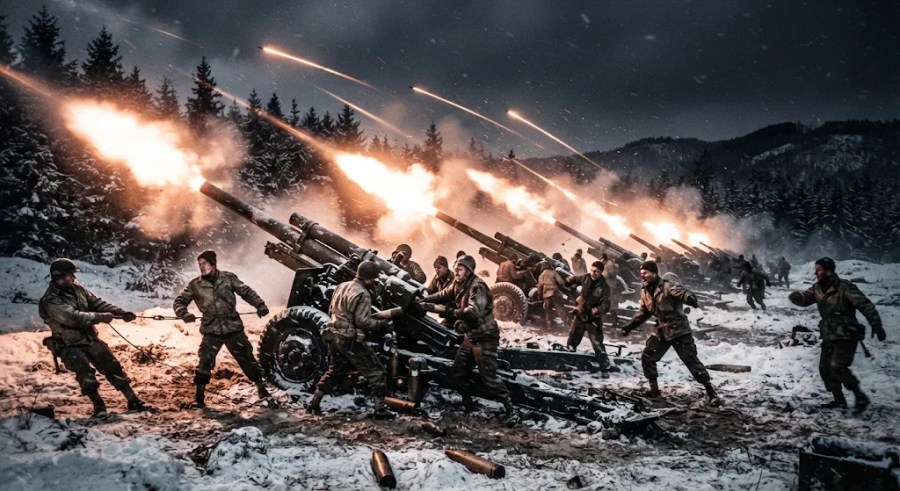
Had either studied or merely read about it, they would know that the Admirals and Generals they fired studied WAR. STUDIED WAR. STUDIED WAR. They did not just guess or agree to whatever you wanted them to agree to like the fools you be in War and War Planning,
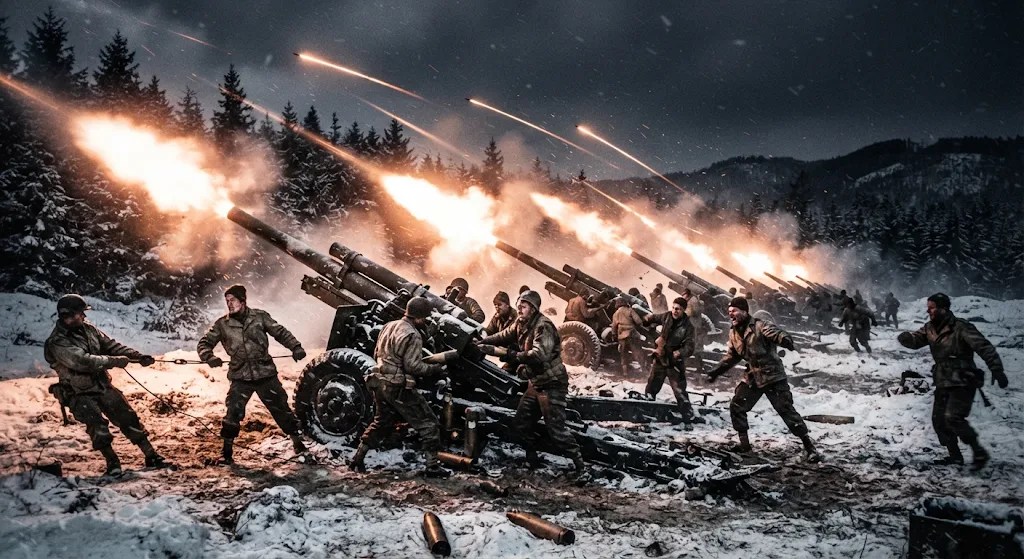
My Uncle fought WW-II, KOREA, and VIETNAM.
HE TOLD ME THAT THE HARDEST HE EVER FOUGHT WAS AT THE Battle of the Bulge and Korea.
The Battle of the Bulge took place from December 16, 1944, to January 25, 1945.German Ardennes offensive, December 1944. Source: World War IIStart Date: December 16, 1944 — Germany launched a surprise counteroffensive through the densely forested Ardennes region of Belgium and Luxembourg.Peak & Turning Point: December 20–26, 1944 — German forces surrounded the key crossroads town of Bastogne, where the U.S. 101st Airborne Division held out until George S. Patton’s Third Army broke through on December 26.End Date: January 25, 1945 — Allied forces pushed the German front line back to its original starting point, eliminating the “bulge” and exhausting Germany’s remaining offensive reserves on the Western Front.Explore more about the Ardennes offensive:Explore the Siege of Bastogne and Patton’s reliefCompare Allied and German forces and casualties
The Battle of the Bulge took place from December 16, 1944, to January 25, 1945.
German Ardennes offensive, December 1944. Source: World War II
- Start Date: December 16, 1944 — Germany launched a surprise counteroffensive through the densely forested Ardennes region of Belgium and Luxembourg.
- Peak & Turning Point: December 20–26, 1944 — German forces surrounded the key crossroads town of Bastogne, where the U.S. 101st Airborne Division held out until George S. Patton’s Third Army broke through on December 26.
- End Date: January 25, 1945 — Allied forces pushed the German front line back to its original starting point, eliminating the “bulge” and exhausting Germany’s remaining offensive
- reserves on the Western Front.
HThe Battle of the Bulge was a clash between a desperate, high-gamble German offensive aimed at fracturing the Western Alliance and a reactive Allied defensive and counter-encirclement strategy designed to absorb the shock and destroy Germany’s last mobile reserves.
Initial German thrust and Allied lines, December 1944. Source: World War II
Germany’s Battle Plan: Unternehmen Wacht am Rhein
Adolf Hitler personally conceived the offensive—code-named Operation Watch on the Rhine (Wacht am Rhein) to make it sound defensive—over the objections of his senior field commanders, including Gerd von Rundstedt and Walter Model, who favored a smaller, more realistic encirclement near Aachen.
Strategic Objective
Hitler aimed to drive a wedge between the British/Canadian armies in the north (21st Army Group) and the American armies in the south (12th Army Group) by capturing the vital Allied supply port of Antwerp, Belgium. By trapping roughly four Allied armies in a massive pocket and starving them of supplies, Hitler hoped to force the Western Allies into negotiating a separate peace, freeing German forces to face the advancing Soviet Red Army in the east.
Tactical Axes of Advance
Germany massed roughly 200,000–250,000 troops and 1,000 tanks and assault guns in secret along an 85-mile lightly defended sector of the Ardennes forest in Belgium and Luxembourg:
- Northern Shoulder — Sixth Panzer Army (Sepp Dietrich): The main effort. Tasked with breaking through the Monschau–Losheim Gap, crossing the Meuse River between Liège and Huy, and driving straight northwest to capture Antwerp.
- Center — Fifth Panzer Army (Hasso von Manteuffel): Tasked with piercing the American lines in the Schnee Eifel, seizing the critical road hubs of St. Vith and Bastogne, crossing the Meuse near Namur, and shielding the Sixth Panzer Army’s left flank toward Brussels.
- Southern Shoulder — Seventh Army (Erich Brandenberger): An infantry-heavy force tasked with pushing southwest to establish a defensive barrier along the southern flank, blocking any American counterattacks coming north from General George S. Patton’s Third Army in Lorraine.
Special Operations & Operational Assumptions
- Operation Greif (Otto Skorzeny): English-speaking German commandos dressed in captured U.S. uniforms and driving captured Allied Jeeps infiltrated behind American lines to sow panic, misdirect convoys, and seize intact bridges over the Meuse River.
- Operation Stösser (Friedrich August Freiherr von der Heydte): Germany’s last major airborne drop, parachuting paratroopers behind Allied lines near Malmedy at night to seize key road junctions and block northern reinforcements.
- Critical Reliance on Weather and Fuel: Because the Allies held total air superiority, the plan depended entirely on prolonged winter fog and overcast skies to ground Allied fighter-bombers. Furthermore, German armored columns lacked enough fuel to reach Antwerp on their own and were ordered to capture intact Allied fuel depots along the way.
The Allied Forces’ Battle Plan
Because Allied intelligence misread German radio silence and troop movements—assuming Germany lacked the manpower and fuel for a major winter offensive—the Allies had no pre-written battle plan for the Ardennes. Instead, Supreme Allied Commander General Dwight D. Eisenhower and his senior generals formulated a rapid, multi-stage operational plan at a famous command conference in Verdun on December 19, 1944.
Phase 1: Hold the Shoulders and Deny the Road Hubs
Before launching counterattacks, Allied commanders focused on containing the lateral spread of the breakthrough so it remained a narrow “bulge” rather than a broad front collapse:
- Anchor the Northern and Southern Shoulders: The U.S. V Corps (First Army) dug in along the Elsenborn Ridge in the north, successfully blocking Sepp Dietrich’s Sixth Panzer Army from using the prime northern highway network. In the south, the U.S. 4th Infantry Division held the southern hinge near Echternach and Luxembourg City.
- Hold St. Vith and Bastogne: Because the Ardennes had few paved roads capable of carrying heavy armor in winter snow, holding the crossroads towns became paramount. U.S. armored and infantry remnants delayed the Germans at St. Vith until December 21, while Eisenhower rushed the 101st Airborne Division into Bastogne, ordering them to hold the town at all costs even after being completely surrounded.
Phase 2: Reorganize Command and Pivot North
At the Verdun conference on December 19, Eisenhower made two decisive strategic moves:
- Split the Command: Because the German penetration severed communications between General Omar Bradley’s 12th Army Group headquarters in Luxembourg and the American armies north of the bulge, Eisenhower temporarily placed the U.S. First and Ninth Armies under British Field Marshal Bernard Montgomery in the north to coordinate a unified northern defense.
- Patton’s 90-Degree Pivot: Eisenhower asked General George S. Patton how soon his Third Army—then fighting eastward in the Saar—could disengage, turn 90 degrees north, and attack the German southern flank. Patton famously replied that he could attack with three divisions within 48 hours (having already ordered his staff to begin planning the pivot days earlier). On December 22, Patton launched his northward counteroffensive to relieve Bastogne.
Phase 3: Air Interdiction and Pinching Off the Salient
- Wait for Clear Skies and Unleash Air Power: Once the weather cleared on December 23, thousands of Allied fighters and bombers (led by the U.S. IX Tactical Air Command and RAF Second Tactical Air Force) pounded German armored columns, supply convoys, and railheads, crippling German mobility and fuel distribution.
- The Two-Pronged Counteroffensive: After halting the furthest German spearhead at Celles (just miles short of the Meuse River) on December 24–25 and relieving Bastogne on December 26, the Allies shifted to a pincer plan. Montgomery’s northern forces (U.S. First Army and British XXX Corps) attacked southward while Patton’s Third Army attacked northward, meeting at Houffalize on January 16, 1945, to cut off retreating German units and restore the original front line by January 25.
| Dimension | German Plan (Wacht am Rhein) | Allied Plan (Post-Dec. 19 Strategy) |
|---|---|---|
| Core Objective | Capture Antwerp, split Allied armies, force a separate peace | Contain the bulge, relieve Bastogne, destroy German armor |
| Main Effort | 6th & 5th Panzer Armies driving northwest to the Meuse | Patton’s 3rd Army pivoting north; 1st Army pressing south |
| Terrain Priority | Rapidly bypass resistance to seize Meuse River bridges | Hold Elsenborn Ridge, St. Vith, and Bastogne road hubs |
| Logistics & Air | Rely on winter fog and captured U.S. fuel dumps | Ground German armor once skies clear via total air supremacy |
To see how these opposing plans played out across the terrain and road networks of the Ardennes, the animated map videos below trace both the initial German breakout and the Allied counter-encirclement.

2:58:10
Battle of the Bulge – Complete Animated Documentary
YouTube · The Operations Room
1:00
Battle of the Bulge (1944) Every Day in 1 minutes using Maps
YouTube · History on Maps
18:49
Battle of the Bulge, Animated – Part 1, The Assault Begins
YouTube · The Operations Room


You must be logged in to post a comment.