
Is GOD still punishing Israel? Yes, according to the Bible, God had Israel wander in the wilderness for forty years following the Exodus from Egypt. During this time, God gave Moses the Ten Commandments, led them with a pillar of cloud during the day and a pillar of fire during the night, and provided them with manna and quail. And most likely still is Today. But why? Is this another Trial by God?
It is not possible to answer this question definitively because it involves personal religious beliefs. According to some beliefs, it is possible for events in our world to be a ‘trial’ from God, and that Israel’s lack of peace could potentially be one such ‘trial’. Other beliefs state that God does not interfere in our lives or actively create trials for us. Ultimately, the answer to this question depends on what you believe about God and the nature of His involvement in our lives.
Israel spent the 40 years wandering in the wilderness. During this time, the Israelites were led by Moses and endured various trials as God tested their trust and commitment to Him. During these 40 years, the people of Israel developed as a nation and more laws were given to Moses to bind them together. In the end, when they arrived at the Promised Land, the Israelites were ready to establish the nation of Israel and take their place among the nations of the world.
Islam and Judaism have a complex and intertwined history that stretches back centuries. Muslims and Jews have lived side by side in many parts of the world, and each have had a profound influence on the other.
Beginning in the Middle Ages, Muslim and Jewish communities often encountered one another in places such as Spain. Muslims and Jews often lived in relative harmony during this period, as both communities respected one another’s religious practices. This period was known as the Golden Age of Jewish-Muslim relations, during which both communities flourished under Islamic rule.
However, political and religious tensions between the two communities began to increase during the 16th century when the Inquisition began, which led to widespread persecution of the Jews. This further deepened the rift between the two communities, and tensions remained high throughout the following centuries.
The 20th century saw further upheaval in Jewish-Muslim relations as conflicts between Israel and the Palestinian people, as well as the broader Arab world, began to take shape. The two communities have since experienced a cycle of conflict and cooperation, often in the context of politics and war.
Today, Jews and Muslims continue to grapple with their shared history and the ongoing struggle to build peace and mutual understanding. While wars and conflicts between the two communities continue to erupt, many Muslim and Jewish leaders work together to promote and build peaceful dialogue and understanding.
The complex relationship between Jews and Muslims dates back to the 7th century AD, when Muslims conquered Jerusalem, introducing Islam to the region. Throughout history, Jews and Muslims often coexisted peacefully and shared mutual respect, with some Jewish communities even converting to Islam. By the 19th century, however, the relationship between the two groups had grown increasingly strained, with increased competition for scarce resources and the introduction of Zionism leading to heightened tensions.
The first major conflict between Jews and Muslims arose in the late 19th century with the increasing number of Jewish immigrants to Palestine. This created an atmosphere of mutual distrust and hostility, with some Muslim scholars considering Zionism as a threat to Muslim political control. This tension only increased with the establishment of the State of Israel in 1948.
In the following decades, the relationship between Jews and Muslims became increasingly strained, with intractable conflict and violent clashes in places such as the West Bank and Gaza Strip in the 1970s and 1980s. The 1980s also saw the emergence of militant Islamic groups such as Hamas, who attacked both Israeli and Palestinian civilian targets in an effort to force their agenda on both sides.
Since then, the relationship between Jews and Muslims has become increasingly complex. While there are still groups and individuals who promote violence and use religion as a way to justify their actions, there are also many Muslims and Jews who are willing to engage in dialogue, work together to find peaceful solutions, and promote mutual understanding. Despite the obstacles, many communities around the world have seen progress in intercultural exchanges, programs and initiatives across cultures, and the development of dialogue and mutual understanding.
The parties involved in the Israeli-Palestinian conflict are:
- Israelis
- Palestinians
- United Nations
- United States
- European Union
- Arab League
- Hamas
- Islamic Jihad
- Hezbollah
- Jordan
- Syria
- Egypt
- Saudi Arabia.
There were many people involved in the establishment of the State of Israel, including pioneering Zionists and influential leaders. The most prominent figures often associated with the founding of Israel are David Ben-Gurion, Israel’s first prime minister, and Chaim Weizmann, the first president of Israel. Ben-Gurion is often referred to as the “Father of the State of Israel” while Weizmann is referred to as the “Father of the Zionist Movement”. Other notable figures who played major roles in the founding of Israel include Golda Meir, Moshe Sharett, Levi Eshkol, and Menachem Begin.
The British Mandate for Palestine, which was established by the League of Nations in 1922, was used to establish the land of Israel in 1948. The British Mandate for Palestine was a League of Nations mandate established after World War I which granted the United Kingdom responsibility for the administration of Palestine, with the intention of eventually establishing a Jewish homeland there. The British Mandate for Palestine came into effect in 1920 and ended after the British withdrawal in 1948, following the creation of the State of Israel.
Prior to 1922, the land that is now known as the State of Israel had been held by the Ottoman Empire, as part of its province of Syria. Following the conclusion of World War I in 1918, the Allied Powers (most notably Britain and France) divided the Ottoman Empire into separate countries, with Israel being one of them. The mandate for the people of Israel was provided by the League of Nations, which established the conditions for the Jewish population of the land to pursue national aspirations and serve as the basis for the eventual creation of the modern State of Israel.
The Palestinian people began migrating out of Palestine in the late 1800s, with mass emigration taking place in the first half of the 20th century. The majority settled in other parts of the Middle East, such as Jordan, Lebanon, Syria, and Egypt. There was also a significant Palestinian diaspora across the globe, most notably in North America, Europe, and Australia. During the late 1800s, Palestine was part of the Ottoman Empire. The area was under Turkish control until the end of World War I, when the Allied powers (Great Britain, France, Italy, and Russia) divided the region up and established the British mandate in Palestine.
A British Mandate was an authorized legal rule or instruction handed down by the League of Nations (the precursor of the United Nations) allowing the United Kingdom to govern certain territories formerly under the control of the defeated German, Ottoman and Austro-Hungarian Empires following the end of World War I. The British Mandate system was meant to provide a form of national self-determination but only under the supervision and guidance of Britain, as the mandatory country, for an indefinite period of time.
On May 14, 1948, David Ben-Gurion, the head of the Jewish Agency, proclaimed the establishment of the State of Israel. U.S. President Harry S. Truman recognized the new nation on the same day. In May 1948, Israel was officially declared an independent state with David Ben-Gurion, the head of the Jewish Agency, as the prime minister. While this historic event seemed to be a victory for Jews, it also marked the beginning of more violence with the Arabs.
You need to read more, don’t you? I had to. So, here is another Read into History that will ultimately cause you to ponder Why Israel was recognized as a Date and there wasn’t a Partition of A Jewish State and an Palestinian State?
The Balfour Declaration of 1917 was a letter from then-British Foreign Secretary Arthur James Balfour to Baron Rothschild, a leader in the British Jewish community, expressing the British government’s support for the establishment of a Jewish homeland in Palestine. The letter declared the British government’s view that “it is right that Palestine should be reconstituted as the National Home of the Jewish people” and specified that “nothing shall be done which may prejudice the civil and religious rights of existing non-Jewish communities in Palestine.” The declaration ultimately led to the British Mandate for Palestine, which granted Britain administrative rule for Palestine.
https://www.trumanlibrary.gov/museum/ordinary-man/recognition-of-israel
The British, who held a colonial mandate for Palestine until May 1948, opposed both the creation of a Jewish state and an Arab state in Palestine as well as unlimited immigration of Jewish refugees to the region. Throughout 1947, the United Nations Special Commission on Palestine examined the Palestinian question and recommended the partition of Palestine into a Jewish and an Arab state. On November 29, 1947 the United Nations adopted Resolution 181 (also known as the Partition Resolution) that would divide Great Britain’s former Palestinian mandate into Jewish and Arab states in May 1948 when the British mandate was scheduled to end. Under the resolution, the area of religious significance surrounding Jerusalem would remain a corpus separatum under international control administered by the United Nations.
Later, as the date for British departure from Palestine drew near, the Department of State grew concerned about the possibility of an all-out war in Palestine as Arab states threatened to attack almost as soon as the UN passed the partition resolution.
Despite growing conflict between Palestinian Arabs and Palestinian Jews and despite the Department of State’s endorsement of a trusteeship, Truman ultimately decided to recognize the State of Israel.
And Conflicts have blurred up every since over Israel and Palestinians.
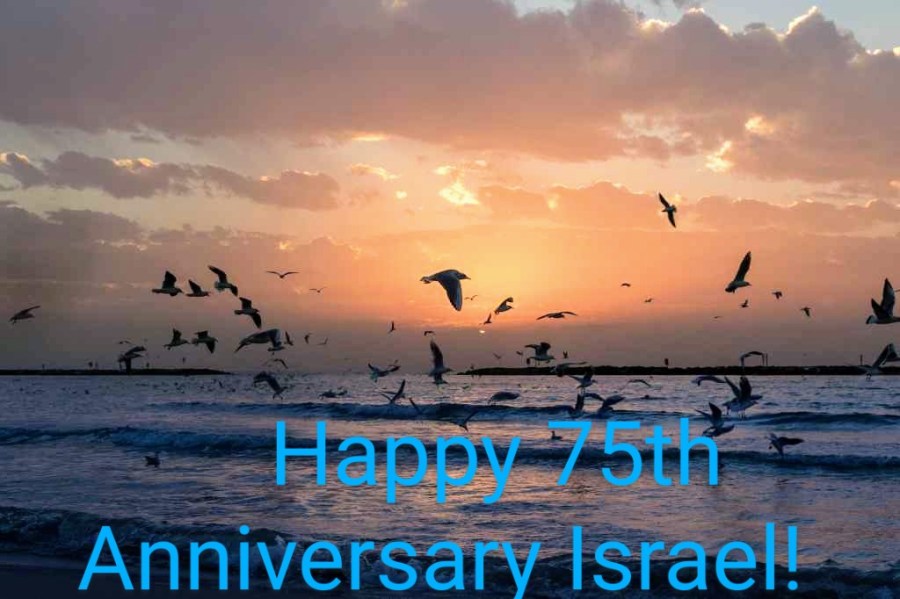
But it’s 75th Anniversary Time! Happy 75th Anniversary Israel. You GOD protect you and your State and May God help you keep it always-
Sincerely with Great Respect,
The Living Breathing James Brown



You must be logged in to post a comment.