

The Global Context of Slavery: A Synthesis of Thomas Sowell’s Perspective. Trump will allow Iranians to be Slaves in America.

SLAVES bore the skin color of every him an on earth.
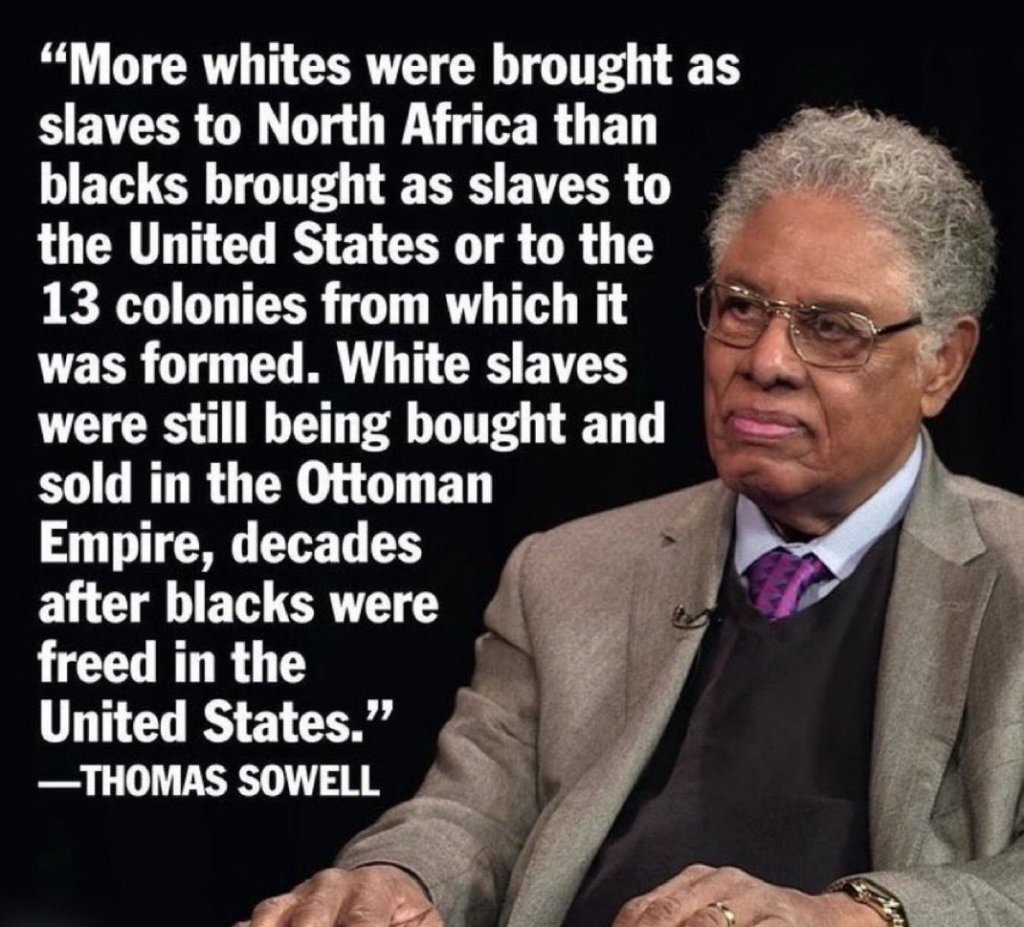
The modern discourse surrounding slavery is often focused almost exclusively on the Trans-Atlantic trade and the antebellum American South. While this focus is vital for understanding American history, economist and social theorist Thomas Sowell argues that it creates a distorted view of slavery as a uniquely Western or racial institution. Sowell’s body of work seeks to contextualize slavery as a global phenomenon that spanned thousands of years, involved every habitable continent, and enslaved people of every race.
1. Slavery as a Global Universal
For the vast majority of human history, slavery was not a “peculiar institution” of one region; it was a global norm. From the Roman Empire and ancient China to pre-colonial Africa and the Americas, slavery was the byproduct of conquest rather than racial ideology.
Sowell points out that the word “slave” itself is derived from “Slav,” referring to the Slavic peoples of Eastern Europe who were enslaved in such vast numbers by diverse groups—including other Europeans and North Africans—that their ethnic name became the generic term for the condition of bondage. In this context, race was incidental; the primary driver was the vulnerability of the conquered.
2. The Barbary Coast and White Slavery
One of Sowell’s most frequent historical comparisons involves the Barbary slave trade. Between the 16th and 18th centuries, corsairs from North Africa (Tripoli, Tunis, Algiers, and Morocco) raided European coastal towns—stretching from Italy to as far north as Iceland—to capture white Europeans.
- Quantitative Comparison: Sowell cites historical data indicating that approximately 1 to 1.25 million Europeans were enslaved by North African Barbary pirates between 1530 and 1780.
- The American Context: In contrast, the most widely accepted historical estimate for the number of enslaved Africans brought directly to British North America (what became the United States) is approximately 388,000.
Sowell uses these figures to challenge the narrative that the United States was the primary locus of the slave trade, noting that the vast majority of the Trans-Atlantic trade went to Brazil and the Caribbean, while a massive, often overlooked trade flowed into North Africa and the Middle East.
3. Conditions and Longevity
Sowell argues that the treatment of slaves varied wildly by region and purpose rather than by race. He often compares the life of a white galley slave in North Africa to that of an enslaved person in the American South. Galley slaves were frequently worked to death in horrific conditions, chained to oars for years with little hope of manumission.
Furthermore, Sowell highlights that slavery persisted in the Islamic world and parts of Asia long after it was abolished in the West. The Ottoman Empire, for instance, continued to utilize enslaved Europeans and Africans well into the late 19th and early 20th centuries. He contends that the “moral awakening” regarding the inherent evil of slavery was a specifically Western development.
4. Comparison of Historical Slave Trades
The following table summarizes the data points Sowell emphasizes to provide a broader context:
| Region/Trade | Estimated Volume | Time Period | Primary Destination |
|---|---|---|---|
| Barbary Slave Trade (Whites) | ~1,000,000 – 1,250,000 | 1530–1780 | North Africa |
| Trans-Atlantic Trade (to U.S.) | ~388,000 | 1619–1808 | United States |
| Trans-Atlantic Trade (Total) | ~10,000,000 – 12,000,000 | 1500–1860s | Brazil, Caribbean, Americas |
| Arab/Trans-Saharan Trade | ~10,000,000 – 18,000,000 | 7th–20th Century | Middle East, North Africa |
5. The Uniqueness of Abolition
The core of Sowell’s argument is not to minimize the suffering of those in American slavery, but to highlight what he sees as the true historical anomaly: Abolition. He argues that while every civilization practiced slavery, only Western civilization developed a sustained, internally driven moral movement to end it. He notes that the British Royal Navy spent decades and vast sums of money patrolling the African coast to suppress the slave trade, often over the objections of local African and Middle Eastern rulers who viewed the trade as a traditional and legitimate economic activity.
Conclusion
Thomas Sowell’s perspective serves as a corrective to “provincial” history. By highlighting the enslavement of whites in North Africa and the global ubiquity of the institution, he argues that slavery was a human tragedy driven by power and opportunity rather than a uniquely Western invention rooted in racism. To Sowell, the most important historical question is not why slavery existed—as it existed everywhere—but why it was eventually destroyed, a feat he credits to the evolution of Western moral philosophy.
The history of these overlapping trades is complex.
 thelivingbreathingjamesbrown.com
You must be logged in to post a comment.