
The Lexicon of Delegitimization: An Analysis of Vladimir Putin’s Nicknames and Slogans
Abstract
In the landscape of modern political conflict, language serves not merely as a tool of communication, but as an active instrument of psychological warfare, resistance, and delegitimization. This paper analyzes the emergence and sociocultural significance of the derogatory nicknames and slogans used to describe Vladimir Putin, particularly within the context of the Russo-Ukrainian War. By examining key epithets—Khuilo, Bunker Grandpa, Putler, and various zoomorphic and descriptive insults—this analysis demonstrates how popular humor, collective defiance, and historical parallels are leveraged to undermine authority, demystify power, and project resistance.
Introduction
Political nicknames and chants are traditional phenomena, but their scale and globalization during the 21st century have taken on new dimensions through internet culture, mass protests, and decentralized media. Following the 2014 annexation of Crimea and the subsequent full-scale invasion of Ukraine in 2022, public discourse surrounding the Russian leadership underwent a profound transformation. The discourse moved away from formal diplomatic language into the realm of popular satire and intense derision.
This paper examines the sociopolitical context and psychological impact of the primary monikers used to denote the Russian president, analyzing how each nickname functions as a distinct rhetorical weapon against state power.
Analysis of the Nicknames
1. Khuilo (Putin Khuylo!)
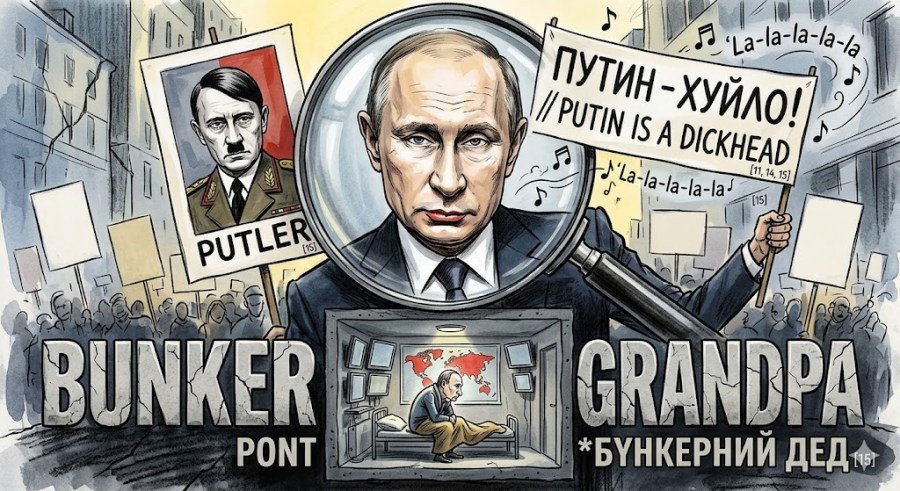
The phrase Putin khuylo! (often translated as “Putin is a dickhead” or “Putin is a fucker”) originated in 2014 among Ukrainian football supporters before rapidly expanding into a ubiquitous global protest slogan.
- Linguistic and Cultural Meaning: The term is rooted in Russian and Ukrainian profanity, derived from the noun khuy (penis). By applying this direct, vulgar anatomy to the head of state, the chant aggressively strips the political figure of his institutional dignity.
- The “La-la-la-la” Cadence: The addition of the nonsensical, upbeat melody (“La-la-la-la…”) creates a stark juxtaposition with the vulgarity of the lyrics. This musical component transformed the phrase into an accessible, communal rally cry, lowering the barrier to entry for mass participation.
- Socio-Political Function: It acts as an equalizer. In authoritarian systems, the leader is elevated above the public sphere. The chant forces a demystification of that power, reducing a powerful autocrat to an object of base ridicule.
2. Bunker Grandpa (Bunkerniy Ded)
The nickname Bunker Grandpa emerged predominantly during the COVID-19 pandemic and the subsequent years of the war, pointing to the leader’s physical and psychological isolation.
- Spatial and Political Isolation: The term highlights the extreme security measures and the growing distance between the Kremlin leadership and the realities on the ground. The image of the “bunker” represents a closed-off, paranoid environment detached from the consequences of the policies being enacted.
- Generational and Decrepit Connotations: The use of the word ded (“grandpa” or “old man”) challenges the strongman, hyper-masculine imagery cultivated by state media. It frames the leadership not as dynamic and visionary, but as archaic, out of touch, and physically decrepit.
3. Putler
A portmanteau of “Putin” and “Hitler,” this moniker explicitly draws a historical parallel between modern Russian state actions and the totalitarian regimes of the 20th century.
- Historical Equivalence: This nickname is frequently displayed on protest placards during international rallies and Ukrainian demonstrations. It links the expansionist policies—particularly the 2022 invasion and the occupation of sovereign territories—with the atrocities of Nazi Germany.
- Moral Delegitimization: Unlike the vulgarity of Khuilo or the mockery of Bunker Grandpa, Putler operates on a moral and historical register. It attempts to frame the conflict in absolute terms of good versus evil and aggression versus international law.
4. Additional Epithets: The Dwarf, The Toad, and The Thief
Beyond the primary three nicknames, popular discourse in Ukraine and opposition circles utilizes descriptive and zoomorphic metaphors:
- “The Dwarf” (Karlik): Plays on the perception of his physical stature, directly opposing the carefully constructed political imagery of a larger-than-life, imposing leader.
- “The Toad” (Zhaba): A zoomorphic insult that strips away human dignity, often associated with cold-bloodedness and ugliness in Slavic folklore.
- “The Thief” (Vor): Focuses on the accusations of massive state corruption and kleptocracy, contrasting the wealth of the ruling elite with the economic struggles of the general populace.
Conclusion
The linguistic treatment of Vladimir Putin in contemporary discourse represents a significant case study in how collective humor and protest language challenge authoritarian control. While international diplomacy relies on carefully measured phrasing, the public sphere utilizes these nicknames to reclaim agency.
Whether through the visceral vulgarity of the Khuilo chant, the historical weight of Putler, or the domestic mockery implied by Bunker Grandpa, these labels serve a dual purpose: they unite communities under a shared cultural identity while systematically dismantling the aura of invincibility surrounding the modern autocrat.
This sounds like Beanie and Butthead
Americans are thinking of Cornholio, the hyperactive alter-ego of the character Beavis from MTV’s animated series Beavis and Butt-Head, created by Mike Judge. Putin is America’s Cornholio.
While the two words sound slightly similar, they have entirely different origins and meanings:
- Cornholio: The Great Cornholio is known for pulling his shirt over his head, waving his arms, and yelling, “I need T.P. for my bunghole!” The name itself is a play on the slang term “cornholing,” which is a vulgar reference to anal sex.
- Khuilo (Khuylo / Huylo): This is a highly offensive Russian and Ukrainian profanity. The root of the word is khuy, which literally translates to “penis” or “prick.” With the suffix -lo, it acts as an insult to describe someone who is a “dickhead” or “fucker.” +1
Although it sounds very similar when spoken quickly in English, Khuilo has no connection to Beavis and Butt-Head.
The Last Official Act by Trump will be to play his Violin as Washington, D.CD.C. burns to the ground.


You must be logged in to post a comment.