
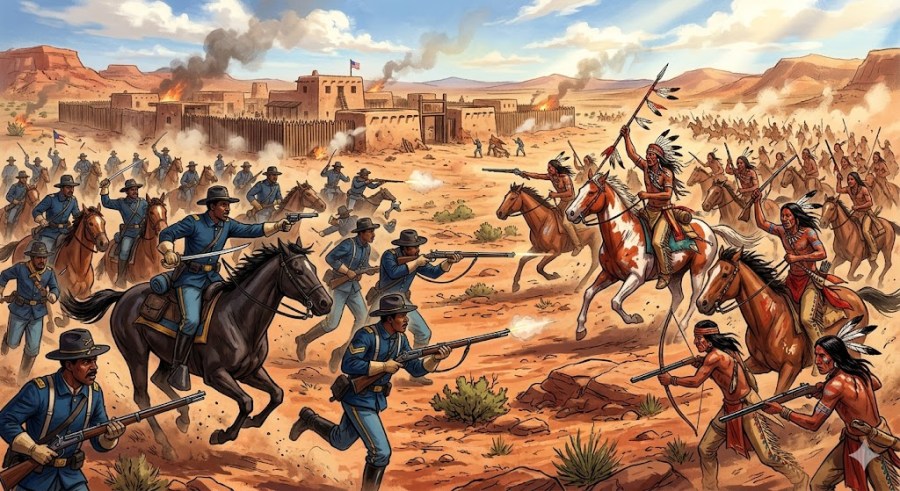
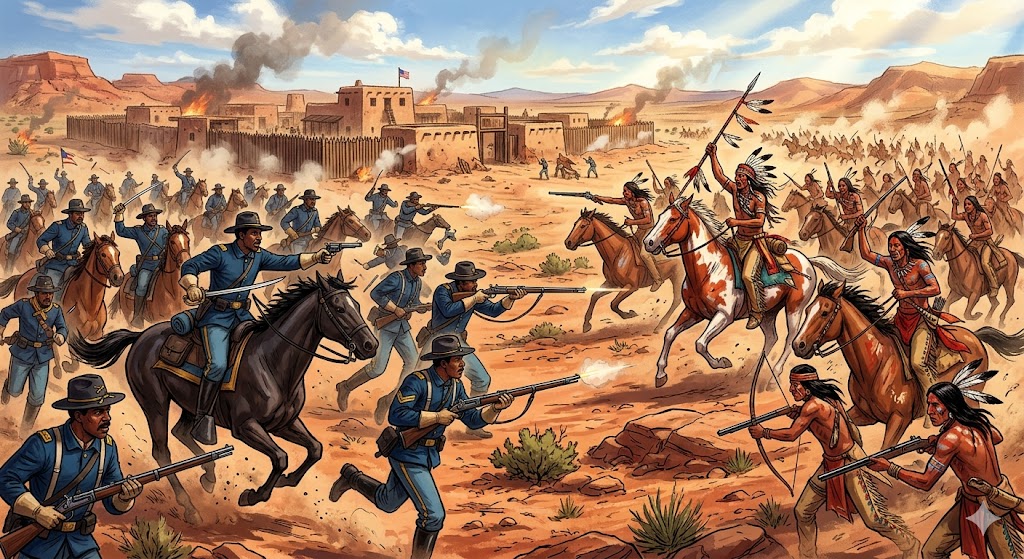
The convergence of Fort Lancaster and the Buffalo Soldiers represents a defining milestone in American military history. Located in the rugged, arid Pecos River Valley of West Texas, Fort Lancaster was the backdrop for the very first major, stand-and-fight engagement fought by the newly formed African American cavalry regiments in Texas.
Texas Time Travel
The Origins of Fort Lancaster
Originally established in August 1855 as “Camp Lancaster,” the outpost was built by the 1st U.S. Infantry near Live Oak Creek. Its primary purpose was to guard the San Antonio–El Paso Road. This vital thoroughfare was heavily traveled by emigrants, stagecoaches, and wagon trains heading west to California following the Gold Rush.
Texas Historical Commission – Texas.gov+ 1
Living at the fort was incredibly isolating. Constructed from a mix of limestone and adobe bricks with thatched roofs, it was a lonely dot in a vast, open prairie. When the Civil War broke out in 1861, federal troops abandoned the fort. It was briefly occupied by Confederate forces but spent most of the war years deserted, falling into disrepair.
Texas Historical Commission – Texas.gov
Enter the Buffalo Soldiers
Following the Civil War, Congress passed the Military Peace Establishment Act of 1866, creating six all-Black peacetime regiments—the 9th and 10th Cavalry, and the 24th, 25th, 38th, and 41st Infantry. These men, many of whom were newly emancipated from slavery or veterans of the United States Colored Troops (USCT), faced intense prejudice, sub-standard equipment, and harsh conditions. Plains Indian nations gave these men the moniker “Buffalo Soldiers,” a name worn with tremendous honor.
Texas Time Travel+ 1
In 1867, the 9th U.S. Cavalry was dispatched to West Texas to reoccupy and rebuild the broken chain of frontier forts. Company K of the 9th Cavalry was assigned to Fort Lancaster, operating it as a sub-post under Fort Stockton.
Apple
The Battle of Fort Lancaster (December 26, 1867)
On the afternoon of December 26, 1867, the Buffalo Soldiers at Fort Lancaster faced their ultimate crucible.
Buffalo Soldiers – Washington DC Chapter
A massive, coordinated force estimated between 900 and 1,200 raiders—consisting primarily of Kickapoo warriors, accompanied by Lipan Apaches, Mexican bandits, and renegade outlaws—descended upon the fort. Their primary objective was to overpower the outpost and seize the army’s horses and livestock.
Buffalo Soldiers – Washington DC Chapter+ 1
At the time, Company K was heavily outnumbered, undermanned, and scattered, leaving only about 60 to 70 soldiers and officers, alongside two civilian women, at the outpost.
Buffalo Soldiers – Washington DC Chapter
The raiders struck simultaneously from three different directions. Under the command of Captain William Frohock, the Buffalo Soldiers did not panic. They swiftly formed defensive lines and utilized steady, disciplined fire from their .50-caliber Spencer repeating rifles and breech-loading firearms to keep the massive force at bay.
Buffalo Soldiers – Washington DC Chapter
The intense, chaotic firefight lasted for hours. While the raiders successfully drove off a significant portion of the fort’s livestock, the Buffalo Soldiers successfully held the fort itself and drove the attackers back into the desert.
Buffalo Soldiers – Washington DC Chapter
The Aftermath and Historical Significance
The battle was costly. Three Buffalo Soldiers made the ultimate sacrifice defending the fort that day: Private Eli Bowers, Private William Sharpe, and Private Anderson Trimble. They were buried on the ridge just above the fort, where their gravesites remain protected today.
GovDelivery
The Battle of Fort Lancaster holds two massive distinctions in history:
- First Major Test: It was the first major battle where the Buffalo Soldiers of the 9th Cavalry fought as a cohesive unit in Texas, proving their exceptional bravery and tactical skill under overwhelming odds. Buffalo Soldiers – Washington DC Chapter
- A Unique Attack: Fort Lancaster holds the distinct title of being the only U.S. Army fort in Texas to be directly assaulted by Native Americans during the Indian Wars (most other engagements occurred as skirmishes out on the open trail). GovDelivery
The Battle of Fort Lancaster is easily one of the most incredible, yet criminaly overlooked, stands in American military history. To put those numbers in perspective, Company K of the 9th U.S. Cavalry was facing odds of nearly 15 to 1.
In the regular frontier army, a force of that size descending on an unfortified, open-layout post usually meant total annihilation. Fort Lancaster didn’t have towering log stockades or stone walls enclosing the garrison—it was a collection of adobe and stone structures spread out along the road near the Pecos River, making it a logistical nightmare to defend when surrounded.
The remnants of Fort Lancaster today, highlighting the open, unfortified nature of the outpost.. Source: Texas Historical Commission – Texas.gov
What makes this specific engagement on December 26, 1867, so legendary is how Captain William Frohock and his text-thin line of Buffalo Soldiers managed to hold their composure. The raiders weren’t just looking for a quick skirmish; they launched a multi-pronged, coordinated assault, attempting to stampede the horses while simultaneously pinning down the infantry barracks and officers’ quarters.
The discipline of the 9th Cavalry saved the day. Instead of panicking under the massive wave of attackers, the troopers utilized the scattered stone buildings as makeshift breastworks and relied on the superior firepower of their breech-loading Spencer carbines. They managed to break the momentum of the charge, drive the raiders back into the chaparral, and successfully protect the core of the post despite being desperately undermanned.
It stands as the first major test and victory for the newly formed 9th Cavalry in Texas, proving the sheer resilience and tactical discipline of the Buffalo Soldiers when the line was stretched to its absolute limit.
If you’re diving deeper into this engagement for your research or next writing piece, where should we focus?
Examine the tactical breakdown of the battle
Explore the roles of the two civilian women
Look at the aftermath and official army reports
The defense of Fort Lancaster on December 26, 1867, is a masterclass in how a tiny, disciplined force can exploit terrain and firepower to survive a worst-case scenario.
When the raiders—a massive coalition of Kickapoo, Lipan Apache, Mexican bandits, and outlaws—struck, Company K of the 9th Cavalry was stripped down to the bone. Captain William Frohock and Lieutenant Frederick Smith had only about 58 to 70 effective troopers on hand, meaning they were surrounded and outnumbered anywhere from 10-to-1 to 15-to-1.
Buffalo Soldiers – Washington DC Chapter
The tactical execution of the battle details exactly how the Buffalo Soldiers prevented what should have been an absolute massacre.
Phase 1: The Opening Ambush and Stampede
The engagement began with terrifying speed on the perimeter of the post. The garrison’s horse herd was being led to water near the Pecos River when the raiders struck from the brush.
- The Catalyst: A civilian teamster named William Sharpe, who was leading the herd, was lassoed, dragged from his mount, and killed instantly. The Historical Marker Database
- The Initial Casualties: Sensing the disaster, troopers Andrew Trimble and Eli Boyer fought desperately to turn the herd back toward the fort, but both were cut down and killed in the initial onslaught. The Historical Marker Database
- The Stampede: The raiders successfully panicked and stampeded the Army horse herd. In his later recollections, Captain Frohock admitted this was a double-edged sword: “Had this stampede not occurred, it is doubtful if the defense against such overwhelming odds could have been successful.” By securing the livestock early, a significant portion of the raiders shifted their focus to driving the stolen horses away, rather than committing 100% of their manpower to a suicidal frontal assault on the buildings. Scribd
Phase 2: The Crescent Skirmish Line
As the raiders surged past the perimeter, they launched a coordinated, multi-pronged assault, striking Fort Lancaster simultaneously from the north, south, and west.
The Historical Marker Database
Because Fort Lancaster was a completely open post with no stockade walls, Frohock couldn’t rely on traditional fortifications. Instead, he made two brilliant tactical moves:
- Exploiting the Adobe/Stone Layout: He ordered his men out of the open spaces and utilized the scattered, heavy stone and adobe barracks, officer’s quarters, and commissary buildings as makeshift breastworks.
- The Crescent Line: Frohock deployed his small contingent into a tight, crescent-shaped skirmish line facing outward. This defensive arc allowed the troopers to maximize their interlocking fields of fire, ensuring that no matter which angle the raiders charged from, they were running directly into a wall of lead. The Historical Marker Database
The Decisive Factor: The Spencer Carbine
The ultimate equalizer in this fight was the .50-caliber Spencer repeating rimfire rifle/carbine carried by the 9th Cavalry.
HistoryNet
[Trooper with Spencer Carbine] ---> 7 Shots in 11 Seconds ---> Devastating Lever-Action Firepower VS.[Massed Frontal Assault] <--- Broken Momentum <--- High-Volume Interlocking Fields of Fire
In 1867, many frontier Native American warriors and raiders were still accustomed to fighting adversaries armed with muzzle-loading rifles or single-shot Springfield muskets. The standard tactic against single-shot weapons was to draw the defender’s fire, wait for the reload lull, and then overwhelm the line during the 20-to-30-second vulnerability window.
The Spencer completely shattered that calculus.
- Rate of Fire: Loaded via a 7-round tubular magazine inserted through the buttstock, a disciplined Buffalo Soldier could empty all seven rounds in about 11 seconds.
- Shock Value: When the raiders charged the crescent line expecting a pause after the first volley, the Buffalo Soldiers kept firing continuously. The sheer volume of fire coming from just 60 men sounded like a force three times their size. Freimaurer-Wiki
- Close-Quarter Defense: For any raiders who managed to breach the perimeter of the stone buildings, the troopers transitioned to their .44 Remington revolvers, maintaining a devastating rate of close-range fire that made a final breakthrough impossible. HistoryNet
Phase 3: The Counter-Attack
The battle raged for hours. Realizing that a static defense would eventually allow the massive force to wear them down, Captain Frohock took an incredibly bold gamble once the raiders’ initial momentum stalled.
Buffalo Soldiers – Washington DC Chapter+ 1
Leaving a small detachment behind to secure the buildings and protect the two civilian women, Frohock took the bulk of Company K and ordered an advance.
Scribd
The Buffalo Soldiers moved out of their defensive positions and pushed forward into the open, moving toward the raiders’ lines in a controlled skirmish formation. The raiders had formed a massive, mile-wide battle line, but they were entirely unprepared for a heavily outnumbered infantry force to attack them.
Scribd
Hit by a steady, advancing sheet of Spencer fire, the raiders’ line broke. They attempted to reform farther back, but the discipline of the 9th Cavalry held firm, systematically driving the remaining hostiles back into the chaparral until they broke off the engagement entirely and retreated.
Scribd
The Aftermath
When the smoke cleared, the tactical brilliance of the defense was undeniable:
- U.S. Army Losses: 3 killed (the teamster and two troopers caught in the initial herd ambush). No further losses were sustained once the defensive line was established. Internet Archive+ 1
- Raider Losses: An estimated 20 killed and 11 wounded left on or near the field.
For a regiment whose reputation had been previously marred by early organizational struggles and friction with abusive officers, Company K’s performance at Fort Lancaster completely altered the narrative. It proved to the high command that the Buffalo Soldiers were a fiercely disciplined, lethal fighting force capable of holding the line when the odds were stacked entirely against them.
The Historical Marker Database
Fort Lancaster Today
Texas Historical Commission – Texas.gov+ 3
By the late 1870s, as the frontier moved further west, Fort Lancaster was permanently abandoned.
American Battlefield Trust
Today, it is preserved as the Fort Lancaster and Battlefield State Historic Site, managed by the Texas Historical Commission. Visitors traveling through the Pecos Trail Region can walk through the evocative limestone ruins, look out over the exact landscape where the 1867 battle took place, and pay tribute to the incredible resilience of the Buffalo Soldiers who held the line against all odds.
Texas Time Travel
The abandoned military outpost positioned between Lubbock and Waco is Fort Phantom Hill.
Established in 1851 as part of a line of frontier defense, its official name was the “Post on the Clear Fork of the Brazos.” Today, it sits just north of Abilene—strikingly placed right between the High Plains of Lubbock and the Central Texas hub of Waco. It remains one of the most evocative historic destinations in the state, known for its towering, solitary stone chimneys that pierce the Texas sky like monuments to a bygone era.
Texas Almanac+ 1
The Story of Fort Phantom Hill
Life at Fort Phantom Hill was notoriously difficult. The soldiers faced harsh weather, a severe lack of good timber, and water that was often brackish and bitter. The post was so uninviting that when the federal troops finally evacuated in 1854, someone intentionally set fire to the fort, destroying the log structures and leaving behind only the stone foundations, the powder magazine, the guardhouse, and the chimneys.
Texas Almanac+ 1
Today, it is a beautifully preserved, free-to-visit historic site where you can walk among the ruins and feel the immense quiet of the Texas prairie.
Texas’ Most Active Fort: The Frontier Conflict
When looking at the 1800s, determining which fort fought the “most” Indian battles depends on whether you count direct attacks on the fort itself or the long-range scouting expeditions launched from its gates.
- Fort Lancaster: Located further southwest, Fort Lancaster holds the unique distinction of being the only U.S. Army post in Texas to be directly attacked by a massive force of Native Americans (the 1867 Battle of Fort Lancaster, defended successfully by the Buffalo Soldiers of the 9th U.S. Cavalry). Texas Historical Commission – Texas.gov
- Fort Davis & Fort Richardson: In terms of total campaigns, long-range patrols, and skirmishes, Fort Davis (in West Texas) and Fort Richardson (in Jacksboro) log the highest numbers of military engagements. Their cavalry units spent decades riding thousands of miles across the rugged terrain, clashing with highly mobile native warriors in deep canyons and across open plains.
The Peoples of the Southern Plains
To truly understand this history, one must look at the sovereign Indian nations that dominated these lands long before the first stone of any fort was laid. Texas was a vast crossroads of distinct indigenous cultures, each with its own language, governance, and way of life.
The Comanche (Numunuu)
Known to themselves as the Numunuu (“The People”), the Comanche were the undisputed masters of the Southern Plains, a vast empire known as Comancheria. Originally migrating from the northern Rockies, they adopted the horse in the late 1600s and transformed into one of the most skilled, formidable equestrian societies in global history. They were brilliant traders, fierce protectors of their territory, and expert deep-country navigators who held the expansion of empires—Spanish, Mexican, and American—at bay for over a century.
The Kiowa
Close allies of the Comanche, the Kiowa were deeply spiritual nomadic hunters who migrated to the Southern Plains from the headwaters of the Missouri River. They possessed a highly structured society, celebrated for their elaborate Sun Dance ceremonies, complex heraldry, and expressive winter counts (pictorial calendars painted on hides that recorded their history year by year).
Texas Beyond History
The Waco and Tawakoni (Wichita Peoples)
Unlike the nomadic Comanche, the Waco and Tawakoni (branches of the Wichita people) were semi-sedentary agriculturalists. They lived in large, permanent villages featuring massive, beautiful grass homes that resembled beehives. They were master farmers who cultivated extensive fields of corn, beans, squash, and tobacco along the Brazos and Trinity rivers, trading their crops with nomadic tribes. The city of Waco bears their name today.
The Tonkawa
The Tonkawa were an aggregate of independent bands native to Central Texas. Unlike the Plains tribes, they were traditional adversaries of the Comanche and Kiowa. Because their numbers were heavily depleted by disease and warfare, the Tonkawa frequently allied with early Texas settlers and the U.S. Army, serving as invaluable scouts whose tracking skills were legendary.
The Lipan Apache
Before the Comanche swept south, the Lipan Apache controlled much of the Texas hill country and plains. Pushed southward and westward by the Comanche expansion, the Lipan adapted by blending nomadic buffalo hunting with seasonal farming. They were incredibly resilient, operating in smaller, highly mobile family bands throughout the brush country and mountains of West Texas and northern Mexico.
A Legacy of the Land: The ruins of Fort Phantom Hill and the historic markers across Texas stand not just as monuments to military history, but as quiet witnesses to a profound clash of cultures. The story of Texas cannot be told without honoring the deep roots, immense skill, and enduring spirit of the Native nations who first called these prairies home. .


You must be logged in to post a comment.