
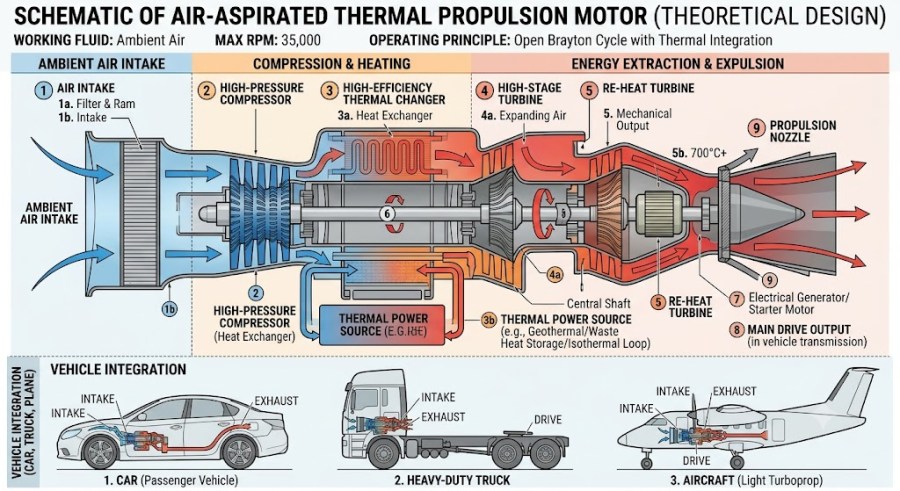
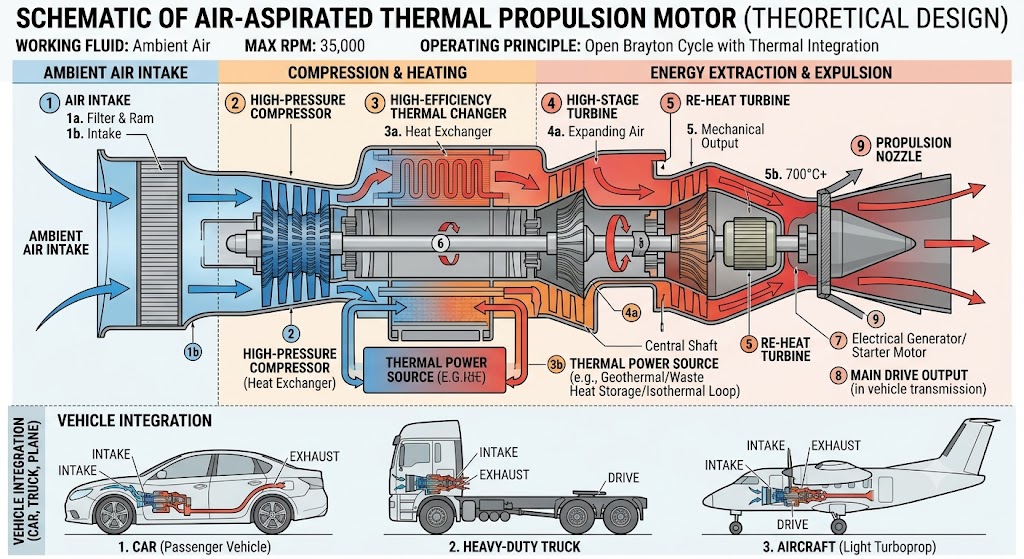
To make a motor run purely on the air it sucks in, we have to look at the laws of thermodynamics.
Ambient air on its own doesn’t contain usable chemical energy like gasoline or jet fuel. To extract mechanical work from air without burning fuel inside it, the engine must operate on an open-cycle thermodynamic process (similar to a Brayton cycle used in jet engines), but it requires an external thermal power source to heat the compressed air.
Here is the step-by-step breakdown of how the engine in the schematic operates to power a car, truck, or plane.
1. Ambient Air Intake
- The Action: As the vehicle moves forward, ambient air is pulled into the front intake assembly via ram-air effect and suction from the internal compressor.
- The Physics: At this stage, the air is at ambient atmospheric pressure and temperature. It passes through a high-flow filter to remove debris before entering the core engine.
2. High-Pressure Compression
- The Action: The air enters a multi-stage axial or centrifugal High-Pressure Compressor. This compressor is mounted on a central rotating shaft.
- The Physics: The spinning blades force the air molecules into a much tighter space, drastically increasing both the pressure and the temperature of the air. However, compressing the air requires mechanical work, which must be supplied by the turbine further down the shaft.
3. External Thermal Integration (The “Fuel” Substitute)
Because this engine does not burn fossil fuels, it cannot generate its own heat internally via combustion. Instead, it routes the highly compressed air through a High-Efficiency Thermal Changer (Heat Exchanger).
- The Heat Source: This exchanger is connected to a separate, closed-loop thermal power source. For a practical vehicle, this would require an incredibly energy-dense heat source—such as a compact, high-temperature molten salt loop, a small-scale nuclear thermal reactor, or a highly advanced thermal battery/storage unit.
- The Result: The compressed air passes through the heat exchanger tubes, absorbing massive amounts of thermal energy without mixing with any fuel. The air rapidly expands as its temperature spikes to several hundred degrees Celsius.
4. Multi-Stage Energy Extraction (The Turbine)
This is where the actual power is generated to run the vehicle. The superheated, high-pressure air rushes out of the heat exchanger and blasts into the Turbine Stages.
- High-Stage Turbine: The expanding air pushes against the first set of turbine blades, forcing the central shaft to spin at high RPM (up to 35,000 RPM in the theoretical design). This turbine’s primary job is to provide the mechanical power needed to keep the front compressor running.
- Re-Heat / Power Turbine: The remaining thermal and kinetic energy in the air passes through a secondary power turbine. This stage extracts the net surplus energy and sends it directly to the Main Drive Output.
5. Vehicle Integration & Exhaust
Once the energy is extracted by the turbines, the air must be expelled so new air can be sucked in.
- Propulsion Nozzle: The air exits through the exhaust at the back. In an aircraft, this hot, fast-moving air acts as a traditional thrust nozzle, pushing the plane forward.
- Mechanical Drive: In cars and heavy trucks, the thrust isn’t used for propulsion. Instead, the rotational energy from the power turbine shaft is geared down through a heavy-duty transmission to turn the wheels.
- The Exhaust: The air leaving the tailpipe is simply clean, hot atmospheric air.
The Thermodynamic Catch (The Reality Check)
While this schematic represents a highly efficient way to move a vehicle using air as the working fluid, it is not a perpetual motion machine.
The engine cannot run solely on ambient air without that external thermal power source (3b in the schematic). If you cut off the external heat supply, the energy required to compress the air in Step 2 would be exactly equal to (or, due to friction and heat loss, greater than) the energy you could extract in Step 4. The engine would instantly stall.
To make it viable for transport, the breakthrough isn’t in the engine itself—it’s in developing an ultra-lightweight, incredibly hot, and long-lasting external heat source to keep that thermal exchanger glowing.


You must be logged in to post a comment.