
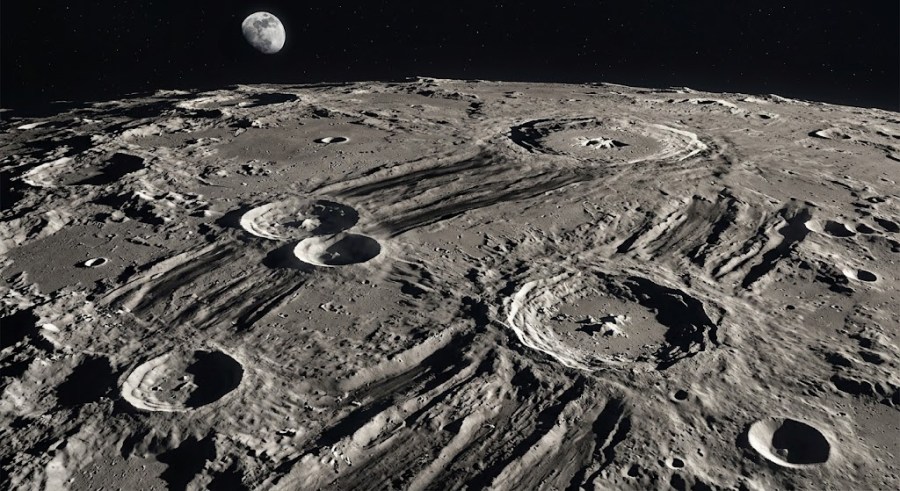
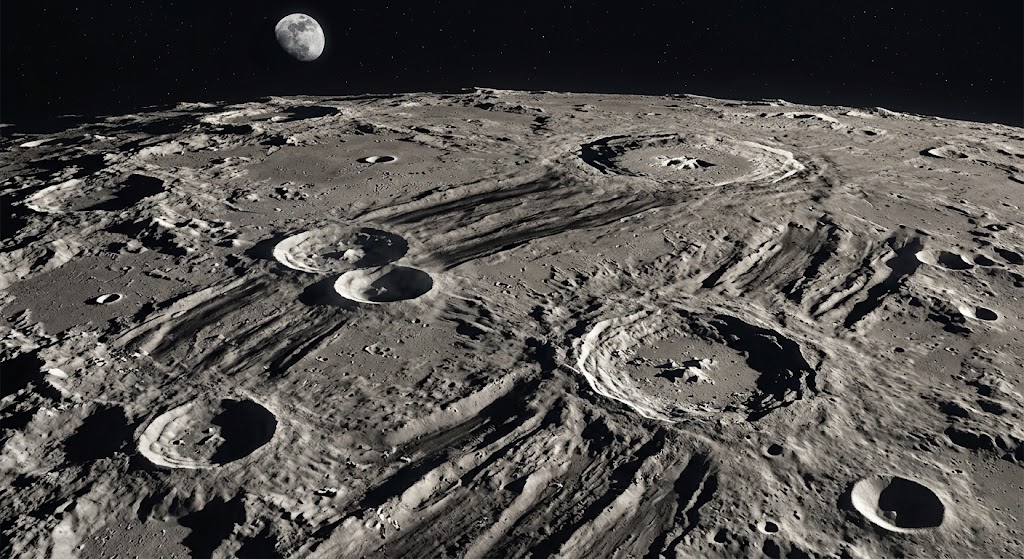
The anomaly began in the Ocean of Storms. When the high-resolution topographic telemetry from the Lunar Reconnaissance Orbiter returned its weekly delta-map, Copernicus crater had slipped six hundred meters east. Within seventy-two hours, observatories in Atacama, Mauna Kea, and Canary Islands confirmed the impossible: Tycho was migrating south toward the polar rim, and the South Pole–Aitken basin had twisted four degrees on its axis. The scars of ancient impacts were crawling across the lunar regolith like constellations shifting across a living skin.
Planetary geologists initially suspected massive subsurface faulting or thermal expansion, but the gravimetric data ruled it out. The surface wasn’t stretching—it was drifting. Deep seismic probes left behind by the Apollo and Artemis missions began transmitting an unnatural, rhythmic harmonic resonance: a low-frequency hum vibrating at precisely eleven hertz.
The answer lay in the moon’s long-misunderstood deep interior. Far beneath the rigid lunar crust, the ancient, partially molten mantle had not cooled into inert basalt. Instead, centuries of gravitational kneading from Earth’s tidal forces, combined with decay from an ultra-dense pocket of primordial, radioactive actinide crystals at the lunar core, had triggered a runaway phase change. The deep mantle had transformed into a supercritical, magnetic ferrofluid mantle layer—a frictionless, hyper-dense magma ocean acting like a planetary-scale ball bearing.
The moon’s rigid titanium-rich crust had completely decoupled from its spinning core.
Worse, the internal ferrofluid gyre had developed its own asymmetric magnetic vortices. These churning, high-density metallic plumes were physically dragging the underside of the outer shell in conflicting directions. The craters weren’t merely drifting together; they were floating along invisible tectonic conveyor currents. Mountains were slowly grinding past crater basins without collapsing, the rock behaving with plastic fluidity under the sheer torque of the interior slip.
Through amateur telescopes and world-class observatories alike, humanity watched the familiar face of the Moon slowly rearrange itself. The Man in the Moon was beginning to turn his head, driven by an uncontainable subterranean engine that had finally slipped its celestial gears.


You must be logged in to post a comment.